What is a riad in Morocco?
A riad is a traditional Moroccan house built around an internal courtyard containing a garden. Derived from Arabic "riyad" (garden), these historic urban homes belonged to wealthy merchants seeking private retreats from busy medina life.
Architectural features include almost no exterior windows (inward-facing design), a central courtyard with citrus trees and a fountain providing natural cooling, multiple stories with rooms facing the courtyard, rooftop terraces offering city panoramas, and zigzag entrance corridors ensuring privacy. Traditional craftsmanship shines through zellige colorful geometric tiles, tadelakt waterproof plaster creating marble-like surfaces, carved stucco featuring Islamic calligraphy, and moucharabieh wooden lattice screens.
Modern riads function as boutique hotels converted from historic buildings, usually featuring 5-10 rooms with personalized, intimate service. Thick walls and courtyard water features naturally control temperature, maintaining cool interiors despite Moroccan heat. Morocco tour packages commonly include riad accommodations in Marrakech, Fes, and imperial city medinas for authentic stays.
Riad vs. Dar: Riads contain interior gardens traditionally divided into four sections with central fountains. Dars are houses with courtyards lacking gardens or trees, though they may include small pools or fountains.
Table of Contents:
#What is a Moroccan Riad?
#The Origins and History of Riads
#Traditional Moroccan Riad Architecture
#Modern Riads: From Homes to Boutique Hotels
#FAQs
Behind the weathered walls of Morocco's ancient medinas stands one of North Africa's most captivating architectural traditions. Moroccan riads, whose name derives from the Arabic word "riyad" meaning "garden," embody centuries of refined design principles that continue to fascinate visitors and scholars alike.
These remarkable structures trace their origins to the grand residences of prosperous merchants and traders who shaped Morocco's historic commercial landscape. A traditional Moroccan riad distinguishes itself through its distinctive inward-facing architecture, where living spaces and communal areas embrace a central courtyard that serves as the home's beating heart. This essential courtyard, adorned with verdant plantings, marble fountains, or reflective pools offers a tranquil sanctuary from the animated energy of medina streets. The sophisticated design philosophy behind these hidden palace homes demonstrates remarkable adaptation to North Africa's demanding climate conditions while honoring the privacy customs deeply rooted in Moroccan society. These architectural treasures have significantly contributed to Morocco's emergence as a celebrated destination for discerning travelers worldwide.
A Moroccan riad transcends the simple concept of residential architecture. The etymology itself illuminates the profound relationship these structures maintain with nature, originating from the Arabic word "ryad" (meaning garden). Riads demonstrate the masterful integration of built environments with organic beauty.
Definition and meaning of 'Riad Morocco.'
At its core, a Moroccan riad functions as an urban residence distinguished by its central interior garden or courtyard. These architectural specimens exist exclusively within the protective embrace of ancient medina walls, featuring open-ceiling configurations that welcome abundant natural light into the heart of the home. The courtyard traditionally presents a marble fountain encircled by four carefully planned sections of verdant vegetation, frequently orange or lemon trees forming a symmetrical garden that reflects the Islamic conception of paradise.
Spatial organization follows deliberate patterns around this central courtyard, positioning common areas and dining spaces at ground level, while private sleeping quarters occupy the upper floors. Many riads feature generous rooftop terraces that offer sweeping panoramic vistas across the medina's ancient landscape.
How Riads differ from regular homes
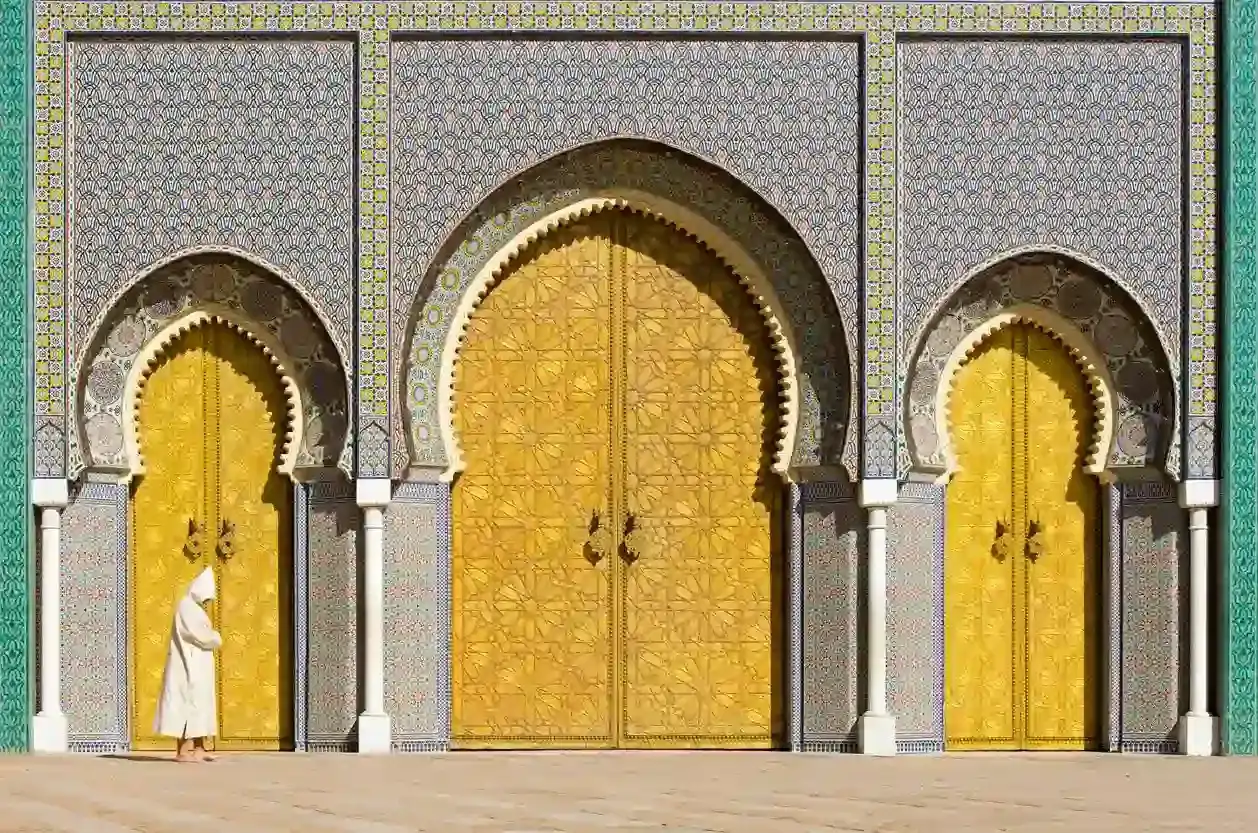
The fundamental distinction between riads and conventional dwellings lies in their orientation philosophy. Traditional Moroccan riads embrace a completely inward-facing approach, contrasting sharply with standard buildings that present windows to the external world. This architectural choice reflects both practical necessity and cultural priorities. External facades maintain deliberate simplicity and restraint—typically displaying only a modest wooden door that hints at the magnificence concealed beyond.
The interior transformation proves remarkable. Surfaces burst into life through elaborate zellige tilework (intricate geometric mosaics), polished tadelakt plaster, and meticulously carved wooden elements, occasionally enhanced with Quranic calligraphy or geometric motifs. Individual rooms express distinct decorative personalities, ensuring each space maintains its unique character.
This inward orientation serves several essential functions: natural temperature regulation through heat and noise exclusion, protection of family privacy (especially significant within Islamic cultural contexts), and creation of peaceful refuges from the vibrant medina atmosphere.
Why are they called 'hidden palace homes'
The designation "hidden palace homes" captures the fundamental character of riads with remarkable precision. External appearances do not suggest the splendor that awaits within. This deliberate modesty honors Islamic principles of humility while acknowledging the historical reality that these residences belonged primarily to prosperous merchants and traders.
Crossing the threshold reveals a completely transformed environment, a realm of serenity, aesthetic refinement, and elegant luxury. The dramatic contrast between modest exteriors and palatial interiors creates an enduring sense of discovery that continues to enchant contemporary visitors, securing these "hidden palaces" in their position among Morocco's most cherished architectural achievements.
Experience the magic of traditional riads with our carefully crafted Morocco travel packages. We include accommodations in the finest boutique riads featuring interior gardens, rooftop terraces, and centuries-old craftsmanship.
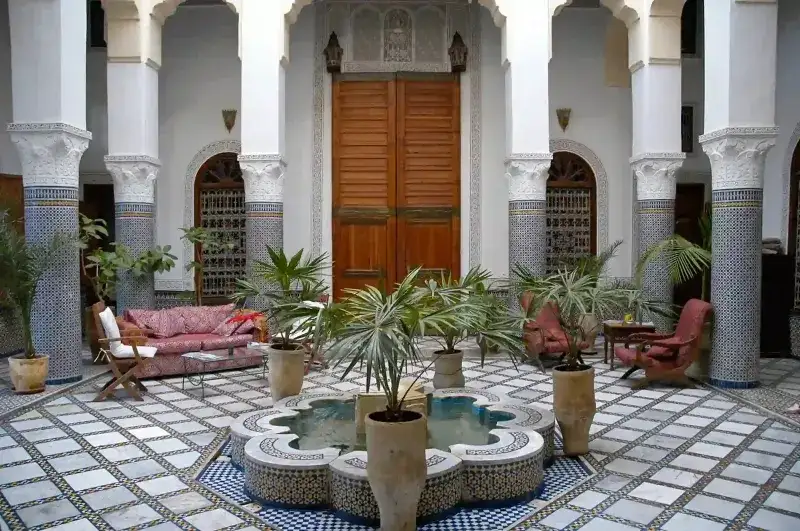
Traditional Moroccan Riad (house) - a type of traditional Moroccan house or palace with an interior garden or courtyard
What is a riad in Morocco?
A riad is a traditional Moroccan house with an interior courtyard garden and fountain. The word means "garden" in Arabic. Riads feature inward-facing design, zellige tilework, carved wood, and no exterior windows. Today they're boutique guesthouses with 5-15 rooms. Morocco travel packages include riad stays in Marrakech and Fes for authentic experiences.
What is a riad vs hotel?
Riads are small (5-15 rooms) in medinas with traditional architecture and personal service. Hotels are larger in modern districts with standard design and amenities. Riads offer authentic cultural experiences; hotels offer more facilities. Morocco vacation packages with riads provide more intimate, authentic stays.
The architectural lineage of Moroccan riads extends across centuries, weaving together cultural influences that traversed the Mediterranean basin and Middle Eastern territories. This etymological journey from the Arabic "riyāḍ" meaning "gardens" reveals the multicultural tapestry that shaped these remarkable dwellings.
Roots in Persian and Andalusian architecture
Courtyard homes flourished throughout the ancient Greco-Roman territories long before Islamic expansion. The geometric garden arrangements that define riad courtyards find their ancestral origins in Persian civilization, where similar principles governed palace and residential design. Following the establishment of Islamic territories after the 7th century, these architectural concepts spread across Mediterranean regions and Middle Eastern lands.
Morocco's architectural foundation traces back to Volubilis, the ancient Roman settlement that introduced early courtyard principles during the Idrisid dynasty era. Through centuries of cultural exchange between civilizations, the distinctive riad format crystallized as a synthesis of these varied architectural traditions.
Evolution through the Islamic and Moroccan dynasties
The 11th century marked a defining moment when Almoravid forces conquered Andalusian territories. Muslim and Jewish craftsmen from Spain were subsequently brought to Morocco, carrying with them sophisticated building techniques and decorative arts. The earliest authentic riad garden documented in Morocco, complete with the characteristic four-part symmetrical layout, appeared in the Almoravid palace constructed by Ali ibn Yusuf in Marrakesh during the early 12th century.
The following century saw riad construction flourish across Morocco's imperial cities, particularly in Fez and Marrakech, where royal households and affluent merchants commissioned these elaborate residences. Each successive dynasty Almohads, Marinids, and Saadians, contributed refinements to the basic formula while preserving fundamental design principles.
Cultural values reflected in the Riad design
Riad architecture manifests Islamic concepts of paradise through interior gardens where flowing water and flourishing vegetation symbolize divine reward. The inward-facing orientation served Islamic society's emphasis on privacy, particularly protecting women's domestic spaces from public observation. This architectural approach reflected the social structure of prosperous Moroccan households, where extended families or polygamous arrangements required careful spatial organization.
These design choices fulfilled both aesthetic aspirations and social requirements, crafting magnificent living environments that honored cultural values still visible in traditional Moroccan riads throughout the kingdom today.
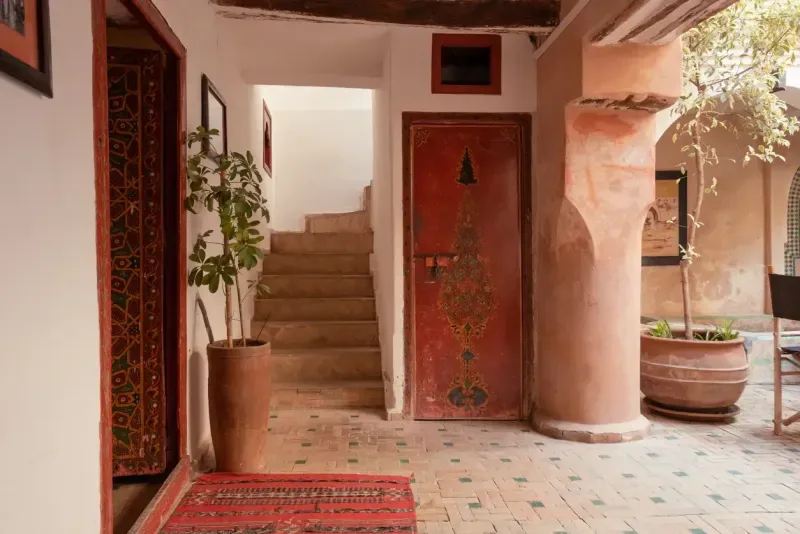
Interior of the entrance of a riyad with stairs, moroccan rugs, plants and red doors in Marrakech, Morocco
Can you drink alcohol in a riad?
Some riads serve alcohol with licenses, others don't. You cannot bring outside alcohol without permission. Check your riad's policy when booking Morocco tour packages. Upscale riads often serve wine/beer; traditional ones may not.
Are riads in Morocco expensive?
Budget: $30-50/night. Mid-range: $80-150/night. Luxury: $200-500+/night. Comparable to hotels but more personalized. Morocco travel packages include mid-range riads with good value.
Customize Your Dream Vacation!
Get in touch with our local experts for an unforgettable journey.
Plan Your Trip
The architectural mastery of traditional riads reveals itself through centuries-old design principles that continue to inspire contemporary builders and historians. These structures represent the pinnacle of desert climate architecture, where every element serves both functional and aesthetic purposes.
Inward-facing layout and privacy
Moroccan riad architecture centers entirely on interior orientation, a radical departure from conventional residential design. Where typical homes display their character through street-facing windows and decorative facades, riads deliberately present austere exteriors marked only by a simple wooden door. This architectural philosophy stems directly from Islamic cultural principles that emphasize family privacy, particularly the protection of domestic spaces where women conduct their daily activities. The transformation experienced when crossing the threshold—from cramped, shadowy medina passages into luminous, ornately decorated interiors ranks among the most striking architectural experiences in the Islamic world.
Use of courtyards, fountains, and gardens
The Sahn, or central courtyard, operates as the architectural and social nucleus of every traditional Moroccan riad. This open-air sanctuary functions simultaneously as a reception area, a family gathering space, and a private garden. Geometric precision governs these spaces, with mathematical proportions creating visual equilibrium that pleases the eye while serving practical needs. The traditional sahrîdj (central fountain) anchors the courtyard, typically surrounded by quadrants of carefully selected plantings, orange and lemon trees for fragrance, jasmine for evening beauty, and mint for culinary purposes. Room placement around this central void follows hierarchical principles, with ground-level spaces designated for communal activities and upper floors reserved for private family quarters.
Materials: tadelakt, zellij, carved wood
Three distinctive materials characterize authentic riad construction, each requiring specialized artisanal skills passed down through generations. Zellij tilework emerges from an intricate process where craftsmen hand-cut glazed terracotta into precise geometric shapes, then assemble them into complex mosaic patterns that can occupy skilled artisans for months in a single room. Tadelakt plaster represents another ancient technique, combining lime with specific regional minerals, then polishing the surface with river stones before sealing with olive oil soap to create lustrous, waterproof walls that age gracefully over decades. Carved cedar wood, harvested exclusively from Middle Atlas forests, undergoes elaborate carving to create geometric screens (moucharabieh), coffered ceilings, and decorative panels that filter light while maintaining privacy.
Climate control through design
The passive cooling system employed in riads demonstrates a sophisticated understanding of thermodynamics and airflow principles. The open courtyard operates as a natural thermal chimney, drawing hot air upward while encouraging cooler air circulation throughout ground-level rooms. Massive earthen walls function as thermal mass, absorbing solar heat during daylight hours and releasing it gradually after sunset, moderating interior temperatures. Water features contribute to cooling through evaporation, while strategic vegetation increases humidity levels that make dry heat more bearable. This natural climate control system regularly achieves interior temperatures several degrees cooler than exterior conditions without mechanical intervention.
Symbolism of water and greenery
Water assumes profound symbolic significance within riad design, extending far beyond mere climate comfort. For desert-dwelling populations, flowing water represents the essence of life, spiritual purity, and divine blessing. The central fountain embodies the home's spiritual center, its gentle sounds creating a meditative ambiance while symbolizing the continuous flow of family life. Garden elements, particularly the aromatic citrus trees and night-blooming jasmine, directly reference Islamic descriptions of paradise, creating earthly representations of divine reward. These combined elements produce spaces that address physical comfort while nurturing spiritual well-being, reflecting the holistic approach characteristic of traditional Moroccan design philosophy.
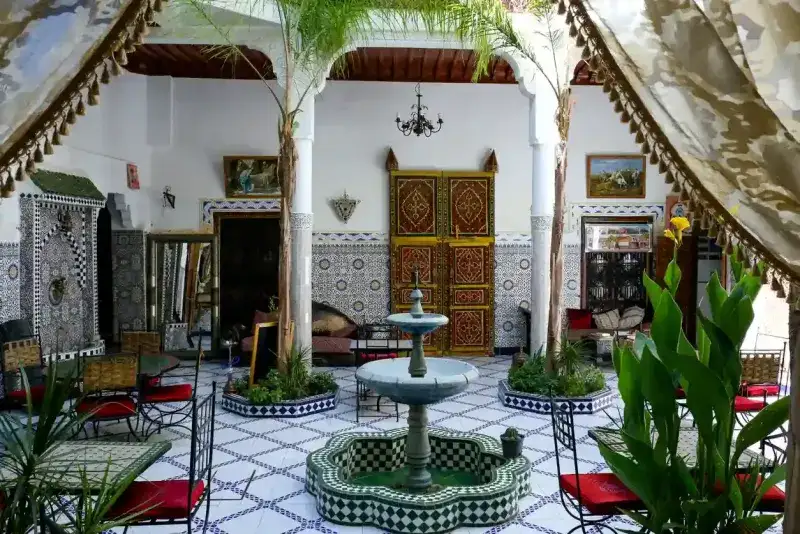
Traditional Moroccan Riad Marrakesh, Morocco
Is 100 dirham a good tip in Morocco?
Yes, 100 dirham ($10 USD) is generous. Standard tips: servers 10-20 dirham, guides 50-100 dirham/day, drivers 30-50 dirham/day, porters 10-20 dirham/bag. Budget $10-15 USD/day for tipping on Morocco vacation packages.
Is 1000 USD a lot in Morocco?
Yes, very substantial. Covers 10-20 nights mid-range riads, 15-20 meals for two, or 5-7 days private guides. The average Moroccan salary is $400-600/month. Morocco tour packages offer excellent value.
Recent decades have witnessed a remarkable renaissance within Morocco's historic medinas, where forgotten Moroccan riads have been meticulously restored to reclaim their former splendor.
Transformation into guesthouses
These architectural gems, once the private domains of affluent merchant families, experienced periods of neglect before discerning European investors recognized their extraordinary potential. The restoration movement gained momentum when notable figures discovered these properties offered unparalleled retreats from metropolitan chaos. Through careful renovation that honors traditional craftsmanship while incorporating contemporary amenities, these ancestral residences have evolved into exclusive boutique accommodations.
Personalized service and intimate atmosphere
The hospitality experience within riads differs markedly from conventional lodging establishments. These properties typically operate under family stewardship, where proprietors share home-prepared cuisine alongside invaluable local insights. The intimate scale generally accommodating between 5 and 15 guests, fosters genuine personal connections where staff members develop meaningful relationships with visitors. Many establishments curate distinctive experiences, from culinary workshops with master chefs to guided explorations of traditional artisan quarters.
Differences between Riads and hotels
| Aspect |
Riad |
Hotel |
| Location |
Inside medinas, near markets |
Often in newer districts |
| Design |
Traditional Moroccan style |
Modern or international |
| Size |
Small (5-15 rooms), intimate |
Large, standardized |
| Hospitality |
Personal, often family-run |
Professional, standardized |
| Price |
$30-50/night (budget) to $200-500/night (luxury) |
Varies widely |
Each imperial city presents distinctive riad characteristics that reflect local heritage and geography. Marrakech features the most extensive selection, ranging from lavishly decorated traditional properties to contemporary interpretations of classic design. Fes offers particularly grand accommodations, with establishments averaging nine bedrooms that showcase the city's position as Morocco's cultural epicenter. Essaouira's coastal riads benefit from temperate maritime conditions and the port city's relaxed ambiance, creating year-round comfort for discerning guests.
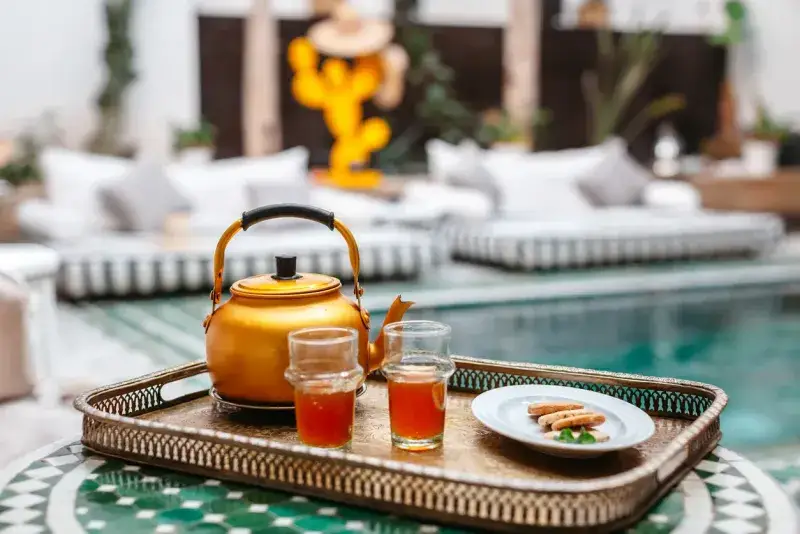
Moroccan mint tea served by the poolside in a peaceful courtyard riad
Conclusion
Moroccan riads represent far more than architectural curiosities; they embody a profound understanding of how built environments can honor both human needs and cultural values. These remarkable structures demonstrate how centuries of refined design wisdom continues to speak to contemporary travelers who seek meaningful connections with place and tradition.
The enduring appeal of riads lies in their ability to create intimate spaces that feel simultaneously ancient and immediate. Each restored riad tells a story of cultural continuity, where traditional craftsmanship meets modern hospitality without sacrificing the essential character that makes these spaces so compelling. The careful preservation of original elements from hand-carved cedar details to ancient fountain systems ensures that visitors experience authentic glimpses into Morocco's rich domestic heritage.
Modern riad accommodations have successfully bridged the gap between historical preservation and contemporary comfort, allowing guests to inhabit spaces once reserved for Morocco's most prosperous families. This transformation has created opportunities for cultural exchange that honor the original intent of these homes while sharing their beauty with a broader audience.
The magic of riads extends beyond their architectural merits to encompass the sensory experiences they provide: the sound of water trickling from central fountains, the play of light across tiled surfaces, the fragrance of orange blossoms carried on evening breezes. These elements combine to create environments that engage visitors on multiple levels, fostering appreciation for both the sophistication of Islamic design principles and the warmth of Moroccan hospitality.
Whether discovered in the labyrinthine passages of Fes, the vibrant souks of Marrakech, or the coastal calm of Essaouira, riads offer travelers authentic encounters with Morocco's architectural soul. They serve as living museums where the boundaries between past and present dissolve, creating spaces where tradition breathes and evolves. A stay within these hidden palace homes provides not merely shelter, but an invitation to participate in Morocco's ongoing story of cultural richness and architectural innovation.
Q1. What distinguishes a Moroccan riad from a typical hotel?
A riad is a traditional Moroccan house with an interior garden, typically converted into a small, intimate guesthouse. Unlike larger hotels, riads offer personalized service, traditional architecture, and are often located within historic medinas, providing a more authentic cultural experience.
Q2. Are private bathrooms standard in Moroccan riads?
Yes, most riads offer private bathrooms attached to each room. The quality and size may vary depending on the riad's star rating, with higher-rated establishments often featuring more spacious and luxurious facilities.
Q3. Can guests consume alcohol in Moroccan riads?
Alcohol policies in riads can vary. Some riads have special licenses allowing them to serve alcohol on the premises. However, it's generally not permitted to bring outside alcohol into riads. It's best to check with your specific riad for their policy.
Q4. What are the key features that define a riad?
A riad is characterized by its inward-facing design, centered around an interior courtyard or garden. Key features include a symmetrical layout, often with a central fountain, traditional Moroccan decor such as zellige tilework and tadelakt plaster, and an emphasis on privacy and tranquility.
Q5. How do riads contribute to climate control in Morocco's hot weather?
Riads employ clever natural cooling techniques. The central courtyard creates a chimney effect, allowing hot air to escape. Thick walls absorb heat during the day and release it at night, while fountains and vegetation provide evaporative cooling. This passive system can significantly reduce interior temperatures compared to the outside.
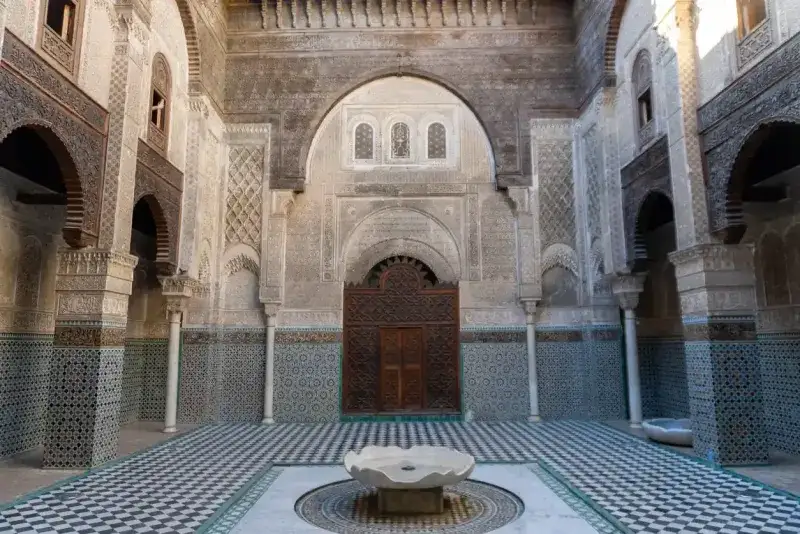
Inner courtyard of riad