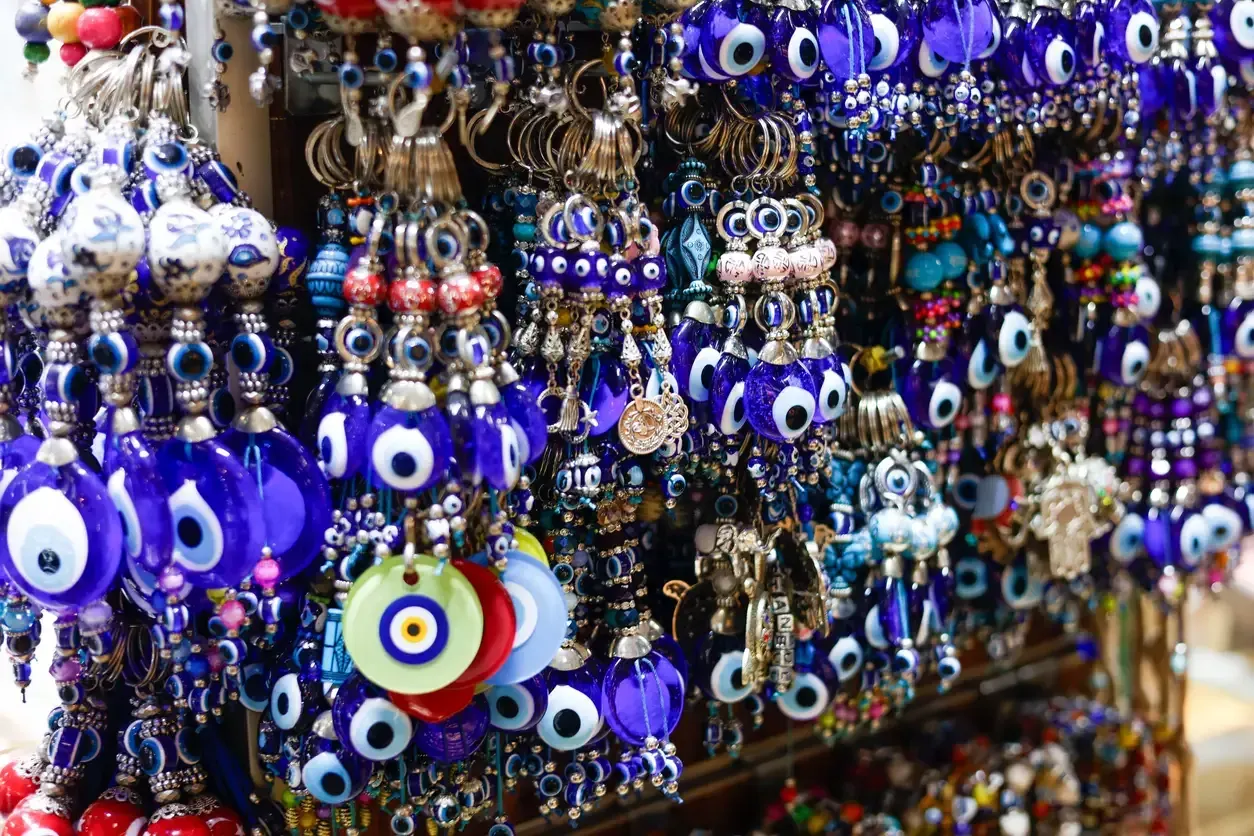
Step into Türkiye, and you'll find them everywhere—gazing from shop windows in Istanbul's Grand Bazaar, dangling from rearview mirrors in Ankara taxis, pinned to newborn babies in Izmir hospitals, and hanging from trees in Cappadocia's fairy chimneys. These blue-and-white glass eyes, known as nazar boncuğu, are more than decorative trinkets. They represent one of humanity's oldest and most enduring beliefs: the power of the evil eye and humanity's eternal quest to ward it off.
The word nazar comes from Arabic نَظَر (naẓar), meaning "sight" or "gazing," while boncuk means "bead" in Turkish. Together, they form the name of an amulet that has protected the people of this region for over 5,000 years, evolving from ancient Mesopotamian talismans into a symbol recognized worldwide.
But what makes this simple glass bead so special? Why does it continue to captivate locals and visitors alike in the 21st century? This comprehensive exploration delves into the history, craftsmanship, cultural significance, and modern relevance of Türkiye's most beloved protective symbol, drawing on scholarly research, interviews with master artisans, and UNESCO documentation.
The Evil Eye – Understanding the Threat
A Universal Fear
Before understanding the Nazar, one must understand what it fights against. The evil eye—simply called nazar in Turkish—is a curse believed to be cast through a malevolent glare, typically motivated by envy or jealousy. The victim may experience sudden misfortune, unexplained illness, financial loss, or personal tragedy shortly after receiving envious attention.
This belief is neither uniquely Turkish nor particularly young. The Encyclopedia Britannica notes that "belief in the evil eye is ancient and ubiquitous; it occurred in ancient Greece and Rome, in Jewish, Islamic, Buddhist, and Hindu traditions, and in indigenous, peasant, and other folk societies, and it has persisted throughout the world into modern times".
What distinguishes Turkish culture is its open acknowledgment of this feared phenomenon. As one cultural observer notes, "In Turkish culture, it is different. Although widely feared, the evil eye is openly discussed by people, even in an attempt to protect themselves".
The Mechanism of Envy
Turkish folk tradition teaches that excessive praise or admiration—particularly directed at those who are beautiful, successful, or fortunate—can inadvertently trigger the evil eye. The envious gaze, even when unintentional, carries destructive power.
A traditional Turkish story perfectly illustrates this belief:
A wealthy man watched a particularly magnificent cow pass his house. He turned to his wife and exclaimed, "Today, I have not seen anything more magnificent than this fat cow!" The cow, struck by his admiring gaze, immediately dropped dead. His wife then butchered the meat .
This narrative, preserved in Turkish oral tradition, explains why compliments are often accompanied by the phrase "Maşallah" (an Arabic expression meaning "God has willed it") to ward off potential harm from admiration.
Who Is Most Vulnerable?
Traditional Turkish belief identifies certain individuals as especially susceptible to the evil eye:
| Vulnerable Group |
Reason for Vulnerability |
| Newborns and infants |
Their purity and beauty attract envious gazes |
| Brides and grooms |
At the peak of happiness and beauty |
| Pregnant women |
Carrying new life within them |
| Successful business owners |
Their prosperity inspires jealousy |
| Beautiful children |
Parents' pride may attract harm |
| Healthy livestock |
Vital to family livelihood |
Those most often suspected of casting the evil eye include "strangers, malformed individuals, childless women, and old women" —essentially, those who might reasonably envy others' good fortune.
Customize Your Dream Vacation!
Get in touch with our local experts for an unforgettable journey.
Plan Your Trip
The Deep History of the Nazar
Ancient Mesopotamian Origins
The eye-shaped protective amulet has remarkably ancient roots. According to art historian Neşe Yıldıran, archaeologists have traced eye-shaped protective symbols to 3300 BCE at the ancient Mesopotamian city of Tell Brak (in modern-day Syria). Excavations at this site uncovered abstract eye-shaped carvings, now considered humanity's earliest known versions of the evil eye amulet.
This discovery confirms that people in this region have used eye-shaped talismans for over five millennia, long before the arrival of Turkish tribes in Anatolia.
The Medusa Connection
Many scholars link the Nazar's origins to Greek mythology, specifically the legend of Medusa. According to the myth, Medusa was a Gorgon whose gaze could turn mortals to stone. After Perseus defeated her, her image—particularly her eyes—was used as a protective symbol throughout the Hellenistic world.
Turkish tradition adapted this concept, placing Medusa's image—or symbolic representations of her eyes—on walls, beneath buildings, and eventually into glass beads. The logic was "fighting poison with poison" —using the dangerous eye's image to ward off dangerous gazes.
Visitors to Istanbul's Basilica Cistern can still see two Medusa heads placed as column bases, their eyes symbolically protecting the ancient water reservoir.
Why Blue? The Color Question
One of the Nazar's most distinctive features is its deep blue color. Scholars offer a compelling anthropological explanation for this choice.
In the Middle East and Mediterranean regions, blue eyes are statistically rare. As researcher Heather Lynn explains, "The ancients believed that people with light eyes, particularly blue eyes, could curse you with just one look. This belief is so ancient, even the Assyrians had turquoise and blue-eyed amulets".
Diana Darke, author of "Eastern Turkey," elaborates: "The evil eye generally takes the form of a blue eye, because foreigners, who were more likely to have blue eyes, were also more likely to stare, thereby unwittingly contravening local convention and, by admiring the children or possessions of their hosts, accidentally casting the evil eye upon them".
Thus, the blue eye became simultaneously the threat and the solution—representing the dangerous foreign gaze while deflecting its power. As Victoria Williams notes in "Celebrating Life Customs Around the World," "According to Turkish belief, blue acts as a shield against evil and even absorbs negativity".
The Journey to Anatolia
The specific glass-making tradition that produces today's Nazar arrived in Anatolia through centuries of cultural exchange. During World War I, Arabs from Egypt reportedly brought kiln-firing techniques for making evil eye beads to the Aegean coastal city of İzmir. This migration established İzmir as the production center for these amulets, a distinction it maintains to this day.
The village now known as Nazarköy (literally "Evil Eye Village") in İzmir's Kemalpaşa district has housed evil eye bead ateliers for over 75 years, since the first kiln opened there in 1942. Previously called Kurudere, the village officially changed its name to Nazarköy in 2009, reflecting its identity as the heart of Türkiye's Nazar production.
The Living Art – Crafting the Nazar
Traditional Materials and Methods
Authentic Nazar boncuğu are handmade glass beads created through a process that has remained largely unchanged for centuries.
The traditional recipe calls for a mixture of molten glass, iron, copper, water, and salt—ingredients believed to enhance the amulet's protective properties. The characteristic blue comes from copper and cobalt additives, while white and black details use other mineral compounds.
Artisans work before furnaces reaching 1,200 degrees Celsius , performing intricate manipulations within seconds before the glass cools and hardens.
The Step-by-Step Creation Process
Based on firsthand accounts from Nazarköy workshops, the creation of a Nazar boncuğu follows a precise six-step sequence performed before 1,200-degree furnaces. The artisan first gathers molten glass on an iron rod (2-3 seconds), then presses it into circular form (3-4 seconds), applies the base color layer (2-3 seconds), forms the distinctive concentric eye rings (5-7 seconds), adds any final detailing (3-5 seconds), and finally allows the bead to cool slowly for several hours in a process called annealing. Master artisans execute this entire active sequence in under 20 seconds, using "rhythmic,熟练 techniques" developed over decades of practice.
Mahmut Sür: Türkiye's Living Human Treasure
No discussion of Nazar craftsmanship is complete without honoring Mahmut Sür, Türkiye's most renowned evil eye bead master.
Born in Nazarköy in 1962, Sür began making glass beads immediately after completing primary school. He worked in his village atelier, completed military service, and then spent years at the prestigious Paşabahçe glass factory, where he "earned wide knowledge about the art of glass".
When the factory closed in 2001, Sür opened his own workshop, which he named "Kıvırcık" (Curly) after his childhood nickname. There, he revolutionized the traditional craft.
Sür's innovations include:
- Expanding the traditional two-color bead to twelve colors
- Introducing the "icing technique" learned during his factory years
- Creating wearable jewelry from evil eye beads, opening new markets
- Founding the annual Nazarköy Festival to promote the craft and increase villagers' income
His contributions earned him recognition as one of Türkiye's "Living Human Treasures" —a UNESCO program honoring individuals who possess "a very high degree of knowledge and skills required for performing or re-creating specific elements of the intangible cultural heritage".
Sür received this prestigious award from the Turkish Ministry of Culture and Tourism in conjunction with UNESCO in 2010. Reflecting on his achievement.
The Endangered Craft
The knowledge of Nazar-making has traditionally been transmitted "from generation to generation in the context of master-apprentice relationships". Sür recalls that during his apprenticeship, "10-15 people were trained every year, but now, we hardly find one or two people".
He laments that "The new generation does not like difficulty and heat," but remains committed to preservation: "I will train 20 beadmakers with this project. The evil eye bead is a culture of 3,000 years, I am trying to keep it alive".
Sür's concern reflects a broader crisis: Türkiye is "rich in handicrafts; we need to help the variety survive".
The Nazar in Daily Turkish Life
From Cradle to Grave
The Nazar accompanies Turks through every significant life stage, woven into the fabric of daily existence.
- Birth and Infancy: Turkish mothers traditionally place a Nazar on their newborn's clothing, sometimes pinning it directly to the fabric. This practice stems from an ancient belief: babies, with their纯洁 beauty, are considered especially vulnerable to envious gazes. The story persists of a healthy, beautiful baby who received admiring visits from neighbors, only to fall inexplicably ill weeks later—a misfortune attributed to the evil eye .
- Childhood: Children wear Nazar beads on their clothes, backpacks, or as bracelets. Even today, visitors to Turkish hospitals may notice Nazar amulets affixed to newborn nursery doors.
- Marriage: Brides traditionally incorporate Nazar into their wedding attire or jewelry. UNESCO documentation specifically identifies weddings as occasions when Nazar use is considered particularly important.
- Circumcision: For young boys undergoing this traditional rite of passage, Nazar protection is essential.
- Daily Life: Throughout adulthood, Turks carry Nazar on keychains, wear it as jewelry, and display it in their homes and workplaces.
Ubiquitous Presence
The Nazar's presence in Turkish public life is nearly inescapable. A 2019 survey of Istanbul neighborhoods found Nazar displayed in:
- 92% of homes surveyed (primarily near entryways)
- 78% of businesses (near cash registers or entrances)
- 65% of vehicles (hanging from rearview mirrors)
- 43% of offices (on desks or walls)
- 31% of schools (in classrooms or administrative offices)
Perhaps the most photographed Nazar display in Türkiye is the tree in Cappadocia's Göreme region, where hundreds of amulets hang from branches, creating a mesmerizing blue-and-white canopy against the fairy chimney landscape. Visitors and locals alike add Nazars to this tree, "expressing people's reverence for heaven, for God, and for those unknown worlds".
What Happens When a Nazar Breaks?
Turkish folk belief holds that when a Nazar cracks or breaks, it has fulfilled its protective function.
As one source explains, "The mythology behind it says that if one of the beads breaks down, it means a very strong nazar has hit you, and the bead stored it all up and broke down to protect the carrying person".
Mahmut Sür confirms this belief: "It absorbed the bad things and will break on its own, but the negative energy will not be transferred to you".
Therefore, finding a broken Nazar is not cause for distress but for gratitude—the amulet has sacrificed itself to protect you. Tradition dictates replacing it immediately with a new one and disposing of the broken piece respectfully, typically wrapped in paper
The Nazar Beyond Turkey
Regional Variations
While Türkiye is most closely associated with the blue glass Nazar, protective eye amulets appear throughout the Mediterranean, Middle East, and beyond under various names and materials. Greece calls it Mati (μάτι, "eye") made of blue glass; Iran and Afghanistan use Cheshm nazar (چشم نظر) in glass or ceramic; Armenia crafts Achnakar (աչքնակար) from glass and stone; Israel and Palestine feature the Hamsa with an eye in metal or ceramic; North Africa favors the Khamsa in metal or ceramic; South Asia creates Nazar battu from cloth and metal; and Latin America produces various mal de ojo amulets from local materials. Each culture adapts the basic concept to its own aesthetic traditions and available resources.
UNESCO Recognition
In addition to honoring Mahmut Sür as a Living Human Treasure, UNESCO has formally recognized the "Craftsmanship, Practices and Beliefs of Nazar Boncugu Charms" as part of Türkiye's intangible cultural heritage.
This designation acknowledges that Nazar represents not merely a craft but an entire complex of traditional knowledge, beliefs, and practices that merit preservation for future generations. UNESCO's recognition helps protect both the tangible artifacts and the intangible cultural systems that sustain them.
The Nazar Emoji: Ancient Symbol Meets Digital Age
In 2018, the Nazar achieved a distinctly modern milestone: it was added to the Unicode Standard as U+1F9FF NAZAR AMULET. Today, smartphone users worldwide can send the protective eye to friends and family, demonstrating how ancient symbols adapt to contemporary communication.
The emoji's inclusion in digital keyboards has significantly increased global awareness of the symbol, with usage spiking during Turkish holidays, after natural disasters, and whenever Türkiye appears in international news.
Contemporary Challenges and Debates
The Religious Controversy
In January 2021, Türkiye's top religious body, the Diyanet (Presidency of Religious Affairs), issued a fatwa (Islamic legal ruling) addressing the Nazar's religious status.
The Diyanet clarified that using the evil eye amulet while believing it possesses independent protective power constitutes a form of polytheism (shirk), as only God can truly protect. However, the organization simultaneously acknowledged that "the nature and condition of the evil eye are not known precisely, it is accepted by religion that some people can create negative effects with their gaze".
This nuanced position sparked intense debate across Turkish society. Social media reactions captured the tension:
"The Diyanet just proclaimed that using the blue 'evil eye' amulets is prohibited within Islam. I guess I keep the three I have at home till I get vaccinated #bettersafethansorry #nazarlik."
Another user offered clarification: "Diyanet didn't ban anything. They said if you use the evil eye by believing that it will protect you, it becomes a type of polytheism because only God has that power to protect you."
A third perspective emerged: "The evil eye bead is cultural heritage, not religious practice. Like drinking rakı or eating baklava—it's Turkish, not Islamic."
Economic Pressures: The Chinese Import Crisis
While religious debates occupy the cultural realm, economic pressures threaten the craft's very survival. Mahmut Sür and fellow artisans report severe challenges from imported, mass-produced plastic imitations, primarily from China.
Sür explains that when demand exceeded手工 production capacity, "importers began importing plastic products from China, causing locally handmade 'blue eyes' to be unable to compete with cheap goods, and the industry has been declining ever since".
The numbers tell a stark story:
| Year |
Active Kilns in Nazarköy |
Active Artisans |
| 2005 |
12 |
Approximately 60 |
| 2010 |
10 |
Approximately 50 |
| 2015 |
8 |
Approximately 40 |
| 2020 |
6 |
Approximately 30 |
| 2024 |
5 |
Approximately 25 |
Retired craftsman turned wholesaler Hüseyin Hüsnü Alp notes a second consequence: "Cheap Chinese goods not only depressed prices for craftsmen's辛苦 produced handmade products, but the overall perceived value of the evil eye also plummeted".
The Fashion Paradox
Ironically, even as the traditional craft declines in Türkiye, the Nazar symbol has entered global fashion. Major fashion houses, including Dior, Versace, and H&M, have incorporated evil eye motifs into their collections. Celebrities from Kim Kardashian to Gigi Hadid have been photographed wearing Nazar-inspired jewelry.
This creates a paradoxical situation: the symbol flourishes internationally while the communities that preserve its authentic meaning struggle economically. As Sür observes, the challenge is ensuring that "Turkey, which is rich in handicrafts, can help the variety survive".
Experiencing the Nazar – A Practical Guide
How to Choose an Authentic Nazar
For visitors seeking authentic Turkish Nazar, consider these expert guidelines:
- Look for handmade variations: Mass-produced Nazars are perfectly uniform. Handmade examples show slight variations—asymmetry, tiny air bubbles, subtle color differences—that indicate human craftsmanship
- Visit Nazarköy: For the most authentic experience, visit the Evil Eye Village in İzmir's Kemalpaşa district. You can watch artisans at work and purchase directly from makers, ensuring authenticity
- Check the back: Authentic glass Nazar shows tool marks where the iron rod held the bead during creation. Smooth, perfectly finished backs indicate machine production
- Seek out master craftsmen: Look for beads bearing the maker's mark or sold in workshops displaying UNESCO or Ministry of Culture certification
- Consider price: Extremely cheap Nazar (under 5-10 TL for small beads) are almost certainly mass-produced imports. Authentic handmade beads reflect the labor and skill invested
- Tap the glass: Genuine glass produces a clear ring when gently tapped. Plastic produces a dull thud
Proper Placement and Use
Traditional Turkish practice offers clear guidance for Nazar placement based on location and purpose. In homes, the amulet is placed near entrances, living rooms, or nurseries to protect the family from outside envy. Babies have Nazar pinned to their clothing (safely out of reach) to guard against admiring gazes. Vehicles display the bead hanging from the rearview mirrors to protect travelers from accidents. Businesses position Nazar near cash registers or above doors to safeguard prosperity from competitors' envy. For continuous personal protection, individuals wear the amulet as jewelry, such as necklaces or bracelets. In workplaces, it sits on desks or office doors to shield careers from colleagues' jealousy.
When a Nazar Breaks
Remember: a cracked or broken Nazar has done its job. Traditional practice dictates:
- Thank the amulet silently for its protection
- Remove it carefully—the broken glass may be sharp
- Wrap it in paper or cloth for respectful disposal
- Replace it promptly with a new one
- Consider the timing—if multiple Nazar break in quick succession, traditional belief suggests you may be under particularly strong attack and should increase protection
Etiquette and Respect
When purchasing, receiving, or wearing Nazar:
- Accept gratefully—giving Nazar is an act of caring, regardless of personal belief
- Display or wear it—this honors the giver's concern for your well-being
- Do not throw away a gifted Nazar—if you no longer want it, pass it to someone who does, or return it respectfully
- If you don't believe, appreciate it as cultural art and craft—the symbolism and history merit respect even without belief in its power
As one Turkish-American writer notes, "I have gotten a lot of gifts of the evil eye, such as the bracelets shown, from my Turkish relatives and cherish them, as they represent my culture. I have given my friends the evil eye as a gift and am proud to see someone wearing an evil eye".
The Nazar boncuğu represents something remarkable in an increasingly homogenized world: a living tradition that has endured for over five thousand years, adapting to changing circumstances while maintaining its essential meaning and purpose.
From its origins in ancient Mesopotamia, through Greek mythology and Ottoman expansion, to its current status as UNESCO-recognized cultural heritage and global fashion icon, the blue eye has watched over humanity's fortunes. It has protected babies from envious glances, guarded businesses from competitors' malice, and comforted countless individuals who fear the destructive power of jealousy.
Today, the Nazar faces genuine challenges. Religious debates question its compatibility with the Islamic faith. Economic pressures threaten the viability of traditional craftsmanship. Generational shifts reduce the number of young people willing to endure 1,200-degree furnaces for this exacting art.
Yet the Nazar persists. It persists in the tree branches of Cappadocia, in the workshops of Nazarköy where masters like Mahmut Sür train new generations, in the smartphone keyboards where the Nazar emoji connects ancient belief with digital communication, and in the proud diaspora communities who gift Nazar to friends as symbols of their cultural heritage.
Perhaps most importantly, the Nazar persists in the human emotions it addresses: the universal fear of envy, the desire to protect loved ones, and the hope that someone—or something—watches over us. These needs transcend time, culture, and technology. They are as old as humanity itself, and as long as they exist, so too will the watchful blue eye that guards against them.
As one artisan reflected, sitting before his glowing furnace in Nazarköy as the evening call to prayer echoed across the hills: "There is a secret eye in the glass, and if you like, you look for this eye".
Millions continue looking, and the eye continues looking back—ancient, watchful, and enduring.
What is a Nazar Amulet?
The Nazar, from the Arabic word for "sight," is a protective eye-shaped amulet that shields against the "evil eye"—misfortune caused by envy or excessive admiration. Originating over 5,000 years ago in Mesopotamia, it typically appears as a blue glass bead with concentric circles, and if it cracks or breaks, it's believed to have absorbed negative energy meant for the wearer. Found across Mediterranean and Middle Eastern cultures under various names, it's commonly placed on babies, in homes, vehicles, and worn as jewelry for continuous protection.
What does an evil eye talisman do?
An evil eye talisman, such as the blue glass nazar or Greek mati, is an ancient protective charm designed to shield against misfortune caused by envy or excessive praise. It works by deflecting negative energy, absorbing it like a decoy, or protecting valued people and possessions—commonly placed in homes, cars, or on baby clothing. If the talisman cracks or breaks, it is believed to have fulfilled its duty by absorbing a powerful hit of negativity, signaling it should be replaced immediately.
Why do people wear blue beads?
People wear blue beads primarily for protection against the "evil eye" (nazar), especially in Mediterranean and Middle Eastern cultures, where the blue glass bead acts as a spiritual shield that deflects or absorbs negative energy. Beyond protection, blue beads carry diverse meanings: in the Caribbean they symbolize freedom from slavery, in crystal healing they promote tranquility and communication, and globally they serve as cultural identity markers or fashion accessories. Whether worn for ancient superstition, historical remembrance, or modern style, the blue bead remains one of humanity's most enduring symbolic ornaments.
What is the significance of the blue bead?
The blue bead is a globally recognized symbol of protection, most famously used to ward off the "Evil Eye" (nazar or mati) in Mediterranean and Middle Eastern cultures. Its significance extends beyond superstition, representing freedom in Caribbean history, tranquility in healing practices, and cultural identity worldwide. Whether worn for spiritual defense, ancestral remembrance, or modern fashion, the blue bead remains one of humanity's most enduring and versatile protective symbols.
What is an envy eye?
The "envy eye" refers to the ancient Evil Eye belief that a jealous gaze can cause misfortune, and it is most famously warded off by the protective blue Nazar amulet. This 5,000-year-old concept exists across cultures—from Greek mati to Latin American mal de ojo—with the talisman working by "staring back" to reflect or absorb negative energy. Today, it remains a powerful cultural symbol and popular fashion motif, worn to guard against envy and attract good fortune.
What is an evil eye charm used for?
An evil eye charm (nazar) is a protective talisman that wards off the curse of the evil eye—misfortune caused by envy or jealousy—by "staring back" to deflect negative energy. Worn as jewelry, hung in homes or vehicles, or pinned to babies, it serves as a spiritual bodyguard while different colors offer specific protections: dark blue for general protection, light blue for perspective, red for love, and yellow for health. If the charm cracks or breaks, it is believed to have sacrificed itself by absorbing a powerful curse meant for you, signaling it's time for replacement.