Table of Contents:
#What to Know About Morocco Before You Go
#Understanding Local Customs and Behavior
#Getting Around Morocco Safely
#Shopping, Money, and Bargaining Tips
#FAQs
Morocco welcomes over 13 million visitors each year to its captivating landscapes and ancient cities. This North African kingdom stands among the continent's safest destinations, drawing travelers who seek authentic cultural encounters, centuries-old architectural wonders, and unforgettable adventures across diverse terrains.
Several key factors deserve your attention before departure. Citizens from the United States, the United Kingdom, European Union nations, Canada, and Australia benefit from visa-free entry policies that permit stays extending up to 90 days. Spring months spanning March through early June, along with autumn's September to December period, provide the most favorable weather conditions for exploration. Morocco's closed currency regulations require visitors to obtain Moroccan dirhams once they arrive in the country.
This detailed guide draws from extensive travel experience to address every aspect of your Moroccan journey. Tour operator selection represents perhaps your most critical pre-trip decision, directly impacting the quality and safety of your entire experience. Professional transportation arrangements become equally important when traversing Morocco's varied road networks, from mountain passes to desert routes. Local customs, market interactions, and safety protocols form additional pillars of successful Moroccan travel that demand careful consideration before your departure.
Successful Moroccan travel hinges on understanding several fundamental regulations and cultural considerations. These practical elements shape your entire journey, from border crossings to cultural immersion during significant religious observances.
Visa-free countries and entry rules
Entry procedures for Morocco remain refreshingly straightforward for most Western travelers. Citizens from the United States, the United Kingdom, European Union countries, Canada, Australia, and numerous other nations enter without visa requirements for stays up to 90 days. Passport validity should extend at least through your departure date, though six months of remaining validity provides additional security.
Border officials must stamp your passport upon arrival. This seemingly routine step prevents potential complications during your departure. Morocco's Electronic Travel Authorization (AEVM) system currently operates on a limited basis but will eventually encompass all visa-exempt travelers.
Overstaying penalties and extensions
Exceeding your authorized 90-day stay triggers immediate legal consequences. Daily accumulating fines, deportation proceedings, and future visa restrictions represent the standard penalties for overstayers.
Extension procedures, however, offer a practical solution for extended visits. Police stations handle extension requests, granting up to an additional 90 days when approached before your initial period expires. Required documentation includes your passport, identification copies, and confirmed departure flight details. Multiple government office visits and potential court appearances may be necessary, so factor additional time into your planning if extensions seem likely.
Traveling during Ramadan
Ramadan presents Morocco at its most spiritually significant, though this sacred month demands cultural sensitivity from visitors. The 2026 observance spans approximately February 17 through March 18. Daily fasting extends from sunrise to sunset, typically covering 5:00 AM until 7:00 PM.
Non-Muslim visitors need not participate in fasting, yet public consumption of food, beverages, or tobacco during daylight hours shows cultural insensitivity. Commercial establishments adapt their schedules accordingly, opening later, closing before sunset, then resuming operations after iftar around 7:30 PM.
Evening hours during Ramadan reveal Morocco's most festive character. Special culinary preparations and community gatherings create an atmosphere unavailable during other periods, providing authentic cultural experiences that reward culturally aware travelers.
Plan smarter with our Morocco travel packages. Get expert tips, cultural insights, and everything you need to know before you go.
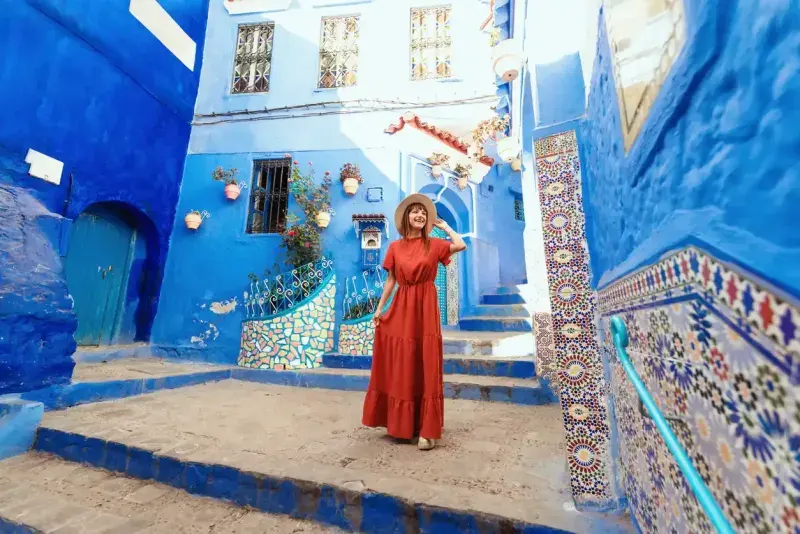
Young woman with red dress visiting the blue city Chefchaouen, Marocco
What should I know before going to Morocco?
Before I go to Morocco: Dress modestly (cover shoulders/knees). Drink only bottled water. Tipping is customary (10% restaurants, 50-100 MAD for guides). Bargain in souks (start 40-50% below asking). I don't need a visa (US/EU/Canada/Australia 90 days). Friday is a holy day with some closures. Morocco tour packages include guides who handle cultural navigation and language.
Is 100 dirham a good tip in Morocco?
Yes, 100 dirham ($10 USD) is generous. Standard tips: servers 10-20 dirham, guides 50-100 dirham/day, drivers 30-50 dirham/day, porters 10-20 dirham/bag. When I book Morocco travel packages, I budget $10-15 USD/day for all tipping.
Cultural awareness forms the foundation of meaningful travel experiences in Morocco. The kingdom's rich Islamic heritage and centuries-old traditions shape daily interactions, and travelers who appreciate these nuances discover deeper connections with local communities.
Modest dress expectations for men and women
Morocco's Islamic foundations establish clear expectations for appropriate attire. Women should ensure coverage of the shoulders, knees, and chest areas when exploring public spaces. Urban centers such as Marrakech and Casablanca demonstrate greater flexibility in dress codes, while rural regions maintain stricter modesty standards. Hair coverings become necessary only when entering mosque grounds. Climate considerations align perfectly with cultural requirements; flowing tunics, maxi skirts, and lightweight pants provide both respectful coverage and comfort under Morocco's sun.
Men find acceptance wearing knee-length shorts and shirts that cover their shoulders. Local observation serves as your most reliable guide to appropriate attire. Contemporary styles appear more frequently among younger urban Moroccans, while traditional dress remains prevalent in smaller villages and rural areas.
Public displays of affection
Moroccan legal framework specifically prohibits public kissing between unmarried couples, classifying such behavior as "an act of aggression against Moroccan Muslim society". Foreign visitors rarely face legal consequences, yet these actions create significant cultural discomfort. Acceptable public gestures include brief hand-holding and walking arm-in-arm, while more intimate expressions should remain private.
Photography do's and don'ts
Photography etiquette requires careful attention to local sensitivities:
- Always ask permission before photographing people
- Market and landscape photography is generally acceptable without special permission
- Snake charmers and street performers typically expect 5-10 dirhams for photos
- Mosques can be photographed from outside, but interior photography is restricted except at the Hassan II Mosque in Casablanca
- Avoid photographing military personnel or government buildings
Respect for religion and prayer times
Sunni Islam guides the spiritual lives of 99% of Moroccans, creating a society where religious observance shapes daily rhythms. The call to prayer echoes five times throughout each day, and travelers demonstrate respect by lowering their voices during these sacred moments. Most mosques remain closed to non-Muslim visitors, with notable exceptions including Casablanca's magnificent Hassan II Mosque. Religious consideration extends to public behavior, particularly during Ramadan, when abstaining from eating, drinking, or smoking in daylight hours shows cultural sensitivity.
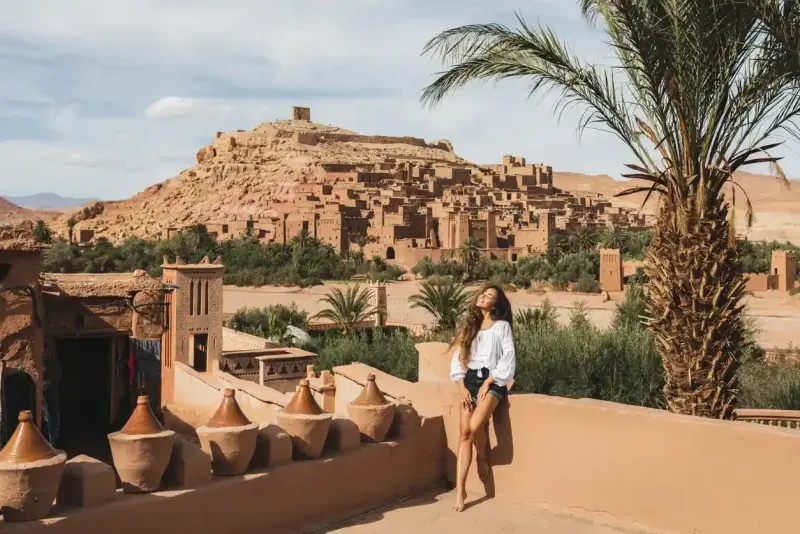
Beautiful young woman happy to travel in Morocco. Ait-Ben-Haddou kasbah on background
Can females wear shorts in Morocco?
I shouldn't wear shorts in Morocco except at beaches or hotel pools. Morocco is conservative I should wear long pants or skirts covering the knees. Shorts attract unwanted attention in cities and medinas. Morocco vacation packages to coastal areas allow beach shorts.
Is $50 a lot in Morocco?
Yes, $50 (500 dirham) is substantial. Buys: dinner for two, full day taxis, a hotel night, or souvenirs. Daily budget: backpacker $30-40, mid-range $70-100, luxury $150+. Morocco trip packages offer excellent value.
Customize Your Dream Vacation!
Get in touch with our local experts for an unforgettable journey.
Plan Your Trip
Morocco's transportation landscape presents visitors with multiple options that cater to different comfort levels and budgets. Understanding these systems before your arrival ensures smooth movement between destinations while maintaining your safety throughout the kingdom.
Petit vs. grand taxis
The country operates two distinct taxi categories that serve separate purposes within its transport network. Petit taxis function exclusively within individual city boundaries, each municipality assigning specific colors. Red vehicles dominate Casablanca's streets, blue taxis serve Rabat, while orange ones traverse Marrakech. These compact cars carry a maximum of three passengers and must operate using functioning meters. Grand taxis fulfill intercity travel requirements, predominantly employing spacious Mercedes vehicles designed for six passengers. Fixed pricing structures govern their routes, positioning them as faster alternatives to buses while remaining more affordable than private vehicle hire.
Train and bus travel tips
Morocco's railway system connects major urban centers with remarkable efficiency and value. The modern Al Boraq high-speed service covers the Tangier-Casablanca corridor in slightly more than two hours. Traditional rail lines serve additional key destinations, including Fes and Marrakech. Areas beyond railway reach benefit from established bus operators such as CTM and Supratours, both known for dependable service. Though buses operate roughly 30% slower than shared taxi options, they consistently deliver superior safety standards and passenger comfort.
Driving rules and road safety
Vehicle rental requires familiarity with Morocco's right-hand driving system. Speed regulations establish clear limits: motorways permit 120 km/h, secondary roads allow 100 km/h, while urban zones restrict speeds to 60 km/h. Seatbelt usage remains mandatory throughout the country, and travelers should anticipate regular police checkpoint encounters. Night driving presents additional challenges, as many local drivers, particularly taxi operators, interpret traffic regulations with considerable flexibility rather than strict adherence.
Apps for transportation and navigation
Several digital tools enhance travel efficiency across Morocco. ONCF Trafic delivers current train scheduling information, while Careem provides ride-hailing services similar to international platforms in major cities. Maps. Me stands out for its offline mapping capabilities, particularly valuable when exploring intricate medina layouts where cellular connectivity often proves unreliable.
Is it better to use cash or card in Morocco?
I need both. Cards (Visa, Mastercard) work at hotels and restaurants. I need cash for markets, taxis, tips, and small vendors. I'll use ATMs for the best rates. Morocco tour packages handle major expenses. I mainly need cash for tips and shopping.
How much is $100 USD in Morocco?
$100 USD = approximately 950-1,000 Moroccan Dirhams (MAD). Check xe.com for current rates. Buys: 10-15 meals, 2-3 nights in budget hotels, 20+ taxi rides, or plenty of souvenirs. Morocco travel packages include the main costs, and $100 cash covers tips and extras.
Morocco's labyrinthine souks pulse with centuries-old trading traditions that continue to captivate modern visitors. These bustling marketplaces demand specific financial knowledge and cultural awareness to ensure authentic, rewarding experiences.
Bring cash and use local currency
Physical currency dominates Moroccan commerce, accounting for over 70% of all transactions. Bank-affiliated ATMs provide the most reliable withdrawal options throughout urban centers. Select the dirham charging over the home currency conversion to avoid unnecessary exchange fees. The dirham's closed currency status means acquisition occurs exclusively within Morocco's borders.
How to bargain respectfully
Market negotiations follow time-honored protocols that reward patience and cultural sensitivity. Opening offers around 25% of quoted prices establishes realistic starting points. Final agreements typically settle between 33-50% of the initial asking amounts. Successful bargaining relies on genuine conversation about your journey and interests, creating personal connections with vendors. Strategic displays of mild hesitation often yield favorable price adjustments.
Avoiding common scams in markets
Vendors occasionally extend complimentary mint tea invitations that carry hidden payment expectations. Restaurant bills merit careful review for unauthorized additions. High-value items such as handwoven carpets and pure argan oil require authenticity verification, as quality substitutions occur frequently.
Tipping etiquette in Morocco
Service gratuities follow established local standards that acknowledge hospitality workers appropriately. Restaurant service warrants 10-15% additions unless charges appear on final bills. Taxi fares benefit from simple rounding for brief journeys or 10% supplements for extended travel. Hotel personnel appreciate daily recognition: housekeeping staff (10-20 dirhams), luggage assistance (10-20 dirhams per service), and concierge support (10-20 dirhams).
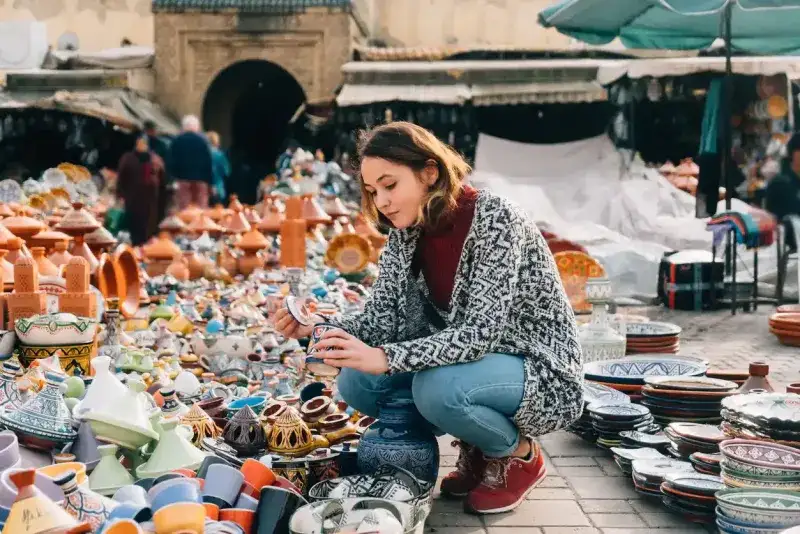
Woman choosing Ceramic in shop in Meknes, Morocco
Conclusion
Morocco stands ready to reward the well-prepared traveler with experiences that linger long after departure. The kingdom's ancient medinas, Atlas Mountain villages, and Saharan landscapes reveal their treasures most readily to visitors who understand the cultural rhythms and practical realities of this fascinating destination.
Successful Moroccan travel hinges on thoughtful preparation rather than chance encounters. Those who invest time in understanding local customs, transportation networks, and financial systems discover a country far more accessible than its mystique suggests. The difference between a good trip and an extraordinary one often lies in these foundational details.
Morocco's gift to thoughtful visitors extends beyond its celebrated architecture and landscapes. The country offers genuine cultural immersion opportunities that become increasingly rare in our connected world. Markets buzzing with artisan activity, evening calls to prayer echoing across ancient city walls, and desert nights filled with traditional music create memories that photographs cannot capture.
The practical knowledge outlined here serves as your foundation, yet Morocco's true rewards emerge through respectful engagement with its people and traditions. Each interaction, whether negotiating in a souk, sharing tea with a local family, or simply observing daily life unfold in a village square, adds depth to your understanding of North African culture.
This ancient crossroads between Africa and Europe continues to enchant visitors precisely because it maintains its authentic character while welcoming respectful exploration. Your journey through Morocco will likely challenge preconceptions, expand cultural awareness, and provide stories that enrich conversations for years to come.
Well-informed travelers consistently report that Morocco exceeded their expectations, not despite its complexities but because of them. The country rewards patience, cultural sensitivity, and genuine curiosity with access to experiences unavailable to the unprepared visitor.
Q1. What are the essential things to know before traveling to Morocco?
Before visiting Morocco, it's important to know that many countries have visa-free entry for up to 90 days. The best times to visit are spring and autumn for pleasant weather. Morocco uses a closed currency system, so you'll need to acquire Moroccan dirhams after arrival. It's also crucial to respect local customs, dress modestly, and be aware of cultural norms, especially during Ramadan.
Q2. How should visitors dress in Morocco?
In Morocco, modest dress is appreciated. Women should cover their shoulders, knees, and chest, especially in rural areas. Men should wear shorts that reach below the knee and shirts that cover the shoulders. In larger cities, dress codes are more relaxed, but it's always best to err on the side of modesty out of respect for local customs.
Q3. What are the transportation options in Morocco?
Morocco offers various transportation options. In cities, petit taxis are color-coded and metered. For intercity travel, grand taxis, trains, and buses are available. The high-speed Al Boraq train connects major cities quickly. If driving, remember that Morocco drives on the right side and observe speed limits. Apps like ONCF Trafic for trains and Careem for ride-hailing can be helpful for navigation.
Q4. How does bargaining work in Moroccan markets?
Bargaining is common in Moroccan markets. Start by offering about 25% of the initial asking price and aim to settle at 33-50% of the original quote. Maintain a friendly demeanor and engage in small talk to establish rapport. Acting slightly disinterested can help secure better deals. Remember, it's an art form, not a battle, so keep it respectful and enjoyable.
Q5. What are the tipping customs in Morocco?
In Morocco, tipping is expected in various situations. In restaurants, 10-15% is standard unless service is already included. For taxis, round up the fare for short trips or add 10% for longer journeys. In hotels, it's customary to tip housekeepers 10-20 dirhams daily, and similar amounts for porters and bellboys per service. Always have some small bills handy for tipping.