Gur Amir Mausoleum

#What Is the Gur Amir Mausoleum?
#History of Gur Amir Mausoleum
#Architecture: A Timurid Masterpiece
#Who Is Buried at Gur Amir Mausoleum?
#Sites Near Gur Amir Mausoleum
#Best Time to Visit Gur Amir Mausoleum
The Gur Amir Mausoleum — from the Persian Gur-e-Amir, "Tomb of the King" — is the burial place of Timur (Tamerlane), founder of the Timurid Empire, and several generations of his dynasty. It stands in Samarkand, Uzbekistan, roughly a ten-minute walk south-west of Registan Square, crowned by a fluted azure dome that has become one of the defining silhouettes of Central Asia.
Built in the opening years of the 15th century, the mausoleum is among the most influential buildings in Islamic architectural history. Its proportions, ribbed dome and high drum were carried by Timurid craftsmen into India, where they shaped Humayun's Tomb and, ultimately, the Taj Mahal.
The complex forms part of the UNESCO World Heritage listing "Samarkand – Crossroads of Cultures" (2001) and ranks alongside the Registan and Shah-i-Zinda as one of the three sights no visitor to Samarkand should skip.
The mausoleum was never intended for Timur. Construction began around 1403 as a tomb for Muhammad Sultan, Timur's favourite grandson and designated heir, who died unexpectedly while on campaign in Anatolia. Timur, reportedly devastated, ordered a mausoleum built beside the madrasah and khanaka (Sufi lodge) that Muhammad Sultan had already founded on the site.
In the winter of 1405, Timur died at Otrar while marching east on a campaign against Ming China. He had intended to be buried in his birthplace, Shahrisabz, but winter passes were snowbound and his body was brought instead to Samarkand. He was interred in the still-unfinished building that became the dynasty's family mausoleum.
Timur's grandson Ulugh Beg — the astronomer-king — completed and enriched the complex, adding the entrance portal and much of the interior decoration. He also commissioned the extraordinary jade tombstone that still covers Timur's cenotaph. Ulugh Beg was himself buried here after his assassination in 1449.
As Samarkand declined with the collapse of overland Silk Road trade, the complex deteriorated badly. Earthquakes brought down the minarets and much of the surrounding madrasah and khanaka, of which only foundations and a portion of one minaret survive today. The Russian Empire annexed Samarkand in 1868, and serious documentation began. Systematic restoration followed under Soviet rule and continued after Uzbekistan's independence in 1991, with major work on the dome completed in the 1990s.
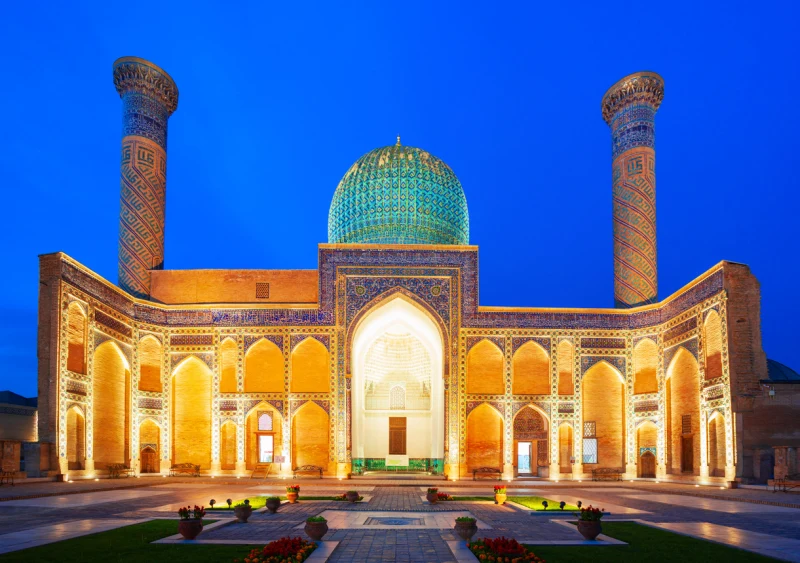
The building's signature is its ribbed dome, roughly 15 metres across and rising about 32 metres above ground, set on a tall cylindrical drum. Sixty-four flutes run down its surface, sheathed in glazed tiles of turquoise and deep blue that shift in tone as the sun moves across them. The drum carries a monumental Kufic inscription in white on blue.
The elevated dome-on-drum profile was a Timurid innovation: it made the building read as monumental from a distance while keeping the interior chamber human in scale. The trick was later exported wholesale to Mughal India.
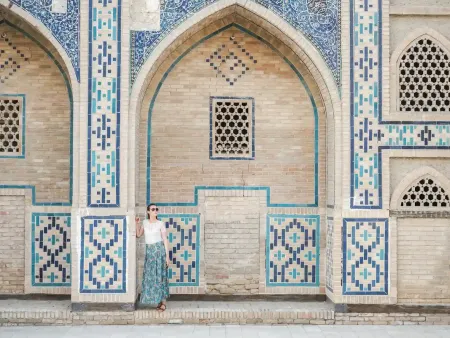
The surviving portal, added under Ulugh Beg, is covered in mosaic faience — geometric interlace, floral arabesque and calligraphic banding in blue, white and gold. Two of the original four corner minarets have been reconstructed.
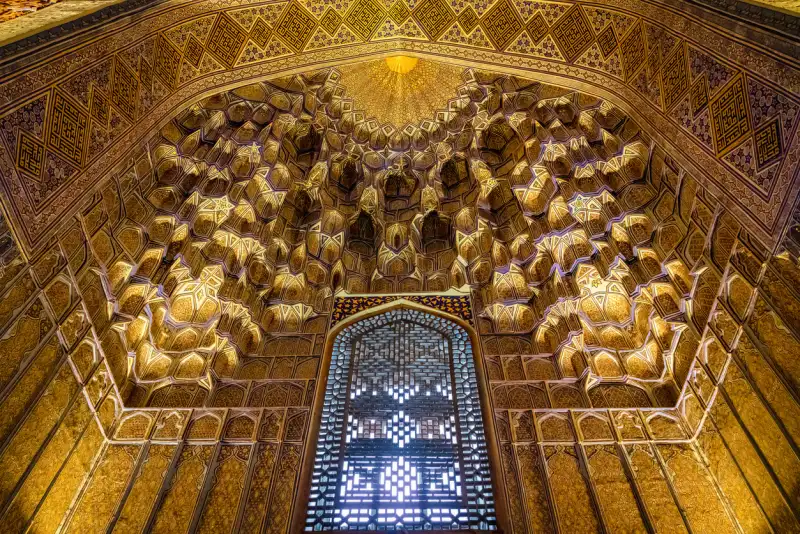
The interior is where Gur Amir surprises people. The lower walls are lined with onyx and jasper panels, above which the surfaces erupt in gilded papier-mâché muqarnas — honeycombed stalactite vaulting — and dense gold-leaf ornament covering almost every visible surface. The effect in low light is closer to a jewellery box than a tomb.
An important detail many visitors miss: the carved stones in the main chamber are cenotaphs, not graves. The actual bodies lie in a crypt directly beneath, in an unadorned vault, each burial positioned exactly below its marker above. The crypt is generally closed to the public.
Get in touch with our local experts for an unforgettable journey.
Plan Your TripThe mausoleum holds the core of the Timurid dynasty:
Timur's cenotaph is covered by a single slab of dark green nephrite jade — long described as the largest such block in the world. Ulugh Beg is credited with bringing it from Mongolia.
Its history is turbulent. In 1740, the Persian ruler Nadir Shah removed the stone and carried it off; it broke in two during transport, and after a run of misfortune he was persuaded to return it. The crack is still clearly visible today, running across the slab.
The mausoleum's most retold story belongs to the twentieth century. In June 1941, a Soviet expedition led by anthropologist Mikhail Gerasimov opened the crypt to examine the remains. Local elders reportedly warned that disturbing the tomb would unleash war.
The exhumation confirmed several historical claims: the skeleton belonged to a man of around 172 cm with injuries to the right leg and right arm consistent with the lameness that gave "Timur the Lame" his name, and traces of reddish hair in the beard. Gerasimov used the skull to produce his famous facial reconstruction.
On 22 June 1941 — within days of the opening — Nazi Germany launched Operation Barbarossa. The coincidence hardened into the legend of the curse. The story's second half is equally durable: the remains were reburied with full Islamic rites in late 1942, shortly before the Soviet victory at Stalingrad.
Historians regard the sequence as coincidence, since the invasion had been planned for months. The legend, however, is now inseparable from the building, and every guide will tell you some version of it.
Timurid architecture travelled with the dynasty. Babur, a direct descendant of Timur, founded the Mughal Empire in India in 1526, and Central Asian craftsmen and design principles followed. Humayun's Tomb in Delhi (1570) is the clearest intermediate step — a bulbous dome on a high drum, set in a formal garden — and its descendant, the Taj Mahal (completed 1653), carries the same lineage. Gur Amir is, in a real sense, the ancestor of the world's most famous mausoleum.
Visiting Gur Amir
What to See
Gur Amir Mausoleum is ideally positioned in the historic heart of Samarkand, making it easy to combine with several of the city's most important landmarks. Visitors can explore the surrounding attractions by walking or taking a short taxi ride, depending on the route and weather.
|
Season |
Months |
Conditions |
Notes |
|
Spring |
April – May |
20–28°C, clear |
Ideal. Best light and comfort |
|
Summer |
June – August |
35–40°C |
Visit at opening only; little shade |
|
Autumn |
September – October |
20–28°C |
Ideal. Fewer crowds than spring |
|
Winter |
November – March |
0–10°C |
Empty site; snow against blue tile |
Best time of day: Arrive at opening, around 8:00, for near-empty courtyards and soft light on the tilework. Return at sunset or after dark for the illuminated exterior — the two visits give completely different photographs, and the site is small enough that seeing it twice costs little time.
Best time of day: Arrive at opening, around 8:00, for near-empty courtyards and soft light on the tilework. Return at sunset or after dark for the illuminated exterior — the two visits give completely different photographs, and the site is small enough that seeing it twice costs little time.
Gur Amir is more than a magnificent mausoleum—it is a window into the legacy of Timur, the brilliance of Timurid architecture, and the rich history of the Silk Road. From its turquoise dome and intricate mosaics to the legendary jade tombstone, every detail tells a story waiting to be discovered. Experience Gur Amir and uncover the timeless treasures of Samarkand with our Uzbekistan Tours.
It is the family mausoleum of the Timurid dynasty in Samarkand, Uzbekistan, and the burial place of the conqueror Timur (Tamerlane). The name means "Tomb of the King" in Persian.
Timur, his sons Shah Rukh and Miran Shah, his grandsons Muhammad Sultan and Ulugh Beg, and his spiritual teacher Sayyid Baraka.
Beyond housing Timur's tomb, it is a defining work of Timurid architecture whose dome-on-drum design influenced Humayun's Tomb and the Taj Mahal.
About 45 to 60 minutes, allowing time for the interior, the courtyard ruins and photographs of the dome.
Roughly 1 km — a 10 to 15 minute walk. The turquoise dome is visible from a distance.
April–May or September–October for weather, and early morning or after dark for the best light. Summer midday is hot with little shade.