Table of Contents:
#The Founding of Kairouan and Its Islamic Origins
#Why Kairouan Became Islam's Fourth Holiest City
#The Great Mosque of Kairouan and Sacred Sites
#Things to Do in Kairouan: Visiting the Holy City
#Conclusion
Hidden within Tunisia's heartland lies a sacred city that most travelers never discover. Kairouan emerges from the North African landscape as Islam's fourth holiest destination, a distinction that places this ancient settlement alongside Mecca, Medina, and Jerusalem in the Islamic world's most revered pantheon. Founded in 670, these weathered walls witnessed the birth of Islam's very first permanent foothold across North Africa.
The city's spiritual magnetism reaches far beyond mere historical significance. Local tradition whispers that seven pilgrimages to Kairouan carry the same divine weight as a single journey to Mecca, a belief that has drawn faithful souls across centuries. This remarkable claim speaks to the profound sanctity that permeates every corner of the walled medina.
Architecture tells the story of this sacred ground through the magnificent Great Mosque of Kairouan, whose 9,000 square meters of prayer space anchors a UNESCO World Heritage Site recognized since 1988. Yet Kairouan offers far more than spiritual contemplation. The city pulses with authentic Tunisian culture, bustling souks overflow with handcrafted treasures, carpet weavers practice their ancient art with mesmerizing precision, and the sweet aroma of traditional Makroudh pastries fills the air.
What follows reveals the fascinating layers of history, faith, and culture that make this sacred city an essential destination for those seeking to understand Islam's remarkable journey across North Africa. Each stone, each prayer hall, each narrow alleyway holds secrets waiting to captivate the curious traveler.

Uqba ibn Nafi and the Military Camp of 670 CE
Arab general Uqba ibn Nafi arrived in the region of Ifriqiya during 670 CE, carrying orders from Caliph Mu'awiya. Military conquest alone proved insufficient for a lasting Islamic presence. Uqba witnessed how local populations embraced Islam during military occupation, only to abandon it once armies moved onward. This pattern demanded a radically different approach: permanent settlement rather than temporary conquest.
Uqba chose an extraordinary location, buried within dense forests teeming with wild beasts and reptiles. The Persian term "Kairouan," meaning "camp" or "caravanserai," became the settlement's name. Rather than pursuing immediate military expansion, the general devoted his initial five years of governorship entirely to construction projects. His vision materialized through the Great Mosque, a government palace (dar al-imara), soldiers' quarters, and defensive walls stretching 2,750 yards. This mosque would later become the architectural blueprint for every subsequent mosque built across the Maghreb.
Strategic Location in North Africa
The site Uqba selected offered remarkable tactical advantages, positioned approximately 99 miles south of modern-day Tunis. Arab forces deliberately avoided the heavily fortified Byzantine coastal strongholds, instead advancing through the more challenging but less defended arid interior. This inland route naturally led to the Qammuniya region, where Kairouan would flourish.
Elevated terrain provided natural defenses against both surprise attacks and seasonal flooding. Byzantine forces had previously established a garrison at Kamounia before the Arab arrival. This strategic positioning allowed Muslim forces to control a vital corridor through North Africa while avoiding the treacherous Mediterranean coastline and ambush-prone western mountains.
Early Resistance and Berber Conversions
The conquest faced fierce opposition from local Berber leaders. Kusaila initially accepted Islam under Uqba's successor, Abu al-Muhajir Dinar. When Uqba resumed command in 681, however, diplomatic relations deteriorated rapidly. Kusaila's warriors killed Uqba at Biskra around 685, roughly fifteen years after Kairouan's founding.
Resistance intensified under a formidable Berber woman known as Al-Kahina (the Priestess), who led the powerful Jawara tribes. Her forces achieved stunning victories against Muslim armies commanded by Hassan ibn al-Nu'man before her ultimate defeat in 698. Following this decisive battle, massive Berber conversions to Islam swept across the region. These new Muslim converts proved invaluable in spreading Islamic teachings throughout the broader Maghreb.
Rise as the Capital of Ifriqiya
The military outpost evolved into an administrative center as the Muslim authority consolidated across North Africa. Under Caliph Abd al-Malik, the Umayyad conquest approached completion. The year 705 marked a crucial transformation: the Maghreb became the independent wilayah (province) of Ifriqiya, administratively separated from Egyptian governance. Kairouan assumed the role of provincial capital, establishing the first Arab administrative center throughout the Maghreb. Scholarly activity flourished as learned men gathered at the mosque, creating an intellectual hub for Islamic jurisprudence and secular knowledge.
Ready to Explore Kairouan's Sacred Wonders?
Discover Islam's 4th Holiest City with Expert-Guided Tunisia Tours!
Now that you understand Kairouan's profound spiritual and cultural significance, it's time to experience this sacred city in person. Our specialized Tunisia tours bring you face-to-face with the magnificent Great Mosque, ancient medina, and living traditions that have endured for over 1,300 years.
The Seven Pilgrimages Tradition
Ancient Islamic tradition weaves a remarkable claim around Kairouan's spiritual power: seven journeys to this Tunisian sanctuary equal the sacred merit of a single pilgrimage to Mecca. This extraordinary belief transformed Kairouan's religious standing across North Africa, where Maghrebi Muslims came to regard the city's sanctity as second only to Islam's birthplace. Such reverence stems from the city's profound connection to Islam's earliest days. The Great Mosque rose from these grounds merely 38 years after the Prophet Muhammad's passing.
Connection to the Prophet Muhammad's Companions
The presence of Abu Djama, revered locally as Sidi Sahib, anchors Kairouan's claim to profound sanctity. This companion of the Prophet arrived in 654 and fell in battle against Berber forces that same year. Legend records that he carried three sacred hairs from Prophet Muhammad's beard, which found their eternal resting place in his tomb. The Zawiya of Sidi Sahib, built around this sacred burial site, draws pilgrims who seek blessed proximity to the Prophet's legacy. Pilgrims also partake of water from the Well of Barouta, believed to flow directly from Mecca itself.
Center of Islamic Scholarship and Maliki Jurisprudence
Between the 9th and 11th centuries, Kairouan flourished as one of Islam's most brilliant intellectual capitals. The Great Mosque functioned as both a spiritual sanctuary and academic institution, nurturing Islamic sciences according to the Maliki school of thought. Scholars from distant lands gathered within its walls, creating a university that medieval observers compared favorably to the University of Paris.
The city produced towering figures of Islamic jurisprudence. Sahnun ibn Sa'id crafted Al-Mudawwana, a foundational legal text that shaped Islamic law throughout the Maghreb. Fellow scholars, Asad B. Al-Furat and Ibn Rashid, further enriched this intellectual tradition. Such scholarly excellence elevated Kairouan to stand alongside Kufa and Medina as one of the three capitals of Muslim learning.
UNESCO World Heritage Recognition
The international community formally acknowledged Kairouan's cultural treasures when UNESCO designated the old city as a World Heritage Site in 1988. This recognition celebrates both the city's architectural marvels and its enduring role as Islam's spiritual capital, ensuring future generations will inherit these irreplaceable cultural riches[91].

Customize Your Dream Vacation!
Get in touch with our local experts for an unforgettable journey.
Plan Your Trip
Architecture and Historical Significance of the Great Mosque
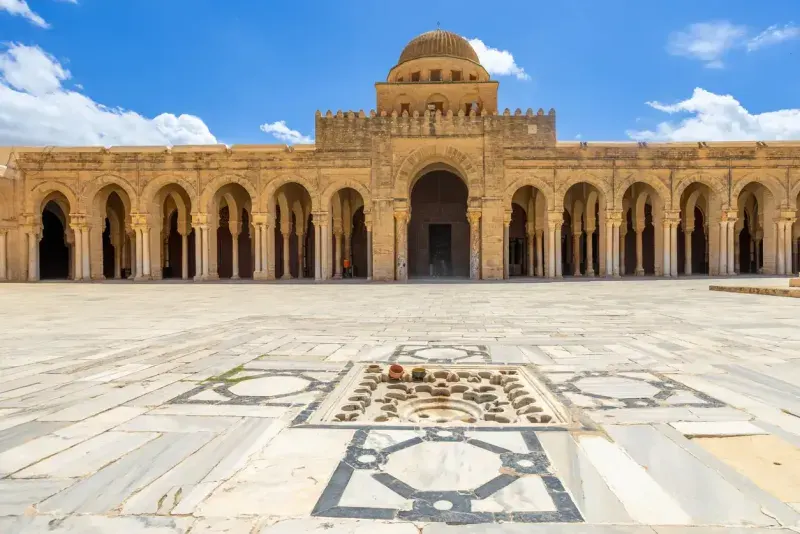
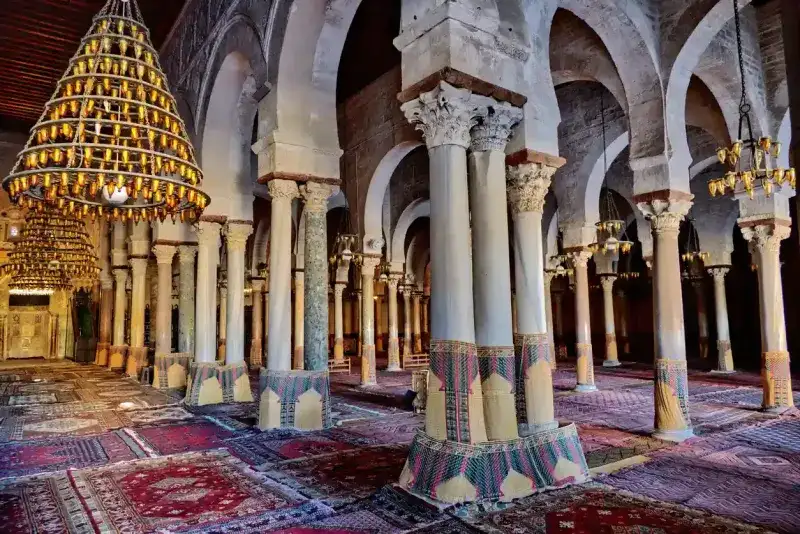
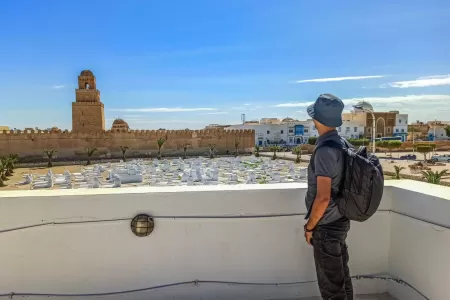
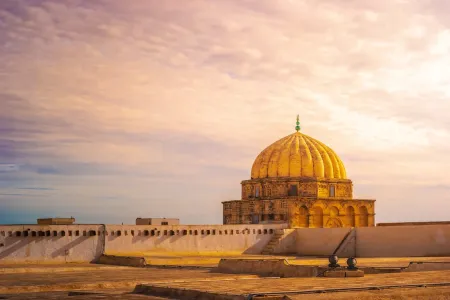
Stone and marble speak across centuries within the Great Mosque's sacred walls. This magnificent structure stretches 125 meters by 75 meters, creating a quadrilateral sanctuary covering approximately 9,000 square meters. Step inside and discover a hypostyle prayer hall where 17 naves rise on columns crafted from marble, porphyry, and granite, each piece carefully salvaged from Roman and Byzantine monuments that once graced this ancient land.
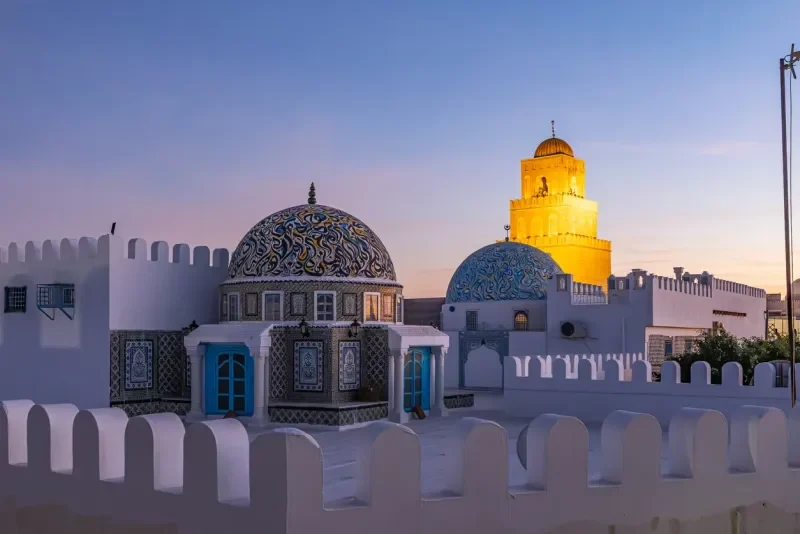
The minaret commands attention as it soars 31.5 meters skyward from its square base measuring 10.7 meters per side, earning distinction as the world's oldest surviving minaret from the 8th-9th centuries. This architectural marvel owes its current form to Aghlabid prince Ziyadat Allah I, who orchestrated the complete reconstruction in 836 CE.
Within the prayer hall, artistry reaches its pinnacle at the mihrab, dating to 862-863 CE. Here, 28 panels of pierced marble create intricate patterns, surrounded by lustrous ceramic tiles that likely originated from distant Iraq. Adjacent stands the minbar, constructed around 862 from over 300 pieces of Indian teak, making it the oldest surviving Muslim preacher's chair.
The Mosque of the Three Doors
Muhammad ibn Khairun al-Ma'firi al-Andalusi commissioned this architectural jewel in 866 CE, creating what remains the oldest decorative façade in Islamic architecture. Three horseshoe arches gracefully rest upon reused ancient columns, while carved floral motifs and Kufic script inscriptions dance above[123]. The façade bears sacred Quranic excerpts from Surah 33:71 and Surah 30:4, alongside a foundation inscription that tells the mosque's origin story. Centuries later, during the Hafsid period in 1440, craftsmen added a minaret featuring double-arched windows framed with decorative tilework.
Zawiya of Sidi Sahib (The Barber's Mosque)
This 17th-century complex shelters the tomb of Abu Zama'a al-Balawi, who met his fate in 654. The current structure emerged from renovations initiated by Hammuda Pasha in 1629, with further expansions completed by Muhammad ibn Murad between 1681 and 1695. Qallalin tiles, carved stucco, and Italian marble columns create a visual feast that honors the sacred occupant within.
Aghlabid Basins: Islamic Engineering Marvel
Between 860 and 862, under the reign of Abu Ibrahim Ahmad, engineers created a water supply system that defied the harsh North African climate. The smaller basin spans 37.4 meters in diameter, containing 4,000 cubic meters of precious water. This carefully filtered supply then flowed into the larger basin, measuring 128 meters across and holding over 57,000 cubic meters. This ingenious filtration system stands as one of medieval Islam's most remarkable hydraulic achievements, ensuring Kairouan's survival in an arid landscape.

Exploring the Medina and Traditional Souks
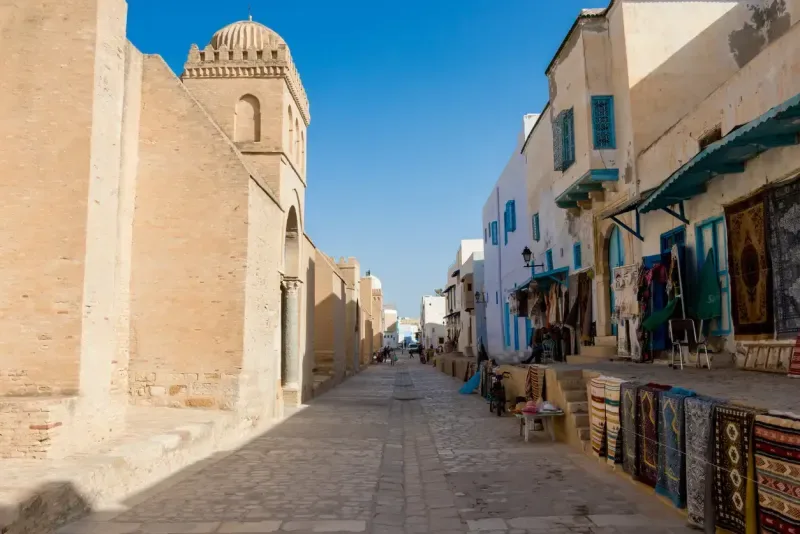
Step through the UNESCO-listed Medina and discover narrow passageways so authentic they served as Cairo's backdrop in Raiders of the Lost Ark. These ancient streets reveal a fascinating cultural tapestry where three distinct communities, Bedouins, Berbers, and Arabs, have woven their identities into the very architecture. Each doorway tells its story through distinctive designs: ring doorknockers mark Bedouin homes, while hands of Fatima protect Berber households, and Arabic script adorns Arab residences. Notice the emerald-painted doors scattered throughout the district; each one signals a mosque within these sacred walls.
Carpet Weaving Workshops
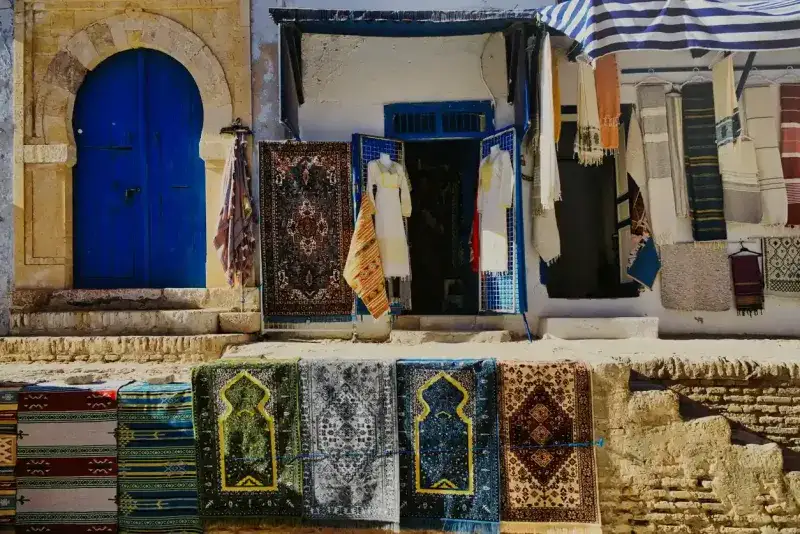
Kairouan's reputation as Tunisia's carpet-making capital rests on an art form that demands extraordinary patience and skill. Witness master weavers whose fingers dance across looms, creating textiles graded by their intricate knot density. Standard carpets contain between 10,000 and 40,000 knots per square meter, while fine examples showcase 65,000 to 90,000 knots compressed into the same space. The most exceptional pieces, those classified as extra fine, boast an astounding 160,000 to 500,000 knots per square meter, with silk carpets occasionally exceeding half a million knots. Workshop visits offer mesmerizing glimpses into this ancient craft, though artisans naturally hope their demonstrations lead to purchases.
Local Cuisine and Makroudh Pastries
Taste buds awaken to Makroudh, Kairouan's beloved signature pastry that transforms simple ingredients into pure indulgence. Date-filled semolina dough receives a golden frying before luxurious honey syrup creates the final sweet coating. The artistry extends beyond flavor, traditional wooden molds, some crafted over two centuries ago, press intricate patterns inspired by the geometric stucco work adorning local mosques. Seek out Makroudh Rqaya near the Aghlabid Basins for the most exceptional examples of this time-honored treat.
Practical Information for Visitors
Respectful attire becomes essential when approaching religious sites shoulders and knees require coverage to honor sacred spaces. The city maintains its welcoming atmosphere well into evening hours, making twilight strolls both safe and enchanting. The summer months of July and August bring scorching temperatures reaching 38°C, testing even the most heat-tolerant travelers. Plan your journey during the gentler seasons of March through April or October through November, when pleasant weather allows comfortable exploration of this remarkable destination.

Kairouan stands apart among the world's sacred destinations, holding secrets that few pilgrimage sites can match. This ancient city weaves together threads of faith, scholarship, and culture into a tapestry that has endured for over thirteen centuries. Every corner of the medina bears witness to Islam's remarkable expansion across North Africa, while the call to prayer still echoes from minarets that have watched over countless generations of believers.
The profound spiritual heritage here transcends simple tourism. Visitors encounter living traditions where artisans still craft carpets using techniques passed down through centuries, where ancient recipes create pastries that taste exactly as they did in medieval times, and where mosque architecture continues to inspire Islamic design worldwide. Such authentic cultural immersion becomes increasingly rare in our modern age.
Spring and autumn months reveal Kairouan at its most welcoming, when comfortable temperatures allow unhurried exploration of narrow alleyways and peaceful contemplation within sacred courtyards. During these seasons, the city's true character emerges neither overwhelming nor underwhelming, but perfectly balanced between reverent silence and vibrant daily life. Few destinations offer such a genuine connection to Islamic civilization's foundational chapters, making Kairouan a pilgrimage worthy of its legendary status.

Is Kairouan worth visiting?
Absolutely yes! Kairouan is Islam's 4th holiest city and a UNESCO World Heritage Site. I'll experience the magnificent Great Mosque (world's oldest minaret), explore the authentic medieval medina, watch master carpet weavers, taste traditional Makroudh pastries, and see Aghlabid Basins (9th-century engineering marvel). Authentic Tunisian culture without tourist crowds. Best visited March-April or October-November. Essential for Islamic history and North African culture enthusiasts.
Why is Kairouan famous?
Kairouan is famous as Islam's 4th holiest city (after Mecca, Medina, and Jerusalem). Founded in 670 CE first permanent Islamic settlement in North Africa. Seven pilgrimages here equal one hajj to Mecca (local tradition). Houses the Great Mosque, North Africa's oldest mosque, and an architectural blueprint for all Maghreb mosques. Major Islamic scholarship center (9th-11th centuries). Renowned for Tunisia's finest carpets. UNESCO World Heritage medina since 1988.
Who is buried in Kairouan?
Abu Zama'a al-Balawi (Sidi Sahib/"The Barber") is buried in Kairouan's Zawiya of Sidi Sahib mosque. He was Prophet Muhammad's companion who died in battle in 654. Legend says he carried three sacred hairs from Prophet Muhammad's beard, buried with him. This makes his tomb deeply sacred—pilgrims visit for blessed proximity to the Prophet's legacy.
Which language does Kairouan speak?
Kairouan speaks Tunisian Arabic (primary language) and Modern Standard Arabic (mosques, formal settings). French is widely spoken as a second language in tourism and business. English is less common but understood at major sites like the Great Mosque. Learning basic Arabic phrases ("Salam aleikum," "Shukran") is appreciated in this sacred city.
Is Tunisia safe for non-Muslims?
Yes, Tunisia is very safe for non-Muslims. Tunisia is moderate and tolerant, with a strong tourism industry welcoming all visitors. I can visit mosques (the Great Mosque allows non-Muslim entry outside prayers), and explore medinas freely. I should dress modestly at religious sites (cover shoulders/knees), remove shoes in mosques, and respect prayer times. Tunisians are welcoming to Western tourists. Tunisia has Jewish and Christian minorities. Same basic safety precautions as any destination apply.