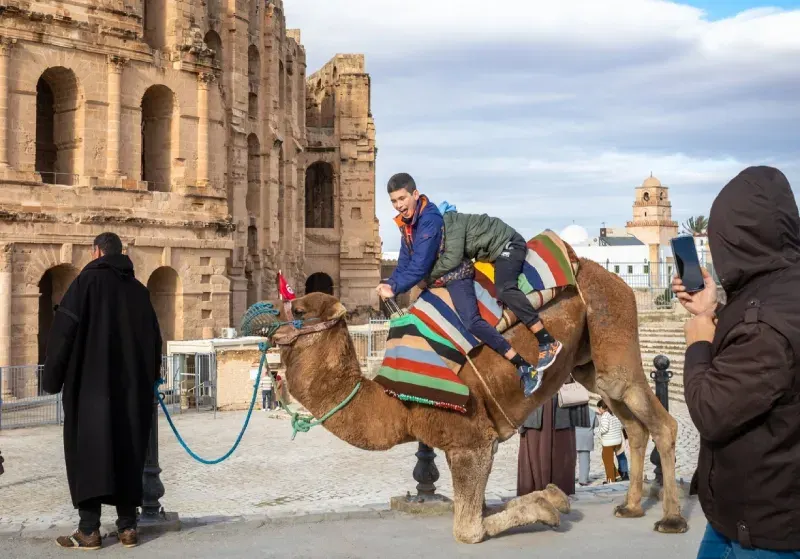
![Two boys on a camel with a striped saddle blanket in front of the Roman amphitheater of El Jem, a day trip from Sousse.]()
Table of Contents:
1- What makes Sousse worth exploring beyond its beaches?
2- Where can you enjoy the coast in and around Sousse?
3- How can you experience local life in Sousse?
4- What should you know before booking your Sousse trip?
5- Is Sousse the right Mediterranean escape for you?
Sousse, Tunisia is worth exploring for its history: a Phoenician trading post, a Roman provincial capital and a 9th-century Aghlabid stronghold all meet in one walled old town. A short walk through the medina covers nearly 3,000 years of Mediterranean history.
Where Sousse sits on Tunisia’s Mediterranean coast
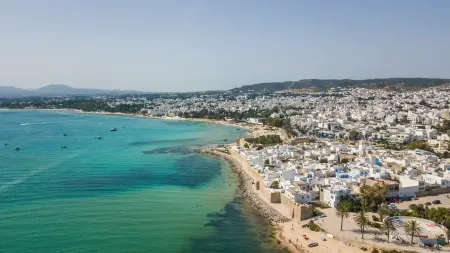
Sousse, Tunisia sits on the Gulf of Hammamet, a sheltered part of the Mediterranean Sea on the country’s Sahel coast. The city covers 45 km² and stands 25 meters above sea level, between the Wadi Bliban to the north and the Wadi al-Halluf to the southeast.
Rail lines link Sousse, Tunisia with Tunis, Sfax and Kasserine, and louages (shared minivans) reach most other towns.
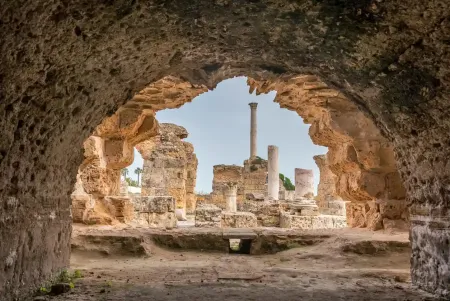
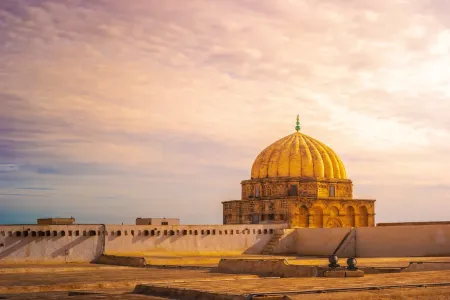
Practical fact: Monastir is just 20 km away, while El Jem’s Roman amphitheater and Kairouan are each roughly 60 km away, so Sousse works well as a base for day trips.
From ancient Hadrumetum to an Aghlabid port
Sousse, Tunisia began as Hadrumetum, a trading post that Phoenicians from Tyre founded around the 11th century BC, before Carthage itself. It later helped Rome in the Third Punic War and won special privileges. Hannibal also used it as a base during the Second Punic War.
Under Rome, Hadrumetum became Roman Africa’s second city after Carthage and the capital of Byzacena province. The ancient city beneath Sousse, Tunisia was sacked by the Vandals in 434 and retaken by the Byzantines in 534.
The 7th-century Arab conquest almost completely destroyed the old city. The Aghlabids later rebuilt it as Susa, and in 827 they launched their invasion of Sicily mainly from the harbor of Sousse, Tunisia.
Why the Medina of Sousse has UNESCO status
The medina of Sousse, Tunisia has UNESCO status because it is a rare, well-kept early Islamic coastal town built to resist pirates. UNESCO inscribed it in 1988 and approved a minor boundary change in 2010.
The site covers 31.68 hectares, with a 60.99-hectare buffer zone. UNESCO notes that Sousse, Tunisia, together with the Medina of Monastir, is the only surviving prototype of coastal military architecture from the first centuries of Islam.
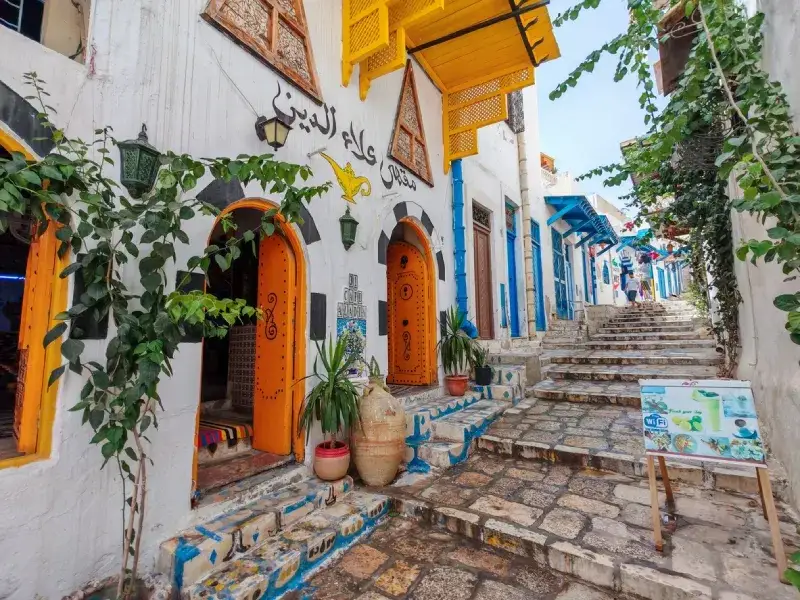
Its planned layout still runs from Bab el Kabli to the ribat, and from Bab el Jedid to Bab el Gharbi. Walking the old town of Sousse, Tunisia means following that same early street plan.
The Ribat, Great Mosque and Roman mosaics
The Ribat, the Great Mosque and the Kasbah museum are the three must-see monuments in Sousse, Tunisia. The Ribat was founded in the late 8th century and rebuilt by the Aghlabid emir Ziyadat Allah I in 821.
An inscription dated 821 above its tower door is the oldest surviving Islamic monumental inscription in Tunisia. Climb the tower, the nador, for views across the souk roofs of Sousse, Tunisia and out to sea.
Next door, the Great Mosque of Sousse, Tunisia was built in 851. With its thick walls and no tall minaret, it looks more like a fortress than a mosque.
Up the hill, the Kasbah houses the Sousse Archaeological Museum, which holds Tunisia’s second-largest mosaic collection after the Bardo in Tunis. Entry in Sousse, Tunisia costs about 10 TND in 2026, and the museum is closed on Mondays.
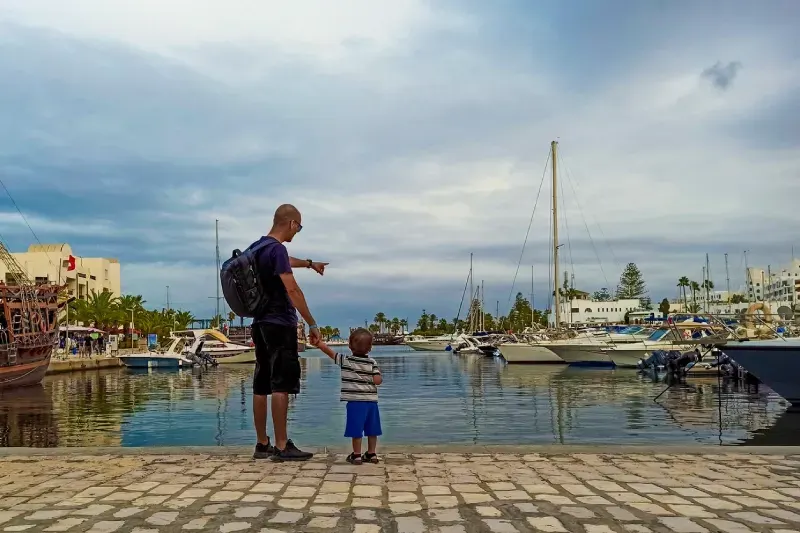
![Father and young son holding hands on the quay at Port El Kantaoui marina, looking out at moored yachts and a pirate-style boat.]()
You can enjoy the coast of Sousse, Tunisia in three main ways: swim at Boujaafar Beach in the city, visit the Port El Kantaoui marina resort, or mix water sports with a relaxing hammam session.
Boujaafar Beach for swimming and seafront walks
Boujaafar Beach runs along the central waterfront of Sousse, Tunisia and is the easiest place to swim or stroll without leaving town.
Practical fact: spend the morning here and the afternoon in the medina, as both sit close together in the city center.
Port El Kantaoui for marina dining and boat trips
Port El Kantaoui is a purpose-built marina resort about 10 km north of central Sousse, Tunisia. It opened in 1979 around an artificial harbor with roughly 340 berths.
Sandy beaches sit on both sides of the marina, and the waterfront is lined with restaurants, cafés, ice-cream shops and boutiques. From this harbor near Sousse, Tunisia, you can book a glass-bottom boat, a pirate-ship cruise or a catamaran trip.
Most trips last 2 to 4 hours, and some include swim stops or dolphin spotting.
Practical fact: a taxi from central Sousse, Tunisia takes 12 to 15 minutes, while Hammam Sousse is only 5 minutes away.
Allow 1 to 2 hours for the marina, or half a day if you add the beach or a boat trip. Prices here are higher than in central Sousse, Tunisia.
Water sports and hammams for active and relaxed days
Port El Kantaoui’s shoreline near Sousse, Tunisia offers several water sports:
jet skiing, parasailing and water skiing
windsurfing, kayaking and sailing
scuba diving and pedal boats
Availability in Sousse, Tunisia depends on the weather and on what each hotel or beach operator offers that day.
Afterward, unwind in a traditional hammam (steam bath). Many hotels in Port El Kantaoui and Sousse, Tunisia run their own hammam and spa, while public hammams in town cost much less. Check hours locally, as some keep separate times for men and women.
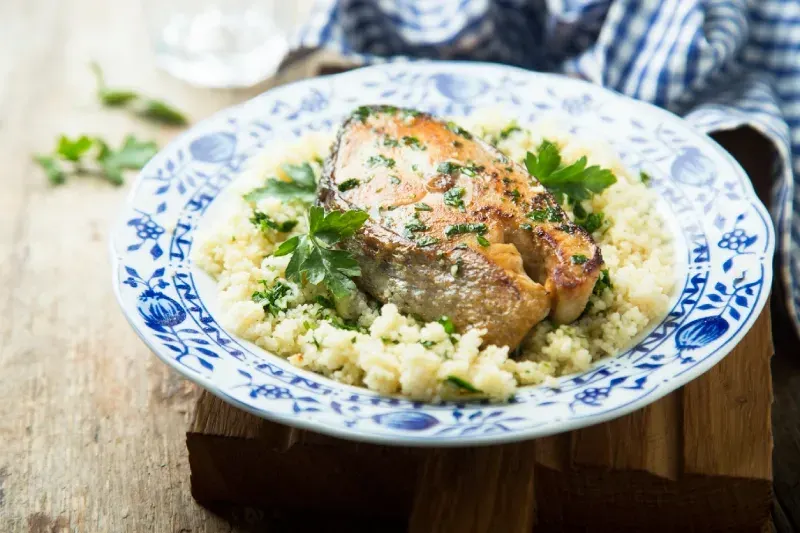
![Pan-seared fish steak on couscous with fresh parsley, served on a blue-and-white Tunisian-style plate.]()
You can experience local life in Sousse, Tunisia through its souks, street food, historic homes and evening cafés. Each one shows a side of the city beyond the beach.
Shopping in the medina souks and bargaining politely
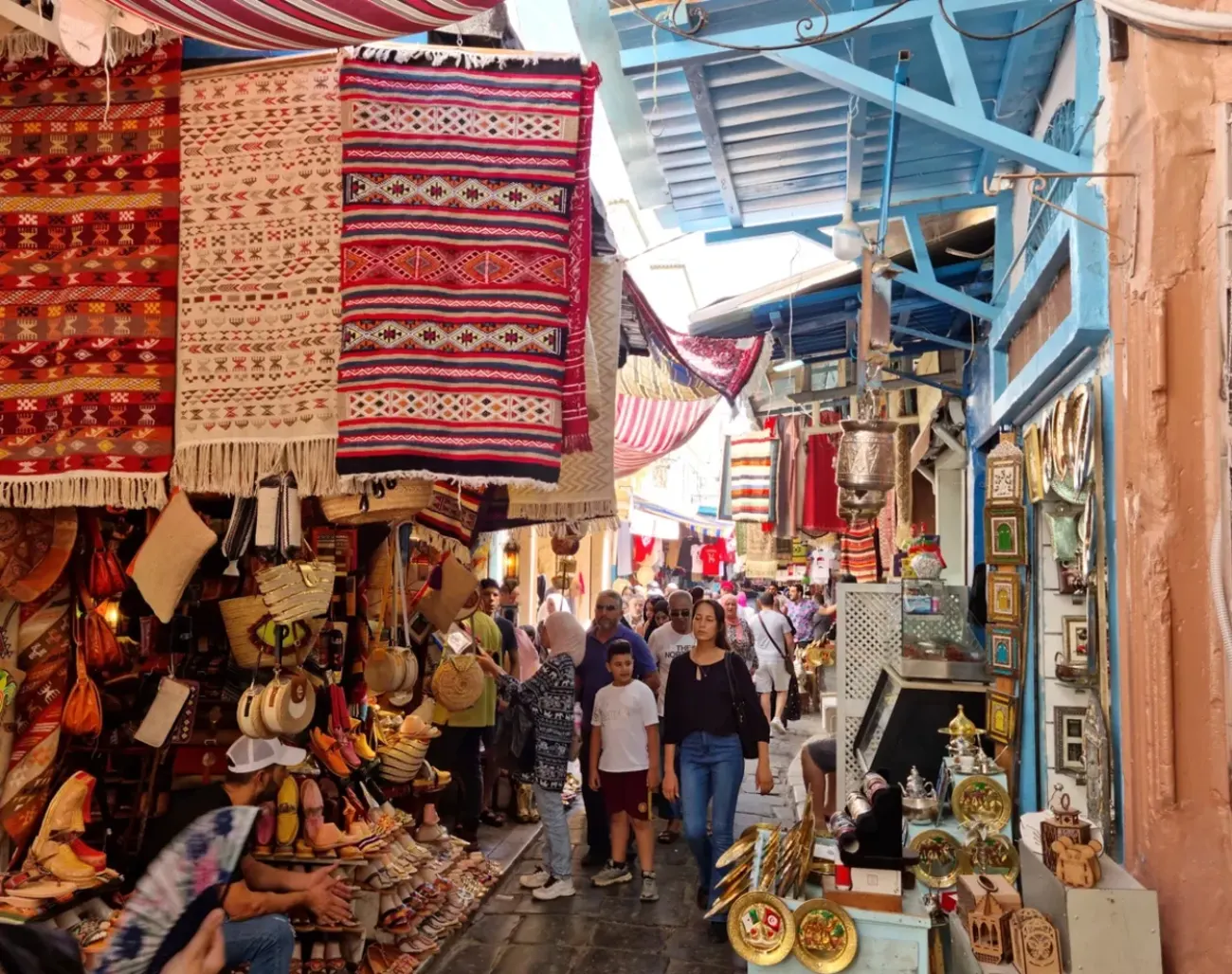
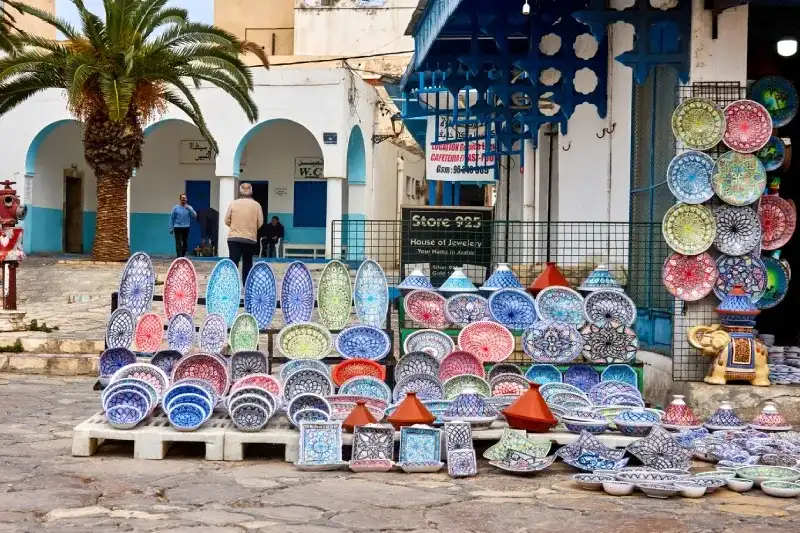
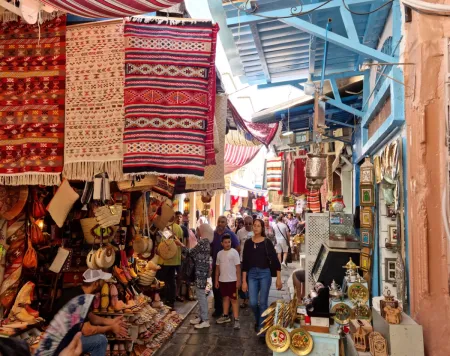
The medina souks of Sousse, Tunisia sell leather goods, ceramics and everyday Tunisian items, and the stalls deeper inside are often more local than those by the gates.
Practical fact: greet the vendor, start your counteroffer at about 40% of the asking price, stay calm and carry small bills. Stall holders in Sousse, Tunisia are less pushy than in many big markets, and modest clothing helps you move through the narrow alleys with less attention.
Trying brik, couscous and fresh seafood
Brik is the snack to try first in Sousse, Tunisia: crisp pastry wrapped around tuna, parsley, capers and a runny egg. At local spots it usually costs 3–6 TND, or roughly €1–2.
Practical fact: bite one corner and tilt the pastry so the yolk runs inward, not down your hand. Fish couscous in a light tomato broth is the other coastal favorite in Sousse, Tunisia.
Prices for fish couscous in Sousse, Tunisia vary a lot with the fish and the setting, and local eateries charge far less than hotel or marina restaurants. A private cooking class costs about 60–150 TND (€18–45) and covers both dishes plus regional seafood recipes.
Visiting Dar Essid to learn about traditional homes
Dar Essid is a house museum in a former aristocratic family home in the medina of Sousse, Tunisia, furnished to show daily life in the 18th and 19th centuries.
Practical fact: entry costs about 5 dinars, and the tower gives wide views over the old town’s rooftops.
Choosing between evening cafés and seasonal nightlife
Evenings in Sousse, Tunisia offer a choice between seafront cafés for mint tea and people-watching, or bars and clubs that fill up in summer.
Practical fact: the medina goes quiet early, so late nights usually move to the hotel strip and the marina.
Customize Your Dream Vacation!
Get in touch with our local experts for an unforgettable journey.
Plan Your Trip
![Hand-painted Tunisian ceramic plates, bowls and tagine pots displayed outside a souvenir shop beside a palm tree.]()
Before booking Sousse, Tunisia, check three things: the season, your airport transfer and the money rules. Spring and early autumn bring the best weather, while Ramadan changes daily schedules.
Best months to visit and how holidays affect opening hours
The best months to visit Sousse, Tunisia are April to June and September to October. Average highs rise from about 21°C in April to about 28°C in June, with little rain.
September is still hot at around 30°C, and October cools to about 26°C. The sea in Sousse, Tunisia stays warm through both months, at roughly 23–25°C.
During Ramadan, restaurants and shops in Sousse, Tunisia often open later, and daytime closures are common even in tourist areas. Ramadan moves about 11 days earlier each year, so check the dates before you book.
Comparison table: Sousse center, the beachfront and Port El Kantaoui by setting, cost and convenience
Sousse center suits tight budgets, the beachfront suits convenience, and Port El Kantaoui suits a resort stay. Here is how the three areas of Sousse, Tunisia compare:
| Area |
Setting |
Cost |
Convenience |
| Sousse center |
Medina and old town |
Budget-friendly |
Walkable, central |
| Beachfront |
Boujaafar Beach |
Mid-range |
Close to medina |
| Port El Kantaoui |
Marina resort |
Higher |
10 km north, taxi needed |
Getting there through Monastir or Enfidha and using local transport
Most visitors reach Sousse, Tunisia through Monastir or Enfidha-Hammamet airport. Monastir airport is about 15 km away and has its own Sahel Metro stop, with trains to Sousse Bab Jedid in about 25–35 minutes for 1–2 TND.
Enfidha-Hammamet airport is about 43 km from Sousse, Tunisia, roughly a 40-minute drive. STS buses link the airport with Sousse a few times a day. You can also take a short taxi to Enfidha town, 10 km away, and catch a train there for a few dinars.
In Sousse, Tunisia, get around on foot in the medina, then use metered taxis, louages or the Sahel Metro for longer trips. Ask the driver to start the meter before you set off.
Building a realistic budget and checking current travel advice
Budget for Sousse, Tunisia in dinars you get on arrival, because bringing Tunisian dinars into or out of the country is not allowed.
There is no limit on foreign currency, but you must declare it at customs if it reaches TND 20,000 or more. To take more than TND 5,000 in foreign cash back out of Sousse, Tunisia, you need that entry declaration, so keep it safe.
Check your government’s current travel advice before booking, as some border regions far from Sousse, Tunisia carry warnings.
![Narrow whitewashed medina alley in Sousse, Tunisia, with orange arched doors, a yellow wooden balcony, potted plants and worn stone steps.]()
Yes, if you want history and beach time in one place, Sousse, Tunisia is a strong choice. It combines ancient ribats and lively souks with fresh seafood and relaxed days by the sea.
Few Mediterranean destinations put history and relaxation this close together. Spend the day in the medina, then head to Port El Kantaoui for the evening. Sousse, Tunisia suits culture lovers and beach seekers alike.
Can visitors use foreign bank cards in Sousse?
Yes. Most ATMs in Sousse, Tunisia accept Visa and Mastercard. Limits and fees depend on the bank, often a few hundred dinars per withdrawal and a fee of around TND 10.
What plug adapter should you pack for Tunisia?
Pack a Type C or Type E adapter for Sousse, Tunisia. The supply is 230V, 50Hz, so most dual-voltage phone chargers and laptops need only a simple adapter, not a converter.
Do I need a visa to visit Sousse, Tunisia?
Many visitors do not. Citizens of the UK, the US, Canada and most EU countries can visit Sousse, Tunisia visa-free for up to 90 days. Check the rules for your passport before you fly, and make sure it is stamped on arrival.
Is Sousse, Tunisia safe for tourists?
Yes, Sousse, Tunisia is generally safe for tourists, and tourist police patrol the medina, the beachfront and the hotel areas. The main risks are petty theft and taxi overcharging, so keep valuables out of sight and agree on the meter or fare first.
What language do people speak in Sousse, Tunisia?
People speak Tunisian Arabic, and French is widely used, especially in hotels and restaurants. English is common in the tourist areas of Sousse, Tunisia but less so elsewhere, so a simple “aslema” (hello) and “yaishek” (thank you) go a long way.
How many days do you need in Sousse, Tunisia?
Three to four days suits most visitors. That gives you a day in the medina, a beach or marina day, and a day trip from Sousse, Tunisia to El Jem or Kairouan. El Jem is about an hour away by train.