Table of content
#History
#How does gorilla trekking work in Volcanoes National Park?
#Wildlife in Volcanoes National Park
#What to do in Volcanoes National Park
#Best time to visit Volcanoes National Park
#How do you get to Volcanoes National Park?
#Where to stay
#Rwanda vs. Uganda: where should you go gorilla trekking?
#FAQS
Volcanoes National Park is a 160 km² protected area of rainforest and bamboo in northwestern Rwanda, about 2–3 hours by road from Kigali. It protects the Rwandan side of the Virunga Massif, a chain of volcanoes shared with Uganda and the Democratic Republic of Congo, and covers five of its eight volcanoes. The park’s slopes rise from farmland at about 2,400 m to the 4,507 m summit of Karisimbi, passing through bamboo forest, hagenia woodland, giant lobelias and alpine meadows.
It is one of the best places in the world to see mountain gorillas, as more than half of the world’s remaining mountain gorillas live in the Virunga area. The park is also home to endangered golden monkeys. Rwanda’s tourism model of high permit prices and small groups funds both conservation and local communities, with part of every permit fee going to villages bordering the park.
The park began in 1925 as a small protected area between Karisimbi, Bisoke and Mikeno, created to protect gorillas from poachers. It soon became part of Albert National Park, the first national park in Africa. After the Congo and Rwanda became independent in the early 1960s, the area was divided, and the Rwandan section became Volcanoes National Park.
The park became world-famous through the American primatologist Dian Fossey. She founded the Karisoke Research Center between Karisimbi and Bisoke in 1967 and spent nearly two decades studying the gorillas. Her book Gorillas in the Mist and her murder in 1985 drew global attention to poaching.
Since then, gorilla numbers in the Virungas have more than doubled. To give the growing population more room, Rwanda is expanding the park by about 23%. The government is resettling affected families in new “green villages.” Every September, the Kwita Izina ceremony names the year’s newborn gorillas. In 2026, 22 baby gorillas were named.
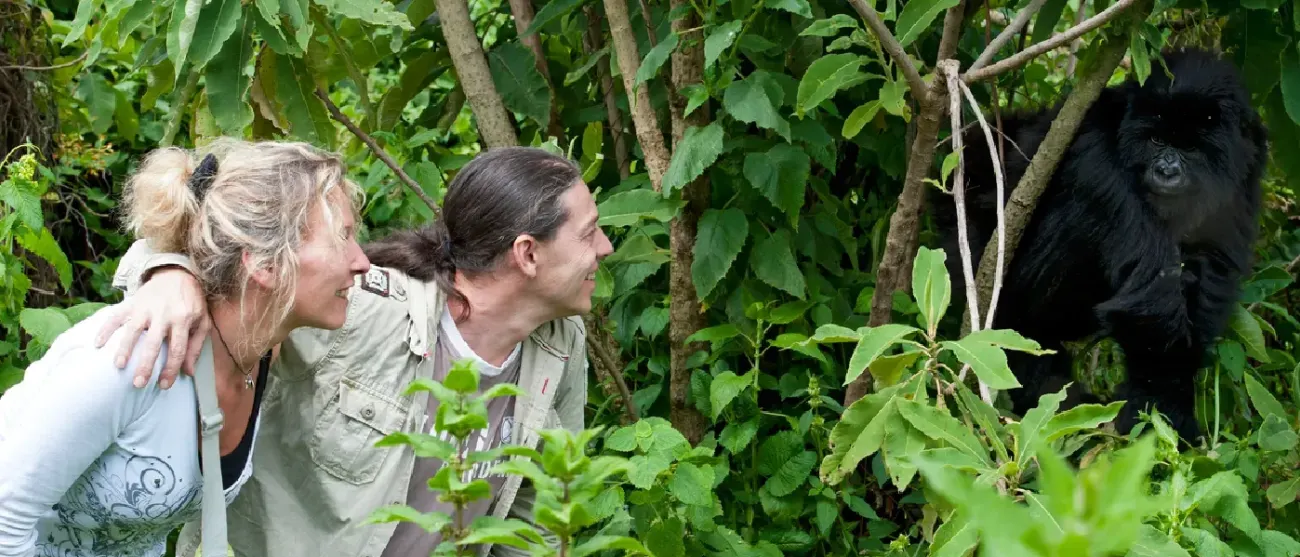
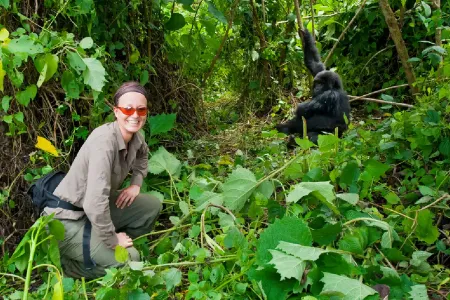
Gorilla trekking is a guided hike to find one of about 12 habituated gorilla families, followed by one hour in their presence. Each family receives a maximum of eight visitors per day. That limits the total to around 100 permits a day across the park.
The day begins at 7:00 am at the park headquarters in Kinigi. Visitors watch a cultural dance performance and receive a briefing. Rangers then assign each person to a gorilla family based on fitness and preference.
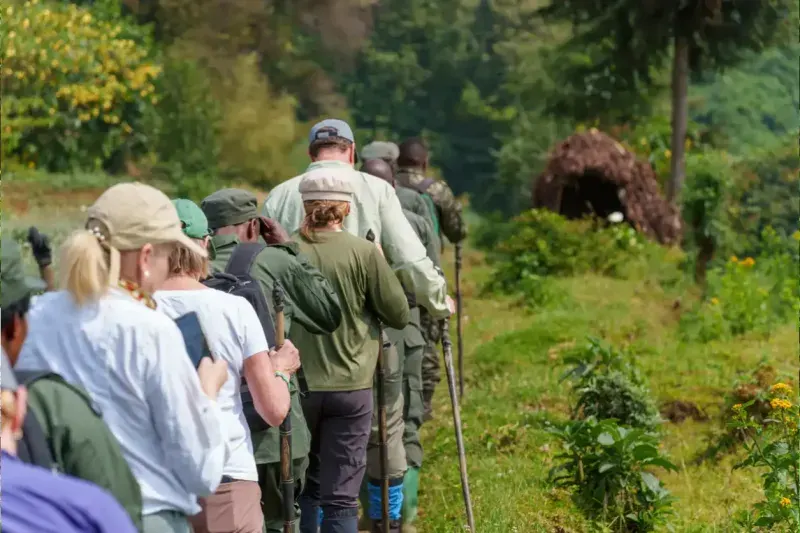
After a short drive to the trailhead, you hike through farmland and into the forest with a ranger guide. Trackers go ahead to locate the group. Treks take between 1 and 6 hours round trip, depending on where the gorillas are that day.
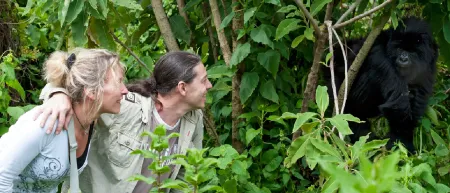
Once you reach the family, you stay about 7 m away while watching silverbacks, mothers and infants feed, play, and rest. Visitors must be at least 15 years old, and anyone with a cold or illness should not trek, because gorillas can catch human diseases.
Memphis Tours visitor note: Tell the rangers at the briefing how fit you are. They can match you with a family that is closer or farther away, so you aren’t stuck on a 5-hour climb you didn’t expect.

Animals
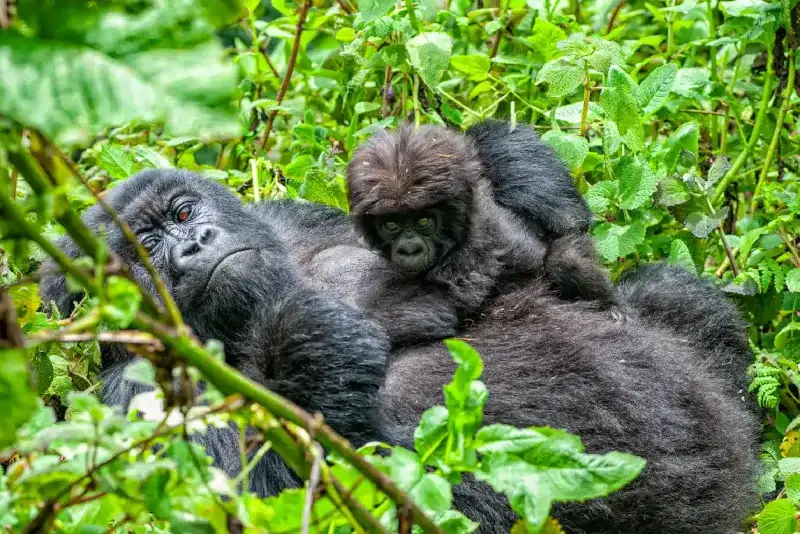
Mountain gorillas are the park’s flagship species. A gorilla family typically includes one or more silverbacks, several adult females, and their young.
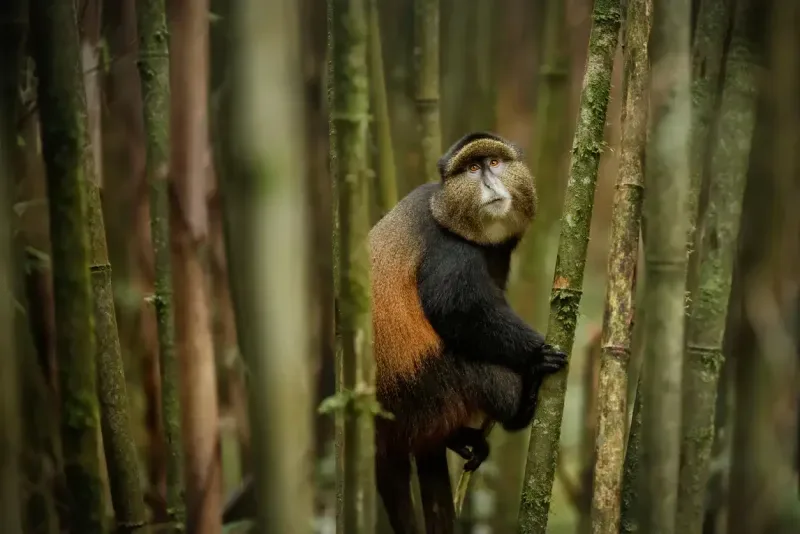
The second highlight is the golden monkey. This striking orange-and-grey primate is endangered and found only in the Albertine Rift highlands. Golden monkeys live in bamboo forest and move constantly, which makes treks to see them lively and great for photography.
Other mammals include:
- Larger animals: buffalo, bushbuck, black-fronted duiker, spotted hyena, bushpig and giant forest hog
- Rare visitors: a small number of forest elephants live in the park but are seldom seen
Ready to meet the gorillas? See mountain gorillas in Volcanoes National Park on our 4-day Short but Sweet Rwanda Retreat
Birdlife
The park has recorded about 200 bird species, including more than a dozen Albertine Rift endemics found nowhere else. It is one of Rwanda’s Important Bird Areas.
Highlights include the Rwenzori turaco, handsome francolin, Rwenzori batis, strange weaver, dusky crimson-wing, collared apalis, red-faced woodland warbler, Archer’s ground robin, and the rare Grauer’s swamp warbler, which lives in high-altitude marshes. Guided birding walks along the park edge and in the bamboo zone give the best chances of sightings.

Customize Your Dream Vacation!
Get in touch with our local experts for an unforgettable journey.
Plan Your Trip
Beyond gorilla trekking, Volcanoes National park offers some of Rwanda’s best hiking and primate experiences. Most visitors stay 2–3 nights to add one or two of these.
- Golden monkey trekking: A morning trek of 1–3 hours into the bamboo forest, with one hour spent with a habituated troop.
- Dian Fossey tomb hike: A 3–4 hour round-trip climb to the ruins of the Karisoke Research Center and to Fossey’s grave, which lies beside the graves of the gorillas she studied.
- Mount Bisoke hike: A steep day hike of about 6 hours to the 3,711 m summit and its crater lake.
- Mount Karisimbi climb: A 2-day trek with an overnight camp, reaching Rwanda’s highest point at 4,507 m.
- Cultural and nearby experiences: Visit the Iby’Iwacu cultural village or the Musanze Caves, or take a boat trip on the twin lakes of Burera and Ruhondo.

The best time to visit is during the two dry seasons, June to September and December to February. Trails are less muddy, and hiking is easier. Gorilla trekking runs year-round, though, and the rainy months bring lush scenery and easier permit availability.
| Season |
Months |
Trail conditions |
Notes |
| Long dry season |
June–September |
Driest, easiest |
Peak demand; book permits 4–6 months ahead |
| Short rains |
October–November |
Muddy, slippery |
Fewer visitors |
| Short dry season |
December–February |
Mostly dry |
Busy over holidays |
| Long rains |
March–May |
Wettest, steep mud |
Lush forest; some lodges offer discounts |
Daytime temperatures are usually 20–25°C. Nights in Kinigi can drop to around 10°C, and it is much colder higher up the volcanoes.
Volcanoes National Park lies about 110 km north-west of Kigali, a scenic drive of 2–3 hours on paved roads to Musanze and the Kinigi headquarters. Most visitors arrive at Kigali International Airport and transfer by road the day before trekking. Helicopter transfers are also available for travellers in a hurry. The park also connects easily to Lake Kivu, about 1.5–2 hours west at Gisenyi.
Most lodges are around Kinigi, close to the park headquarters, so visitors can make the 7:00 am briefing without a long drive. Accommodation ranges from luxury eco-lodges such as Bisate, Singita Kwitonda and Sabyinyo Silverback Lodge to mid-range options like Da Vinci Gorilla Lodge. Budget hotels in Musanze town are about 30 minutes away.
Rwanda is faster and easier, while Uganda is cheaper and offers longer encounters.
| |
Volcanoes NP, Rwanda |
Bwindi NP, Uganda |
| Permit (foreign non-resident) |
US$1,500 |
US$800 |
| Access |
2–3 hours by road from Kigali |
8–9 hours by road from Entebbe, or a domestic flight |
| Terrain |
Open bamboo and volcanic slopes |
Dense, steep rainforest |
| Extra options |
Golden monkeys, volcano hikes |
4-hour gorilla habituation experience |
| Best for |
Short trips, comfort |
Budget, longer gorilla time |
Discover the wonders of Rwanda with our Rwanda safari tours and African safari tours!
How many days do you need in Volcanoes National Park?
Two to three nights in Volcanoes National Park is ideal. That allows a gorilla trek plus golden monkey trekking or a volcano hike.
Can you visit Volcanoes National Park without a gorilla permit?
Yes. Volcanoes National Park offers golden monkey treks, volcano hikes, nature walks and cultural tours, each with its own permit.
Is Volcanoes National Park good for families with children?
Yes, for children over 12, who can join golden monkey treks and some nature walks in Volcanoes National Park. Gorilla trekking requires a minimum age of 15.
What birds can you see in Volcanoes National Park?
Volcanoes National Park has about 200 bird species, including Albertine Rift endemics such as the Rwenzori turaco, handsome francolin and Rwenzori batis.
What can I combine with a visit to Volcanoes National Park?
Volcanoes National Park combines well with:
- Lake Kivu, about 2 hours west
- the Twin Lakes of Burera and Ruhondo
- Kigali city
- Akagera National Park, for a savanna safari
What should I pack for Volcanoes National Park?
For Volcanoes National Park, pack waterproof hiking boots, a rain jacket, warm layers for cold evenings, long trousers, gardening gloves, and a reusable water bottle.