Pyramid of Khufu: The Oldest Wonder of the Ancient World

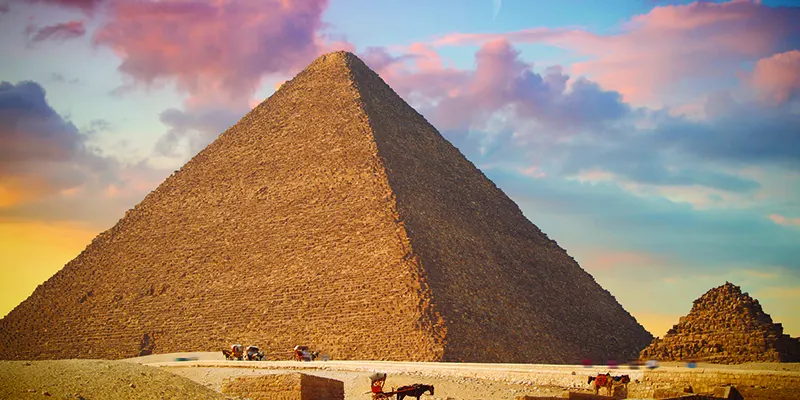
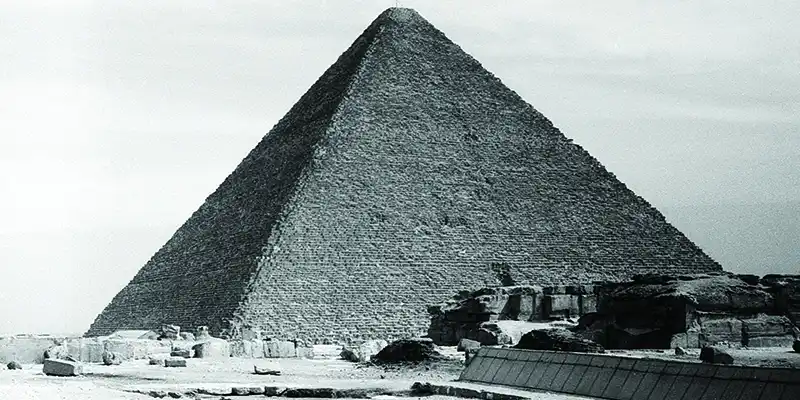
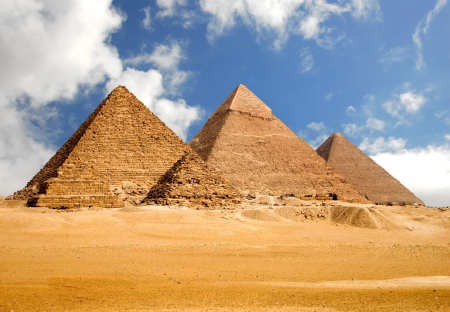
The pyramid of Khufu towers over the Giza plateau as Egypt's largest pyramid. This colossal structure dominates the landscape with its massive presence. Workers completed this architectural marvel around 2600 BC after 26 years of construction. The pyramid reached a height of 146.6 meters (481 feet) and remained the world's tallest human-made structure for more than 3,800 years. The steeple of Old St. Paul's Cathedral in London finally surpassed it in 1221 CE, standing just 2.4 meters (8 feet) taller.
People also call it the Great Pyramid or Cheops pyramid. This ancient wonder uses about 2.3 million massive stone blocks that weigh roughly 6 million tons combined. The base spans 230.3 meters (755.6 ft) on each side and creates a volume of about 2.6 million cubic meters. The builders achieved remarkable precision - the four sides differ in length by only 4.4 cm (1¾ inches). Their extraordinary skill shines through this accuracy, accomplished without any modern tools or technology. This piece will explore how ancient Egyptians built this oldest surviving wonder of the ancient world, from its beginnings to its complex internal design.
The Pyramid of Khufu is the largest pyramid in Egypt and the only surviving wonder of the ancient world, built around 2600 BC on the Giza Plateau.
It earned this status due to its massive scale, precise construction, and the advanced engineering techniques used without modern technology.
Pharaoh Khufu, Snefru and Queen Hetepheres's son, ruled as the second king of Egypt's 4th dynasty from 2589 to 2566 BCE. The Greeks knew him as Cheops, and he built what would later become the oldest wonder of the ancient world. His complete name "Khnum-Khufu" honors the ram-headed deity of fertility and water, meaning "Khnum protects me".
The ancient Egyptians didn't use today's tourist names. They called this magnificent structure "Akhet Khufu," which means "Horizon of Khufu". This name carried deep meaning since the pyramid was Khufu's gateway to paradise. The builders placed this massive monument on the Giza plateau's highest point to make it visible from great distances.
The pyramid primarily served as Khufu's royal tomb. Egyptian funeral customs required four key purposes: a home for the pharaoh's body, a symbol of his power, a way to keep his social status, and a place where people could leave offerings.
Greek historian Herodotus painted Khufu as a harsh ruler, but Egyptian records show him as a wise leader. His funeral cult grew stronger through the centuries and became quite popular during Roman times. The pyramid's perfect arrangement with cardinal directions and its original white limestone exterior showed its connection to the sun god Re, which reflected Egyptian beliefs about life after death.
Pharaoh Khufu was the second ruler of Egypt’s Fourth Dynasty and the son of King Snefru. He commissioned the Great Pyramid as his royal tomb.
The pyramid served as Khufu’s tomb and as a spiritual gateway to the afterlife, reflecting ancient Egyptian beliefs about immortality and divine kingship.
The massive Pyramid of Khufu's construction demanded meticulous planning of materials, labor, and design. Builders used limestone from the Giza plateau as their main material, while Tura quarries' fine white limestone, located 13-17km away, created the outer casing. The King's Chamber, passages, and sarcophagus required granite transported from Aswan, 934km upstream.
Modern research contradicts Herodotus's claim of 100,000 slaves. The pyramid's workforce consisted of about 4,000 skilled workers who quarried stone, hauled materials, and crafted masonry. These craftsmen worked alongside 16-20,000 support workers who made tools and supplied food. Workers earned their wages through daily rations that included ten loaves of bread and beer.
The construction teams lined up in a clear hierarchy. Two major divisions split into smaller groups of 200 men each. DNA evidence reveals that workers came from all parts of Egypt, making this a national endeavor that strengthened the country's unity.
The builders moved stones weighing 2.5 tons on sledges. They wet the sand beneath these sledges, which cut friction by 50%. The Nile River and artificial waterways served as transport routes for materials. The construction achieved remarkable accuracy - the pyramid's sides line up with true north, showing only 2'28" deviation.
Khufu's vizier and nephew, Hemiunu, led this remarkable achievement as the project's architect.
The pyramid was built using limestone and granite blocks transported via the Nile, moved on sledges over wet sand, and assembled with remarkable precision.
No, archaeological evidence shows that skilled, paid workers from across Egypt built the pyramid as part of a well-organized national project.
Get in touch with our local experts for an unforgettable journey.
Plan Your Trip
Khufu's pyramid has a complex network of passages and chambers inside that still leaves archeologists puzzled. This monument stands apart from simpler pyramids with its three main chambers linked by an intricate corridor system. Visitors can enter through the original entrance (now sealed) or Al-Mamun's forced tunnel from the 9th century CE. The first thing they see is a descending passage that leads to an unfinished underground chamber carved into bedrock.
The Grand Gallery stands as the pyramid's most remarkable feature. This ancient engineering marvel stretches 46.71 meters long with granite walls and a corbelled ceiling that reaches 8.74 meters high. This impressive corridor connects to the misleadingly named "Queen's Chamber" and ends up at the "King's Chamber," which builders made entirely from rose granite brought from Aswan.
An empty granite sarcophagus sits in the King's Chamber, which has two narrow "air shafts" that extend to the pyramid's exterior. The Queen's Chamber has two similar shafts, but these oddly stop before reaching outside.
Recent technology has shown us more hidden features. Scientists found a large void above the Grand Gallery using muon radiography in 2016. This space extends at least 30 meters in length. More recently in 2022, researchers found a corridor-shaped structure behind the northern entrance.
The five "relieving chambers" above the King's Chamber might be the most fascinating feature. Builders designed these to spread out the massive weight of the stone above and keep the chamber from collapsing.
The Pyramid of Khufu proves ancient Egyptian ingenuity and ambition. This colossal structure has captivated scholars and visitors for 4,500 years with its remarkable precision and grand scale. Building such a massive monument without modern technology shows the extraordinary skills of ancient Egyptians.
We learn much about Pharaoh Khufu from this pyramid, despite limited historical records of his reign. The structure served as more than just a tomb - it was his gateway to the afterlife. Its name "Akhet Khufu" or "Horizon of Khufu" reflected its deeper purpose as a spiritual connection that dominated the Egyptian landscape.
Skilled paid workers, not slaves, built this wonder through incredible organization. These teams moved massive stone blocks across great distances in a national project that united people from all parts of Egypt. Their collaborative effort achieved engineering feats that remained unmatched for thousands of years.
The pyramid's internal design reveals fascinating features with its network of passages, grand gallery, and mysterious chambers. Each architectural element played specific roles in Egyptian funerary traditions while showcasing brilliant engineering. Many questions still puzzle researchers about certain features like the unfinished chambers and mysterious shafts.
Modern technology unveils new secrets about this ancient wonder constantly. Recent findings of hidden voids and corridors show that the pyramid guards some mysteries closely, even after centuries of study. The world's oldest wonder connects us to our distant past and reminds us of our ancestors' extraordinary capabilities.
Inside are the King’s Chamber, Queen’s Chamber, the Grand Gallery, underground passages, air shafts, and mysterious voids still being studied today.
Explore the wonders of Giza Necropolis Egypt, including the Great Pyramid, Sphinx, and ancient tombs in this ultimate traveler's guide.
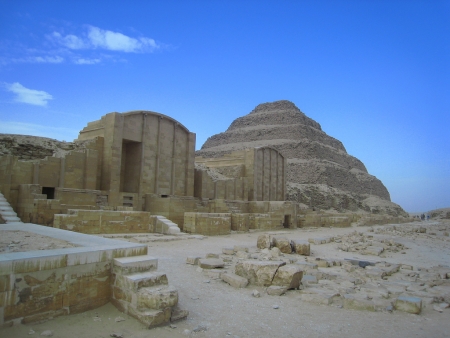
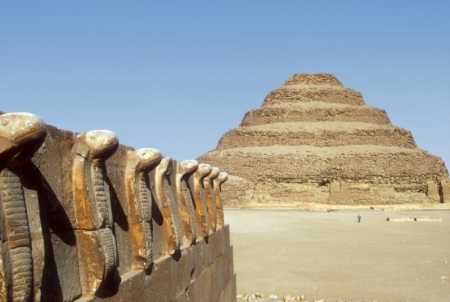
Explore Saqqara Pyramids Egypt, including the iconic Step Pyramid and ancient tombs. Dive into the mysteries of this legendary site now.
Discover the ultimate Egyptian Pyramids Guide with facts on history, construction, and locations to plan your unforgettable adventure.
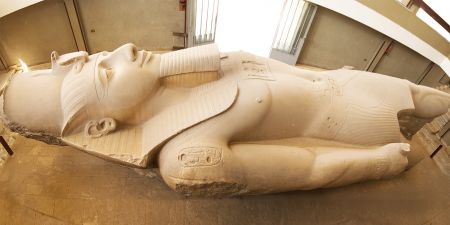
The City of Memphis was one of the oldest and most important cities in ancient Egypt. Located at the entrance to the Nile River Valley near the Giza plateau, it served as the capital of ancient Egypt.
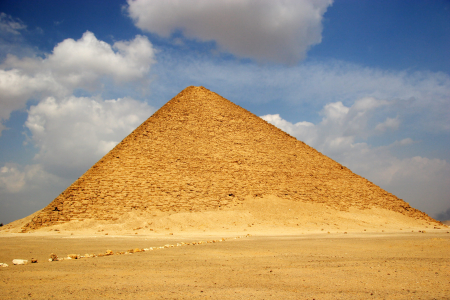
The Dahshur pyramids, located southwest of Cairo, are among Egypt’s most important ancient monuments and home to the iconic Red Pyramid. As part of the historic Dahshur necropolis, they offer a quiet, uncrowded glimpse into early pyramid architecture.
The Pyramid of Khufu, also known as the Cheops Pyramid, is the oldest and largest pyramid in Egypt, located on the Giza Plateau. Built around 2600 BC, it is the only surviving wonder of the ancient world and a symbol of ancient Egyptian engineering.
The Pyramid of Khafre is a remarkable Giza monument with hidden chambers, secret passages, and fascinating facts beyond its exterior.
The Pyramid of Menkaure in Giza is small yet fascinating, revealing granite design, hidden chambers, and discoveries inside.
The Red Pyramid at Dahshur, Egypt, is Sneferu’s architectural masterpiece. Discover its history, design, chambers, and role in ancient Egyptian civilization.
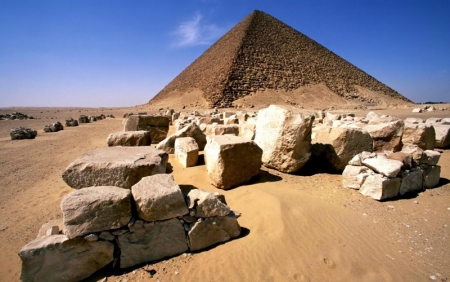
The Bent Pyramid at Dahshur, built by Pharaoh Sneferu around 2600 BCE, features a unique slope change, dual entrances, and intact limestone casing. This architectural innovation influenced later pyramids like the Red Pyramid and the Great Pyramid of Giza.