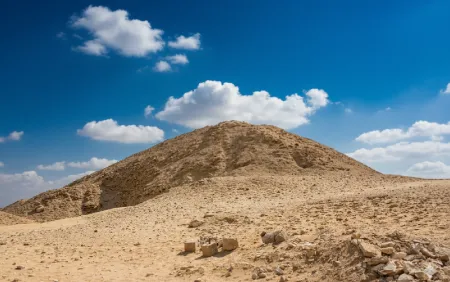
Meidum Pyramid

The Meidum Pyramid represents Egypt's first shot at building a true, straight-sided pyramid and marks a turning point in ancient architectural breakthroughs. The structure now lies in ruins and reaches only 213 feet (65 meters) high, though its original design aimed for an impressive height of 311 feet (95m). This remarkable monument, located about 30 miles south of Memphis, has earned the distinction of being Egypt's most mysterious and least explored pyramid.
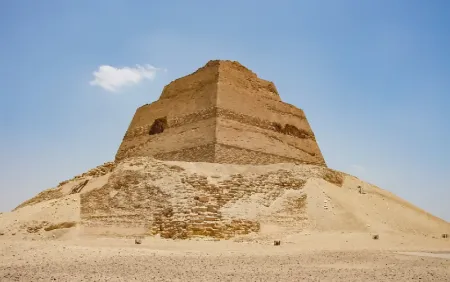
The pyramid's construction began with seven steps, and builders later added an eighth step during its advanced phase. It stands as one of three major pyramids linked to Pharaoh Sneferu's legacy. Construction started around 2630 BC during Sneferu's reign and stretched across four decades. The structure's heavy outer layers eventually gave way and collapsed, which left just a square, three-stepped core surrounded by piles of sand and rubble. This compelling story of architectural trial and error helps us learn about the progress of pyramid building techniques that paved the way for Egypt's more successful monuments.
Archeologists have long debated who built the Meidum Pyramid. This ancient structure stands about 72 kilometers (45 miles) south of modern Cairo and marks a major shift in Egyptian royal architecture.
Scholars believed Pharaoh Huni, the last ruler of Egypt's Third Dynasty, built this pyramid. But recent evidence strongly suggests it was Sneferu, who founded the Fourth Dynasty (circa 2600–2575 BCE). The pyramid complex lacks any inscriptions with Huni's name.
The pyramid's ancient Egyptian name—"Sneferu Endures" (Djed Sneferu)—makes a strong case for Sneferu's ownership. Several of Sneferu's sons' tombs in mastabas around the pyramid add more weight to this claim.
A balanced view suggests that while construction might have started during Huni's reign, Sneferu changed and finished the project. Research shows Sneferu built this pyramid before his 15th year as king and later moved his royal cemetery to Dahshur, about 40 kilometers north.
Sneferu's building program went far beyond the Meidum Pyramid. He built at least three major pyramids—starting with Meidum, then adding the Bent Pyramid and Red Pyramid at Dahshur. This makes him Egypt's most prolific pyramid builder.
The pyramid currently stands at only 213 feet (65 meters) high due to its partial collapse. Originally, it was designed to reach an impressive height of 311 feet (95 meters), making it significantly taller before its structural failure.
Construction began around 2630 BC during Sneferu's reign and continued for approximately four decades. Research suggests Sneferu built this pyramid before his 15th year as king, making it his first pyramid project before moving to Dahshur.
The Meidum Pyramid's architectural rise happened in three distinct construction phases, which archeologist Ludwig Borchardt labeled as E1, E2, and E3. The original phase (E1) started as a step pyramid that resembled Djoser's monument, featuring five steps made of rough limestone blocks. Builders expanded the structure during phase E2 with a uniform 5-meter (approximately 10 cubits) ring-shaped addition around the entire core, which increased the total steps from five to seven.
Phase E3 brought an ambitious attempt to revolutionize this stepped structure into Egypt's first true pyramid by filling in the steps with limestone encasing. This change created fatal structural weaknesses. The outer casing sat on sand instead of solid bedrock, unlike the stable inner core. The inner step pyramid's platforms sloped outward rather than lying flat because builders never designed it for this modification, which created unstable foundations.
A simple yet innovative design marked the pyramid's internal structure. The north face features an entrance 18.5 meters above ground level. Visitors would find a descending passage that leads to a horizontal corridor with a small antechamber before reaching a vertical shaft that opens into the burial chamber. The burial chamber's placement within the pyramid's core showed a remarkable architectural step forward.
The Meidum Pyramid left a lasting legacy despite its collapse. It gave Egypt its first satellite pyramid and earliest eastern offerings chapel, complete with a vestibule and courtyard that contained a central altar.
The pyramid originally began as a step pyramid with five steps made of rough limestone blocks, similar to Djoser's monument. It was later expanded to seven steps before being converted into Egypt's first true pyramid with smooth sides.
Get in touch with our local experts for an unforgettable journey.
Plan Your Trip
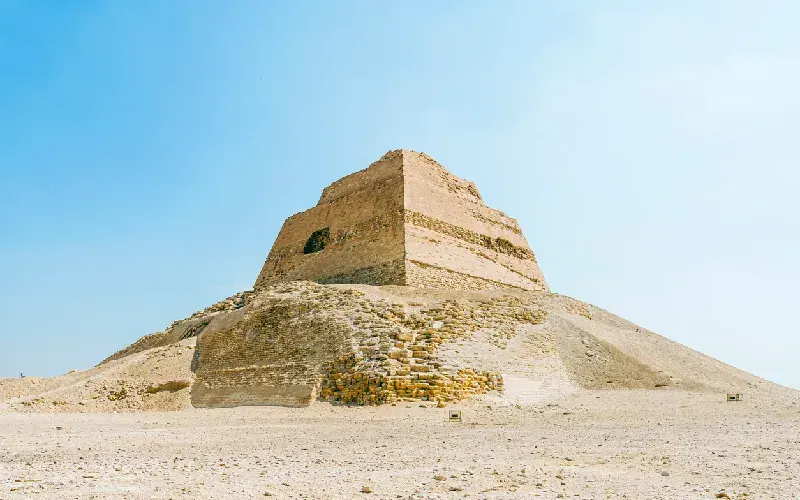
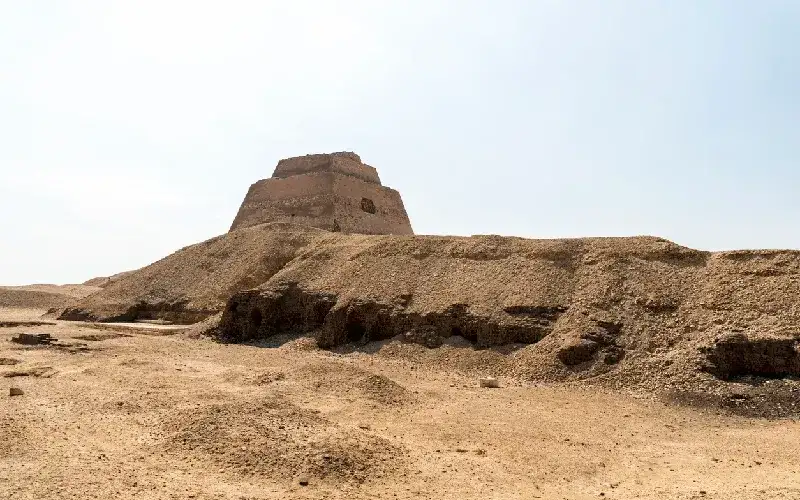
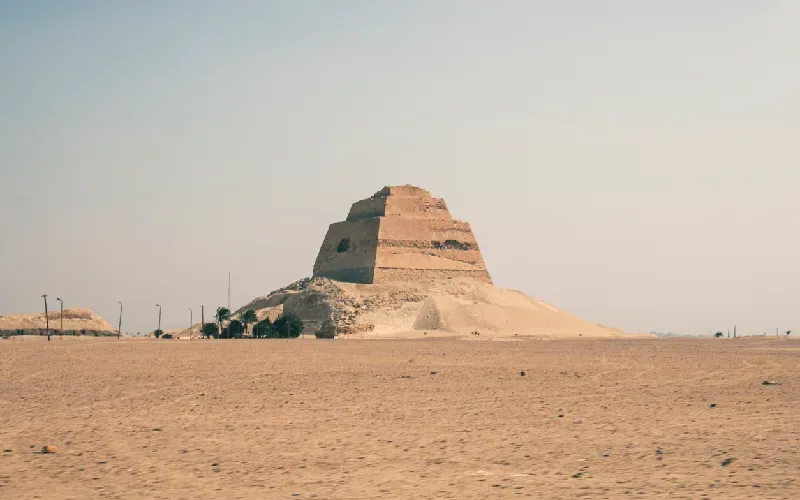
Visitors to the Meidum Pyramid today see a three-stepped tower rising from a mountain of rubble. This striking structure represents a catastrophic structural failure that has captured archeologists' interest for generations.
Popular belief suggested a sudden collapse, but evidence tells a different story. Excavations uncovered stratified layers of debris that suggest gradual erosion through time. The pyramid's collapse originated from basic design flaws. The builders placed the outer casing on desert sand instead of solid bedrock, which created an unstable foundation. The attempted transformation from step pyramid to true pyramid also introduced fatal weaknesses. The inner core's sloping platforms failed to support the additional weight properly.
John Shae Perring started the archeological exploration in 1837. Richard Lepsius continued this work in 1843, and Flinders Petrie expanded it later that century. Petrie's careful measurements showed the pyramid's original dimensions were 1100 cubits around by 175 cubits high, matching the Great Pyramid's proportions.
The unfinished burial chamber holds several interesting features. Wooden supports remain in their original position alongside uncompleted walls. A significant discovery came in 1998 when archeologists found previously unknown corbelled weight-relieving spaces above the niches. This represented the first use of corbelling in Egyptian pyramid construction.
These lessons proved valuable. Sneferu adjusted his next project's design at the Bent Pyramid of Dahshur by reducing its angle from 54° to 43° to improve stability.
The collapse resulted from fundamental design flaws. The outer casing was placed on desert sand instead of solid bedrock, creating an unstable foundation. Additionally, the transformation from a step pyramid to a true pyramid introduced fatal weaknesses, as the inner core's sloping platforms couldn't properly support the additional weight.
The Meidum Pyramid proves ancient Egyptian architectural experimentation, even though it failed structurally. Pharaoh Sneferu turned this ambitious project into a testing ground for pyramid design. His team learned valuable lessons that revolutionized future construction methods.
Egyptian builders' progression from step pyramid to true pyramid shows their constant refinement of techniques. These improvements ended up creating more successful monuments like the Bent Pyramid and Red Pyramid at Dahshur.
The Meidum Pyramid's historical value cannot be questioned. Its design flaws taught vital lessons that helped avoid similar mistakes in later royal tombs. The outer casing built on sand instead of bedrock was a costly mistake. The pyramid's innovative features became standard in later architecture. Corbelled weight-relieving spaces above the niches first appeared here.
Modern archeological discoveries at the site reveal ancient Egyptian construction practices. Wooden supports remain visible in the unfinished burial chamber, showing building methods from over 4,600 years ago. The pyramid's surrounding debris layers tell an interesting story. The structure collapsed gradually rather than all at once, unlike what many people believe.
The Meidum Pyramid might not be as famous as other Egyptian monuments, but it marks a pivotal shift between early step pyramids and the perfect true pyramids that came later. The structure's name "Sneferu Endures" fits perfectly. This bold architectural experiment continues to teach us about human innovation. Without this attempt and its failure, Egypt's iconic pyramids might never have reached their perfect form.
The Meidum Pyramid is located about 72 kilometers (45 miles) south of modern Cairo and approximately 30 miles south of ancient Memphis. It stands in a relatively remote location, making it one of Egypt's least explored pyramids.
While scholars once believed Pharaoh Huni of the Third Dynasty built it, evidence strongly suggests Pharaoh Sneferu of the Fourth Dynasty (circa 2600–2575 BCE) was the builder. The pyramid's ancient name "Sneferu Endures" (Djed Sneferu) and surrounding mastaba tombs of Sneferu's sons support this attribution.
The Meidum Pyramid represents Egypt's first attempt at building a true, straight-sided pyramid. It marked a crucial transition in pyramid architecture and introduced innovative features like corbelled weight-relieving spaces. The lessons learned from its failure directly influenced later successful pyramids.
The pyramid went through three distinct construction phases (labeled E1, E2, and E3). It started as a five-step pyramid, was expanded to seven steps, and finally transformed into a true pyramid by filling in the steps with limestone casing during the final phase.
John Shae Perring began archaeological exploration in 1837, followed by Richard Lepsius in 1843. Flinders Petrie later conducted more extensive work in the late 19th century, providing careful measurements that revealed the pyramid's original dimensions and proportions.
The internal structure features an entrance on the north face 18.5 meters above ground, a descending passage leading to a horizontal corridor with a small antechamber, and a vertical shaft opening into the burial chamber. The burial chamber remains unfinished with visible wooden supports still in place.
Explore the lost Pyramid of Djedefre at Abu Rawash, Egypt, near Giza. Discover Fourth Dynasty architecture, royal history, and ancient artifacts at this historic site.
Abu Sir Pyramids in Egypt are Fifth Dynasty royal tombs located between Giza and Saqqara near Cairo.
The Pyramid of Pepi I in South Saqqara houses Egypt's largest collection of Pyramid Texts—2,263 lines of sacred hieroglyphs from the Old Kingdom era.
The Meidum Pyramid, built by Sneferu around 2630 BC, was Egypt's first attempt at a true pyramid. Now partially collapsed, it taught vital lessons for later pyramids.
The Pyramid of Sahure, built around 2458 BC at Abusir, recently revealed 8 hidden storage chambers. This Fifth Dynasty monument features advanced architecture.
The Pyramid of Senusret III at Dahshur stands 78m tall with unusual western entrance. Its empty sarcophagus suggests the king may have been buried elsewhere.
Teti's pyramid at Saqqara contains Egypt's oldest religious texts & gold star ceiling. Built 2345 BCE, its well-preserved chambers offer intimate exploration.