Menkaure Pyramid, Egypt

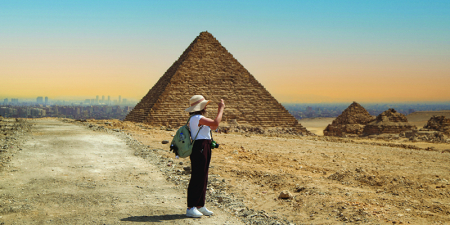
The Menkaure pyramid is the smallest of the three main pyramids in the Giza complex, yet its modest size masks its architectural sophistication. It reaches 61 meters (200 feet) in height with a base of 108.5 meters (356 feet), and features an incline angle of approximately 51°20'25". While it may be the least imposing of Giza's famous trio, the pyramid's chambers show more complexity than those of Khafre's larger pyramid, with a distinctively decorated chamber and another that houses six large niches.
The pyramid's construction reveals a fascinating approach, as its lower section features pink granite cladding while the upper portion employs Tura limestone. The ScanPyramids project team from Cairo University and TUM found two hidden air-filled spaces behind the outer facade. These voids, located at depths of 1.4 meters and 1.13 meters, add another layer of mystery to this remarkable structure. King Menkaure's black stone sarcophagus met an unfortunate fate when it was lost at sea in 1838 during its journey to England. The burial chamber stands as a testament to impressive engineering, with massive granite blocks that have endured through millennia.
The Menkaure Pyramid is the smallest of the three main pyramids in the Giza complex, built around 2500 BCE as the tomb of King Menkaure. Despite its modest size, its interior chambers are more complex than those of Khafre’s pyramid, including a decorated antechamber and a side "cellar" with six niches.
The Menkaure Pyramid, built around 2500 BCE, shows amazing architectural precision. It originally stood 65.5 meters (215 feet) tall. Time and erosion have reduced its height to about 61 meters (200 feet). Each side of its base stretches 108.5 meters (356 feet) with an angle of 51°20'25".
The pyramid's most striking feature is its unique casing materials. Red granite from Aswan quarries, located 580 miles south of Giza, covers the lower section. The builders used polished Tura limestone for the upper portion. Among all Giza pyramids, this was the only one designed with granite instead of limestone cladding.
The builders started by preparing the site at Cairo's highest point. They leveled the ground carefully to create a strong foundation. Two-ton limestone blocks made their way to the construction site. The workers likely used a ramp system to move these massive stones into place.
Menkaure's death around 2503 BCE brought construction to a sudden stop. The workers had only finished 16-18 layers of granite casing. Today, just seven of these layers remain standing due to weather damage and vandalism. Many granite blocks still lie scattered around the pyramid's base, never used in construction.
The pyramid's unfinished state is a chance for archeologists to learn about ancient Egyptian building techniques. It shows how people built both pyramids and temples thousands of years ago.
The lower section of Menkaure Pyramid is clad in red granite from Aswan, while the upper portion is made of polished Tura limestone. This dual-material casing is unique among the Giza pyramids.
The exterior of Menkaure's pyramid looks simple, but its interior chambers reveal complex and intricate designs that surpass those in Khafre's pyramid. A visitor can enter through an opening about four meters above the ground, which guides them down corridors to several distinct chambers.
The first space visitors see is an antechamber with beautiful decorative panels and palace facade carvings. These relief designs hadn't appeared in any major pyramid since Zoser's time. Beyond this lies a second chamber that gives visitors a chance to see the vaulted ceiling above the main burial room.
The pyramid has an interesting side chamber that people call the "cellar," with six large niches carved into it. Nobody knows exactly what this room was meant for, though it might have held treasures or offerings.
Massive granite blocks line the main burial chamber, which once held a beautiful black stone sarcophagus with niched panels. Archeologists found this 8-foot-long basalt masterpiece next to a wooden coffin marked with Menkaure's name. The sarcophagus met a tragic end in 1838 when the merchant ship Beatrice sank off Spain's coast while carrying it to England.
The British Museum now displays the wooden coffin, which carbon dating places between 1212-846 BCE—about 1,300 years after Menkaure lived. Tests showed that the human remains inside came from the early Islamic period.
Inside the pyramid, visitors find a decorated antechamber with palace facade carvings, a vaulted main burial chamber, and a side chamber called the "cellar" with six niches. These chambers show intricate designs and construction techniques.
King Menkaure’s black stone sarcophagus was lost at sea in 1838 during transport to England. The wooden coffin marked with his name survives and is displayed at the British Museum.
Get in touch with our local experts for an unforgettable journey.
Plan Your Trip
Menkaure's pyramid is part of a detailed complex. A mortuary temple stands next to the pyramid. The temple has limestone foundations and an inner core that features granite floors and wall facings. The temple walls contain massive limestone blocks weighing up to 220 tons, and the imported granite ashlars weigh more than 30 tons.
Three smaller pyramids labeled G3-a, G3-b, and G3-c lie south of the main structure. The easternmost pyramid stands as a completed true pyramid with granite casing. Archeologists identified it by finding a limestone pyramidion nearby. The other two pyramids remain incomplete with only their inner cores built.
American archeologist George Andrew Reisner made remarkable discoveries between 1908 and 1910. He found many statues of King Menkaure while excavating the Valley Temple. These discoveries included the famous dyad showing Menkaure with a queen and several triads depicting the king with various deities.
Recent archeological findings reveal a fascinating detail about construction methods. A now-defunct Khufu branch of the Nile helped with construction. This natural waterway worked alongside canals and basins to create a harbor at the pyramid site. This clever water transportation system moved massive stone blocks straight to the Giza Plateau. The site became a busy port that supported the construction of all three major Giza pyramids.
The Menkaure Pyramid shows evidence of ancient Egyptian ingenuity even though it's the smallest of the three main Giza pyramids. This remarkable structure has kept many architectural secrets for 4,500 years, from its distinctive dual-material casing to its complex interior chambers. Scientists found hidden air spaces behind the outer facade, which adds an exciting new chapter to our knowledge of this ancient wonder.
The pyramid may be smaller than its neighbors, but it has more detailed interior elements. Its uniquely decorated antechamber and mysterious six-niched "cellar" room make it special. These features and the sophisticated burial chamber with massive granite blocks show ancient Egyptian builders' remarkable skill.
The pyramid's unfinished state helps archeologists learn about construction methods that would be unknown otherwise. You can see scattered granite blocks at the base and partially finished casing that tell a story of ambitious plans cut short by the pharaoh's death.
The surrounding complex has a mortuary temple, satellite pyramids, and an elaborate harbor system. This shows how these monuments were part of larger religious and functional sites. The Valley Temple's statues, especially the famous dyad and triads showing Menkaure with deities, help us understand ancient Egyptian religious practices better.
Without doubt, the Menkaure Pyramid is more than just the smallest of the Giza trio. This architectural marvel keeps revealing its secrets through ongoing archeological work, showing us that historical importance can surpass physical size. The pyramid's story, from its building methods to its lost sarcophagus, gives us a window into the ambitions, beliefs, and technical achievements of one of history's most enduring civilizations.
King Menkaure was a pharaoh of Egypt’s Fourth Dynasty, known for commissioning the smallest pyramid of the Giza trio. His statues, including dyads and triads, were found in the Valley Temple, showing him alongside queens and deities.
Yes, several statues were discovered in the Valley Temple, including the famous dyad showing Menkaure with a queen and several triads depicting the king with various deities.
A now-defunct branch of the Nile and a network of canals and basins created a harbor that allowed massive granite and limestone blocks to be moved directly to the Giza Plateau.
Canopic jars were vital in ancient Egypt, preserving organs and symbolizing rebirth. Explore their history, the Four Sons of Horus, and modern discoveries.
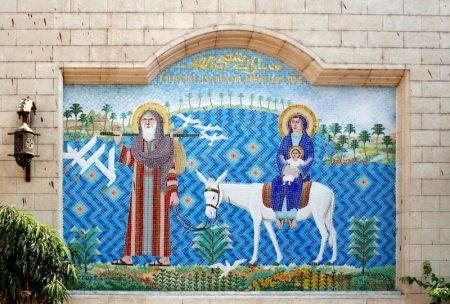
Journey along the Holy Family in Egypt's path. Learn about the historical route, significant sites, and the enduring legacy they left behind.
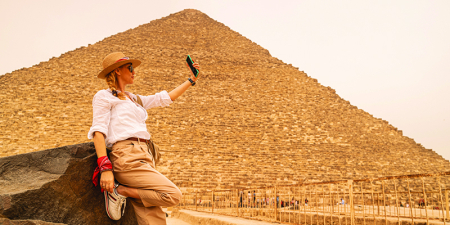
The Khufu Pyramid, located on the Giza Plateau in Egypt, is the largest and most famous pyramid ever built. Constructed around 2600 BC, it reflects ancient Egyptian engineering excellence, deep religious beliefs, and the divine power of Pharaoh Khufu.
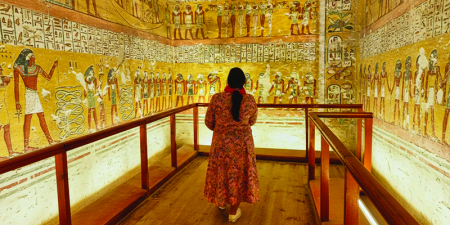
Ramesses IV, a New Kingdom pharaoh, left a lasting legacy through ambitious building projects and a uniquely preserved mummy. His tomb KV2 reveals key insights into ancient Egyptian beliefs about death and eternity.
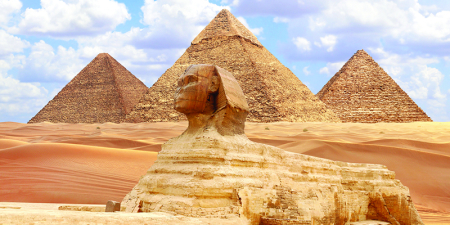
Explore the Khafre Pyramid, Egypt’s second largest Giza pyramid. Discover its unique architecture, the Great Sphinx, Mortuary & Valley Temples, and King Khafre statue in this iconic ancient Egyptian complex.
The Djoser Pyramid in Saqqara, Egypt, is the world’s first Step Pyramid, built for Pharaoh Djoser during the Third Dynasty. Designed by Imhotep, it revolutionized stone construction and ancient Egyptian burial practices, combining ceremonial, symbolic, and functional elements in a single monumental complex.
Menkaure Pyramid in Giza, Egypt, is the smallest of the three main pyramids, featuring unique dual-material casing, complex chambers, mortuary temple, and iconic King Menkaure statues
Discover how the Hathor Temple at Dendara connects ancient Egyptian religion with the stars and cosmos.