Pyramid of Sesostris III
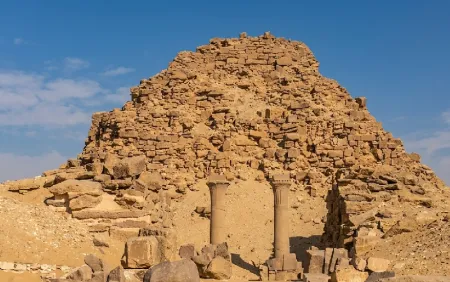
The pyramid of Senusret III towers 78 meters (256 ft) tall with a base of 105 meters (344 ft), hiding secrets that most visitors would never suspect. This remarkable monument differs from the famous Old Kingdom structures. Its entrance lies concealed beneath the pavement of a courtyard west of the pyramid itself.
Senusret III's story is the sort of thing I love - he ruled as the fifth king of Egypt's 12th Dynasty during the 19th century BCE. His pyramid stands at Dahshur's northernmost point. The Greek historian Herodotus visited in the 5th century BCE and called it the most important pyramid of the Middle Kingdom. The structure boasts an impressive volume of 288,488 cubic meters, yet its construction technique sets it apart from earlier pyramids. The builders used a mud-brick core originally covered in limestone blocks, though most of these blocks have vanished over time.
In this piece, we'll explore the hidden chambers and the mysterious granite sarcophagus with its serekh motif, along with the connected tombs where royal ladies rest. We'll also get into why researchers think Senusret III might never have been buried here. Their theory stems from the missing human remains and the sarcophagus's unusually pristine condition.
The pyramid was built during the reign of Senusret III, the fifth king of Egypt's 12th Dynasty, in the 19th century BCE (circa 1878–1840 BCE). This was during the Middle Kingdom period, considered by many historians as the Golden Age of ancient Egypt.
The pyramid stands 78 meters (256 feet) tall with a base measuring 105 meters (344 feet). It has an impressive volume of 288,488 cubic meters, making it one of the significant monuments of the Middle Kingdom.
King Senusret III (r. ca. 1878–1840 BCE) emerged as one of Egypt's most powerful rulers. He oversaw major developments in religion, politics, and the arts. His pyramid at Dahshur stands as evidence of his reign, which many historians think over as the peak of the Middle Kingdom's Golden Age.
The monument's remarkable features stem from its innovative construction technique. Builders placed mudbrick blocks directly on desert gravel without mortar. They poured sand between the gaps instead of using binding agents. A gleaming white Tura limestone cover rested on solid foundations and completed the structure.
The pyramid broke ancient traditions with its unusual entrance placement. The builders placed it on the west side instead of the traditional northern face. This calculated change marked a radical alteration in royal burial practices.
Beautiful craftsmanship adorns the interior walls. White limestone walls grace the burial chamber, which has a whitewashed red granite crypt. A finely carved red granite sarcophagus sits at its center and displays patterns that mirror an enclosure wall with palace façade paneling.
The complex has a small eastern mortuary temple and six smaller pyramids built for royal women. An enclosure wall surrounds these structures. This architectural layout reveals the pharaoh's status and Middle Kingdom Egypt's evolving religious beliefs about the afterlife.
Archeologists faced a significant challenge when they tried to find Senusret III's pyramid entrance. De Morgan spent months before he finally found it hidden in the western courtyard's pavement near the northwest corner. This location broke from traditional pyramid design, which typically placed entrances on the northern side.
The entrance reveals a vertical shaft that connects to a downward-sloping corridor. Visitors who follow this passage reach an antechamber that branches into three crucial areas: a storeroom to the west, the king's chamber to the east, and a small magazine.
The burial chamber stands as a testament to ancient engineering excellence. Red granite lines its walls, carefully covered with a gypsum whitewash. The chamber's roof features an innovative system of three relieving vaults that prevent collapse. Granite forms the lowest vault, limestone sits in the middle, and mudbrick crowns the top. Ten massive limestone beams, each weighing about thirty tons, create the ceiling.
A beautifully carved granite sarcophagus rests against the western wall, its design mimicking a serekh motif similar to Djoser's Step Pyramid's enclosure wall. The southern wall contains a niche that was meant to house the canopic chest.
The sarcophagus yielded little when discovered - just dust, some pottery pieces, and a nearby dagger with an ivory handle. This mysterious emptiness has led experts to believe that Senusret III might have been laid to rest in his elaborate Abydos complex instead.
The interior features a vertical shaft leading to a downward corridor, an antechamber branching to a storeroom, the king's burial chamber, and a small magazine. The burial chamber has red granite walls with gypsum whitewash, an innovative three-vault relieving system, and a beautifully carved granite sarcophagus with serekh motif design.
Get in touch with our local experts for an unforgettable journey.
Plan Your Trip
The main monument at Senusret III's complex was surrounded by seven smaller pyramids built to honor royal women. The sort of thing I love happened in 1894 when French archeologist Jacques de Morgan found two rich sources of stunning jewelry on back-to-back days. These precious items included beautiful gold pectorals decorated with gemstones, bracelets featuring djed-pillar clasps, and anklets adorned with claw pendants.
The complex featured tomb clusters both north and south. Royal women, including Princess Itakayet and Queen Nefrethenut, were laid to rest in the four northern pyramids. Queen Weret II's underground burial chamber stood out among the southern structures. Her tomb connected to rooms beneath the king's pyramid through a lengthy corridor.
Thieves ransacked many tombs during ancient times, but some treasures remained hidden. Princess Sithathor's belongings included gold jewelry decorated with carnelian and lapis lazuli. Princess Mereret's collection contained pectoral collars that displayed royal names.
The archeologists made another remarkable find near the complex's northwest corner - six wooden funerary boats. Each boat stretched 6 meters (20 ft) long. These vessels, with their white decks and painted hulls, likely carried the pharaoh's body along the Nile. Museums throughout Egypt and the United States now house these ancient boats.
This remains a mystery. The sarcophagus was found empty except for some dust, pottery pieces, and a dagger with an ivory handle. The pristine condition of the sarcophagus and absence of human remains suggest Senusret III may have been buried at his elaborate complex in Abydos instead.
The pyramid of Senusret III is one of the most mysterious monuments from ancient Egypt's Middle Kingdom. Our research has found that there was state-of-the-art features that set this structure apart from others. The mud-brick core construction and a hidden western entrance beneath a courtyard pavement make it unique.
This remarkable pyramid reflects its owner's personality. Senusret III ruled during the Middle Kingdom's golden age and without doubt made his mark through religious reforms and artistic developments. His fresh take on pyramid design broke from tradition while keeping its symbolic power.
The empty sarcophagus might be the most puzzling aspect. The burial chamber has whitewashed granite walls and a complex relieving system. Yet the lack of human remains hints that Senusret III might have been buried at his Abydos complex. This mystery continues to intrigue archeologists and historians.
The surrounding complex tells its own fascinating story. Seven smaller pyramids built for royal women stand nearby. Gold jewelry with precious stones that archeologists found gives us a glimpse of this era's grandeur. On top of that, wooden funerary boats buried near the complex show the detailed rituals of royal passage to the afterlife.
The pyramid of Senusret III keeps many secrets even after centuries. Many treasures now sit in museums worldwide, but the site is a chance to peek into Egypt's Middle Kingdom. While Old Kingdom monuments often overshadow this period, it plays a vital role in understanding ancient Egyptian civilization. This architectural wonder is proof of Egyptian ingenuity and spiritual beliefs, whatever its true purpose was. It continues to fascinate people worldwide today.
The Pyramid of Senusret III is located at Dahshur, positioned at the northernmost point of the Dahshur necropolis. It stands among other famous pyramids like the Red Pyramid and Bent Pyramid in this archaeological site south of Cairo.
Unlike traditional pyramids with northern entrances, Senusret III's pyramid features an unusual entrance on the western side, concealed beneath courtyard pavement. Additionally, it was constructed using a mud-brick core originally covered in limestone blocks, differing from the solid stone construction of Old Kingdom pyramids.
French archaeologist Jacques de Morgan discovered the entrance after months of searching in 1894. The entrance was cleverly hidden in the western courtyard's pavement near the northwest corner, making it exceptionally difficult to locate.
Jacques de Morgan discovered stunning jewelry on consecutive days in 1894, including gold pectorals decorated with gemstones, bracelets with djed-pillar clasps, and anklets with claw pendants. Princess Sithathor's gold jewelry featured carnelian and lapis lazuli, while Princess Mereret's collection contained elaborate pectoral collars.
Seven smaller pyramids were built around the main monument to honor royal women. Four northern pyramids housed Princess Itakayet and Queen Nefrethenut, while southern structures included Queen Weret II's underground chamber, which connected to the king's pyramid through a lengthy corridor.
The pyramid was built with a mud-brick core placed directly on desert gravel without mortar, with sand poured between gaps. The structure was originally covered with gleaming white Tura limestone blocks, though most have disappeared over time.
Explore the lost Pyramid of Djedefre at Abu Rawash, Egypt, near Giza. Discover Fourth Dynasty architecture, royal history, and ancient artifacts at this historic site.
Abu Sir Pyramids in Egypt are Fifth Dynasty royal tombs located between Giza and Saqqara near Cairo.
The Pyramid of Pepi I in South Saqqara houses Egypt's largest collection of Pyramid Texts—2,263 lines of sacred hieroglyphs from the Old Kingdom era.
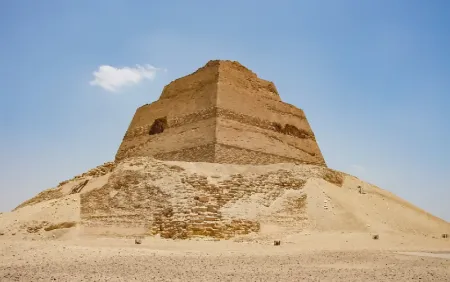
The Meidum Pyramid, built by Sneferu around 2630 BC, was Egypt's first attempt at a true pyramid. Now partially collapsed, it taught vital lessons for later pyramids.
The Pyramid of Sahure, built around 2458 BC at Abusir, recently revealed 8 hidden storage chambers. This Fifth Dynasty monument features advanced architecture.
The Pyramid of Senusret III at Dahshur stands 78m tall with unusual western entrance. Its empty sarcophagus suggests the king may have been buried elsewhere.
Teti's pyramid at Saqqara contains Egypt's oldest religious texts & gold star ceiling. Built 2345 BCE, its well-preserved chambers offer intimate exploration.