Abu Sir Pyramids: Your Essential Guide to Egypt's Royal Necropolis

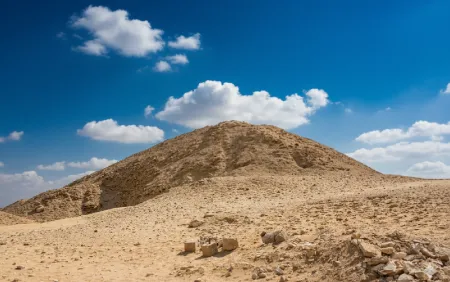
Abu Sir Egypt, derived from the ancient Egyptian name Per-Usire meaning “House of Osiris,” is one of the most important yet underrated archaeological sites in Egypt. Located between the Giza Plateau to the north and Saqqara to the south, the Abu Sir Pyramids form a royal necropolis that played a central role during the Fifth Dynasty of the Old Kingdom.
Unlike the monumental Fourth Dynasty pyramids, Abu Sir reflects a transitional phase in ancient Egyptian history—one marked by evolving religious beliefs, administrative systems, and architectural priorities. Though many of its structures now lie in ruins, the site remains invaluable for understanding royal burial customs and daily life in Old Kingdom Egypt.
Abusir rose to prominence during the Fifth Dynasty (c. 2494–2345 BCE), when Egypt’s royal focus shifted away from the colossal pyramids of Giza. Instead of emphasizing sheer scale, Fifth Dynasty rulers invested in complex temple decoration, solar cult worship, and detailed administrative systems.
As part of the greater Memphite necropolis, Abusir Egypt became a key burial ground reflecting these changing priorities. The site bridges the architectural and ideological gap between the grandeur of Giza and the long-lasting traditions of Saqqara.
Several Fifth Dynasty rulers were buried at Abu Sir Egypt, including Sahure, Neferirkare Kakai, Nyuserre Ini, and Neferefre. Their pyramid complexes illustrate the political, religious, and administrative evolution of royal power during the Old Kingdom.
By the time the Fifth Dynasty came to power, the Giza Plateau was largely occupied by Fourth Dynasty monuments. Pharaoh Userkaf, the dynasty’s founder, selected Abusir for his solar temple, setting a precedent followed by rulers such as Sahure, Neferirkare Kakai, Nyuserre Ini, and Neferefre.
Abusir offered practical advantages. Some pyramids, such as Sahure’s, were built on elevated ground approximately 20 meters above the Nile valley temples. This not only enhanced visibility but also simplified construction logistics while reinforcing the symbolic dominance of royal tombs.
The Fifth Dynasty selected Abu Sir due to its proximity to Memphis, available space after the Giza Plateau was largely occupied, and its strong connection to solar cult worship. The location also allowed efficient construction and reinforced the symbolic dominance of royal monuments.
Get in touch with our local experts for an unforgettable journey.
Plan Your Trip
Abusir was closely linked to Memphis, Egypt’s capital during the Old Kingdom. Stretching along the western bank of the Nile, the necropolis formed part of a continuous burial landscape extending from Giza to Saqqara.
An ancient waterway known as Abusir Lake connected the site directly to the Nile, enabling efficient transportation of limestone, tools, and offerings. This access supported both pyramid construction and the long-term maintenance of mortuary cults, reinforcing Abusir’s religious and economic importance.
The Abu Sir Pyramids are located in Abusir Egypt, on the western bank of the Nile, between the Giza Plateau to the north and Saqqara to the south, near modern-day Cairo. This strategic position made Abusir part of the greater Memphite necropolis.
The Abu Sir Pyramids are notably smaller and less robust than those of the Fourth Dynasty. Sahure’s pyramid, for example, measured around 78 meters at its base and reached only 47 meters in height.
Builders relied on local limestone, mud mortar, and infill materials such as sand, pottery fragments, and rubble. Many pyramids began as step pyramids and were later modified, reflecting cost-saving measures and reduced resources. This decline likely points to weakened royal authority or economic limitations during the Fifth Dynasty.
Unlike the massive Fourth Dynasty pyramids at Giza, the Abu Sir Pyramids are smaller and constructed using local limestone, mud mortar, and rubble. This reflects economic limitations and a shift toward temple decoration, solar worship, and administrative complexity rather than monumental scale.
Sahure’s pyramid complex, known as Khai-ba Sahure, set new artistic standards. While modest in size, its mortuary temple once featured approximately 10,000 square meters of finely carved reliefs, depicting trade, religious rituals, and royal power.
Architectural innovations included palm-shaped columns and highly detailed wall reliefs. Recent excavations revealed hidden storage chambers, offering new insights into pyramid construction techniques in Abusir Egypt.
Neferirkare’s pyramid is the tallest in Abu Sir, originally reaching about 72 meters. It began as a step pyramid before being converted into a true pyramid—a project left unfinished due to the king’s death.
The hastily completed mortuary temple used mudbrick instead of stone. Within this complex, archaeologists discovered the famous Abusir Papyri, which provide unparalleled records of temple administration and daily operations.
Niuserre’s pyramid complex, Men-sut Niuserre, is the best preserved among the Abu Sir Pyramids. Standing approximately 52 meters high, it introduced architectural features that influenced later Egyptian monuments.
Its L-shaped mortuary temple adapted to existing structures and included the antichambre carrée, a square chamber with a central column. Niuserre also reused Neferirkare’s causeway, demonstrating practical resource management.
Neferefre’s pyramid remains unfinished due to his early death. Originally planned as a pyramid, it was converted into a mastaba-like structure known as “The Mound.”
Excavations uncovered fragments of the king’s mummy and a nearby slaughterhouse for ritual animal sacrifices. This site provides rare evidence of how ancient Egyptians adapted burial plans under unexpected circumstances.
Mastaba of Ptahshepses
The mastaba of Ptahshepses, vizier and son-in-law of Nyuserre, is the largest non-royal tomb of the Old Kingdom. Measuring 80 by 107 meters, it features six-meter-high lotus columns—the oldest of their kind—and architectural elements once reserved for royalty.
Queen Khentkaus II, wife of Neferirkare and mother of two kings, had her own pyramid complex at Abusir Egypt. Originally a satellite structure, it evolved into an independent monument with a mortuary temple.
Her royal titles suggest she may have briefly ruled Egypt, highlighting the political significance of royal women during the Fifth Dynasty.
In 2017, archaeologists uncovered a solar temple dedicated to Ramesses II near the Abu Sir Pyramids. Dating to the New Kingdom, this discovery demonstrates the site’s continued religious importance long after the Old Kingdom ended.
South of the main pyramids lies a cemetery for officials and priests dating from the Early Dynastic Period through the Old Kingdom. Known as the Bonnet Cemetery, it provides valuable evidence of early administration and foreign trade through unique copper artifacts.
A Late Period cemetery southwest of Neferefre’s pyramid contains deep shaft tombs belonging to high-ranking officials. The intact tomb of High Priest Iufaa, with its massive limestone sarcophagus, offers rare insight into burial practices just before the Persian conquest of Egypt.
Discovered in 1893, the Abusir Papyri are the largest collection of Old Kingdom administrative documents ever found. Dating to the 24th century BCE, they record priestly duties, supply deliveries, inventories, and festival schedules.
Written in hieratic script, these texts reveal a highly organized system that managed royal mortuary temples and illustrates daily life in Old Kingdom Egypt.
Since 1960, the Czech Institute of Egyptology has led extensive excavations at Abusir Egypt. Their discoveries—including Neferefre’s funerary complex and thousands of papyrus fragments—have transformed scholarly understanding of the Fifth Dynasty.
Ongoing research continues to reshape knowledge of Abu Sir. Recent discoveries include Late Period burials and the long-lost valley temple of Niuserre, now accessible thanks to lowered groundwater levels.
The Abusir Papyri are the largest collection of Old Kingdom administrative documents ever discovered. Found near Neferirkare’s pyramid, they document priestly duties, temple supplies, and daily operations, offering rare insight into everyday life in ancient Egypt.
The Abu Sir Pyramids represent a crucial chapter in ancient Egyptian history. Though overshadowed by Giza, Abusir Egypt offers unmatched insight into Fifth Dynasty burial practices, administrative sophistication, and architectural innovation.
From royal pyramids to non-royal mastabas, and from the Abusir Papyri to recent archaeological breakthroughs, the site reveals a dynamic landscape of religious, political, and economic change. For historians, scholars, and travelers seeking a deeper understanding of Old Kingdom Egypt, Abu Sir remains an essential—and remarkably authentic—destination.
Yes, the Abu Sir Pyramids are open to visitors today, although the site is less developed than Giza or Saqqara. Travelers interested in archaeology, Old Kingdom history, and lesser-known ancient sites near Cairo often find Abusir Egypt a rewarding and authentic destination.
Explore the lost Pyramid of Djedefre at Abu Rawash, Egypt, near Giza. Discover Fourth Dynasty architecture, royal history, and ancient artifacts at this historic site.
Abu Sir Pyramids in Egypt are Fifth Dynasty royal tombs located between Giza and Saqqara near Cairo.
The Pyramid of Pepi I in South Saqqara houses Egypt's largest collection of Pyramid Texts—2,263 lines of sacred hieroglyphs from the Old Kingdom era.
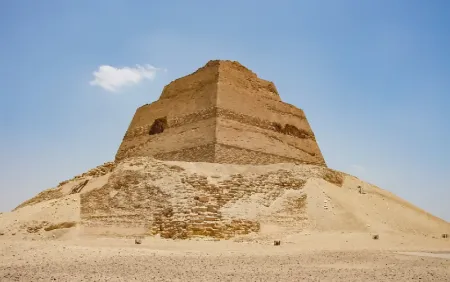
The Meidum Pyramid, built by Sneferu around 2630 BC, was Egypt's first attempt at a true pyramid. Now partially collapsed, it taught vital lessons for later pyramids.
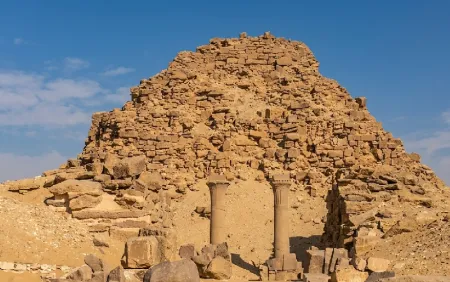
The Pyramid of Sahure, built around 2458 BC at Abusir, recently revealed 8 hidden storage chambers. This Fifth Dynasty monument features advanced architecture.
The Pyramid of Senusret III at Dahshur stands 78m tall with unusual western entrance. Its empty sarcophagus suggests the king may have been buried elsewhere.
Teti's pyramid at Saqqara contains Egypt's oldest religious texts & gold star ceiling. Built 2345 BCE, its well-preserved chambers offer intimate exploration.