Saints Sergius and Bacchus Church

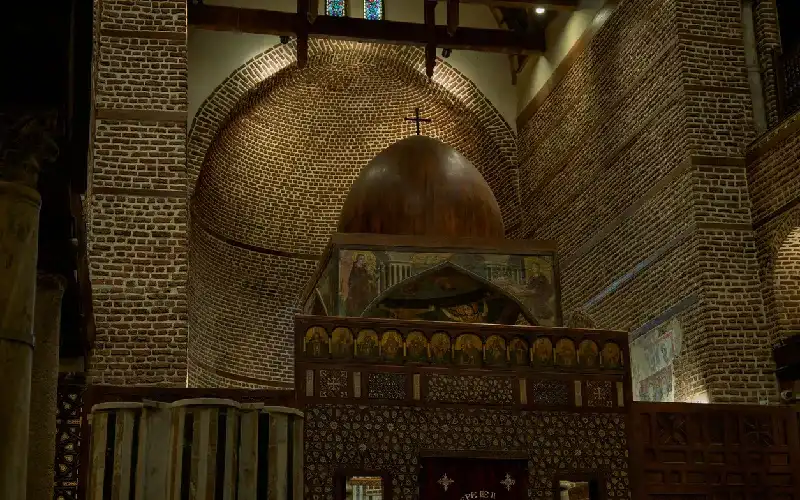
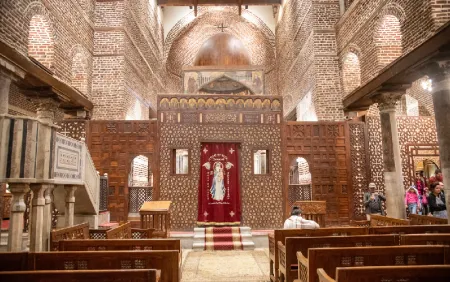
The Church of Saint Sergius and Bacchus represents one of Egypt's oldest Christian churches with roots dating back to the 7th century.
Athanasius, a scribe working for the Umayyad governor of Egypt, built this ancient structure. A 6.5 meter limestone wall supports the church, and historians believe this wall once formed part of the Amnis Traianus entrance, a Roman canal from the second century.
The church honors two saints, Sergius and Bacchus, who served as high-ranking Roman army officers. Roman authorities found that they were secret Christians and subjected them to torture before killing them. The Egyptian church's history includes several fires and restorations, with its first major fire occurring in 750. Meanwhile, Emperor Justinian's reign (527-65) saw the construction of another Church of St Sergius and Bacchus in Constantinople. The building showcases remarkable architectural innovation through its amazing vaults and a 50-foot dome built without pendentives, demonstrating the builders' exceptional brick-faced masonry skills. The historic district of Old Cairo houses this architectural marvel, which stands on what remains of the Roman Fortress of Babylon.
Yes, there are two distinct churches: one in Old Cairo, Egypt, dating to the 7th century built by Athanasius, and another in Constantinople (modern Istanbul) built by Emperor Justinian I between 527-536 AD. Both honor the same martyred saints.
The Egyptian Church of Saint Sergius and Bacchus is located in the historic district of Old Cairo, standing on what remains of the Roman Fortress of Babylon. A 6.5-meter limestone wall supports the church, believed to have once formed part of the Amnis Traianus entrance, a Roman canal from the second century.
Emperor Justinian I built the Church of Saint Sergius and Bacchus between 527 and 536 AD. This was one of his first major projects after he became the Byzantine emperor. The church found its home within the Hormisdas Palace complex in Constantinople, where Justinian lived before becoming emperor.
A fascinating story lies behind the church's dedication. During Justin I's reign, Justinian faced death accusations for plotting against the throne. The story goes that Saints Sergius and Bacchus appeared to Justin and proved Justinian's innocence. Justinian promised to honor these saints with a church once he became emperor.
The new church connected to an existing one through shared spaces. Justinian had built the Church of Saints Peter and Paul around 518/519, and both churches shared the same narthex, atrium and propylaea. The building's entablature proudly displays an inscription that honors both Justinian and his wife Theodora.
The church might have served a special purpose in the early 530s. Scholars suggest it provided shelter to non-Chalcedonian Christians under Theodora's protection. The choice of military saints Sergius and Bacchus, who died near the Persian frontier, could help predict protection against Persia.
This remarkable building's design would shape Justinian's greatest achievement - Hagia Sophia.
The Egyptian Church of Saint Sergius and Bacchus has roots dating back to the 7th century. Athanasius, a scribe working for the Umayyad governor of Egypt, built this ancient structure, making it one of Egypt's oldest Christian churches.
Emperor Justinian I built the Constantinople Church of Saint Sergius and Bacchus between 527 and 536 AD. This was one of his first major architectural projects after becoming Byzantine emperor, constructed within the Hormisdas Palace complex where he lived before his reign.
The Church of Saint Sergius and Bacchus represented a breakthrough in architecture during its time. Its unique double-shell design features an octagonal core cleverly nested within an irregular rectangular exterior. A spectacular sixteen-sided dome crowns the structure. The dome spans 50 feet (16 meters) in diameter and soars over 30 meters high.
Unlike traditional designs, it was built without pendentives. The dome's construction used sixteen longitudinal compartments that intersect to create groins, which provide structural integrity and graceful esthetics.
The impressive dome rests on eight wedge-shaped piers. Between these piers stand pairs of columns that create an open, spacious interior.
These columns showcase alternating verd antique (green) and red Synnada marble. They stand on bases made from blue-veined white Proconnesian marble sourced from the island of Marmora. The lower columns showcase beautiful "melon capitals", while the gallery's columns feature Ionic capitals with impost blocks.
The church's interior walls once displayed vibrant marble revetments. Gold mosaics decorated the dome, sanctuary, and vaults, bathing the space in luminous beauty. On top of that, it features an elegant entablature with a Greek inscription that honors Justinian and Theodora. This groundbreaking design later inspired other structures, including San Vitale in Ravenna. The church stands as a crucial milestone in Byzantine sacred architecture's evolution.
Get in touch with our local experts for an unforgettable journey.
Plan Your Trip
The Church of Saint Sergius and Bacchus stood as a most important symbol in Byzantine religious politics, surpassing its architectural beauty.
Religious controversies between Chalcedonian and Monophysite Christians became deeply connected to this church. Empress Theodora, known to favor Miaphysite (Monophysite) beliefs, offered protection to Monophysite leaders in the Hormisdas Palace. The church's dedicatory inscription honors Theodora with these words: "May he [Sergius] increase the power of the God-crowned Theodora whose mind is adorned with piety".
The building served as the Monastery of Sergius throughout the Byzantine period. The monastery's first known abbot Paul put his signature on anti-Monophysite documents at the Council of 536. All the same, Pope Vigilius found sanctuary at the monastery during theological disputes around 547.
Under abbot John the Grammarian's leadership from 815-837, the church became a prominent center of Iconoclasm - the movement against religious images. The church walls witnessed numerous interrogations of icon supporters. Emperor Basil I later restored the church's declining state between 867-886.
The building held ceremonial importance too. Emperors would visit on Easter Tuesday and attend services from an imperial gallery that overlooked the sanctuary, according to the tenth-century Book of Ceremonies. More Latin clergy received permission to conduct services there by 880. The church remained a powerful religious and political center throughout Byzantine times.
The Church of Saint Sergius and Bacchus stands as proof of Byzantine architectural genius and religious importance. Emperor Justinian built this remarkable structure between 527 and 536 AD. The church showcases state-of-the-art features through its octagonal design and an impressive dome built without pendentives. The church's clever use of columns, marble revetments, and gold mosaics created a luminous sacred space that engaged visitors across centuries.
The church played multiple roles beyond a place of worship. Of course, it served as a symbol of Justinian's power and provided sanctuary for religious groups under Empress Theodora's protection. Later, it became a center for controversial religious movements like Iconoclasm. The tenth-century Book of Ceremonies shows how the building hosted key imperial events.
The Church of Saint Sergius and Bacchus's architectural brilliance inspired many other structures, especially San Vitale in Ravenna and possibly parts of Hagia Sophia. This ancient marvel survived fires, religious disputes, and political turmoil, and still fascinates historians, architects, and visitors today. The sacred building's legacy continues as a lasting symbol of Byzantine creativity and faith that connects past and present through its magnificent walls, columns, and soaring dome.
Saints Sergius and Bacchus were high-ranking Roman army officers who served as secret Christians. When Roman authorities discovered their faith, they subjected them to torture and execution. They died near the Persian frontier and became venerated as Christian martyrs.
According to tradition, during Emperor Justin I's reign, Justinian faced death accusations for plotting against the throne. Saints Sergius and Bacchus appeared to Justin and proved Justinian's innocence. Justinian promised to honor these saints with a church once he became emperor.
The Egyptian church's history includes several fires and restorations, with its first major fire occurring in 750 AD. Despite these challenges, the church has survived and continues to stand as one of Egypt's oldest Christian architectural monuments.
The church features a unique double-shell design with an octagonal core nested within an irregular rectangular exterior. Its sixteen-sided dome spans 50 feet (16 meters) and was built without pendentives—a remarkable architectural achievement using sixteen longitudinal compartments with intersecting groins.
The impressive dome rests on eight wedge-shaped piers with pairs of columns between them creating an open interior. The dome soars over 30 meters high and was constructed using sixteen longitudinal compartments that intersect to create groins, providing both structural integrity and graceful aesthetics.
The church showcases alternating verd antique (green) and red Synnada marble columns standing on bases made from blue-veined white Proconnesian marble from the island of Marmora. Interior walls displayed vibrant marble revetments, while gold mosaics decorated the dome, sanctuary, and vaults.
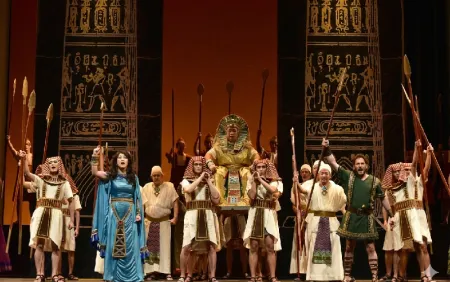
Opera Aida premiered in Cairo 1871, telling a timeless love story in ancient Egypt. Performed at Pyramids & temples, Verdi's masterpiece captivates audiences.
Saints Sergius and Bacchus Church were built to be dedicated to two Martyrs (Sergius and Bacchusand) traditionally believed to have been built on the spot where the Holy Family rested at the end of their journey into Egypt.
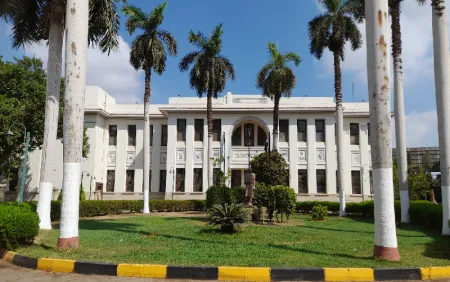
Cairo's Agricultural Museum, established 1938, features 7 halls showcasing 7,000 years of Egyptian farming history and ancient agricultural artifacts.
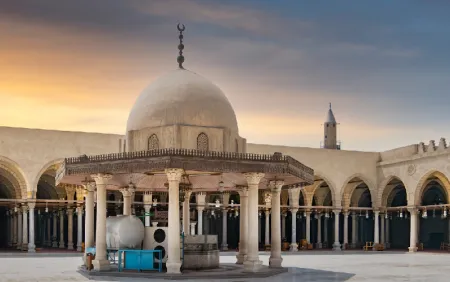
Fustat, founded 641 CE, was Egypt's first Islamic capital with 200,000 residents. This Silk Road trade hub beneath Old Cairo was deliberately destroyed in 1168.
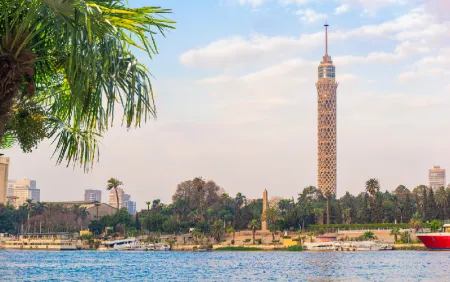
Cairo Tower's 187m lotus design offers 360° views & rotating restaurant. Discover hidden terrace & local secrets for Egypt's iconic landmark built 1956-1961.
Explore Birqash Camel Market in Cairo, where tradition and culture meet. Witness camel trading, local life, and a unique Egyptian market experience.
El Mosky is Cairo's authentic medieval marketplace from Ayyubid era. Serves locals with genuine prices, traditional crafts & spices. Metro accessible.
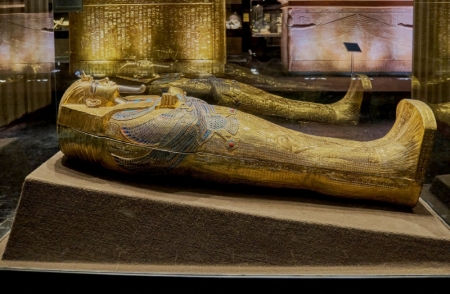
Learn about King Tutankhamun treasures and explore the secrets of his tomb, royal rituals, and preserved artifacts.
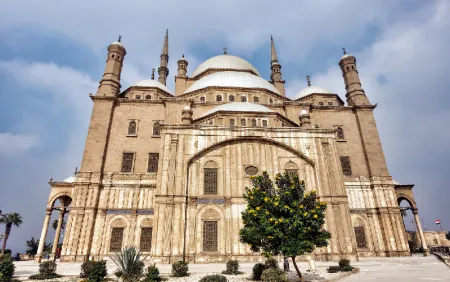
The Mohamed Ali Mosque is an Ottoman masterpiece built 1832-1857 inside Cairo Citadel. Called the Alabaster Mosque for its distinctive walls, it features a 52-meter central dome.
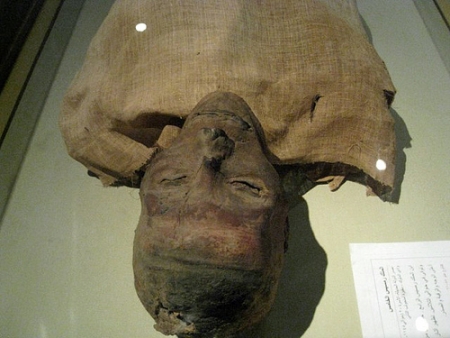
Egyptian mummies at Cairo's museums include 22 royal pharaohs moved in 2021 to NMEC. Features Tutankhamun, Hatshepsut, Seti I and 4,300-year-old preservation techniques.
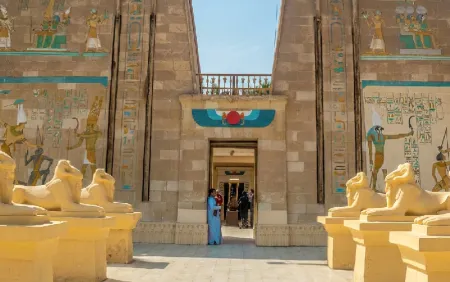
Pharaonic Village in Cairo, founded 1984, is a 30-acre living museum with 12 museums, King Tut's tomb replica & live ancient Egyptian demonstrations.
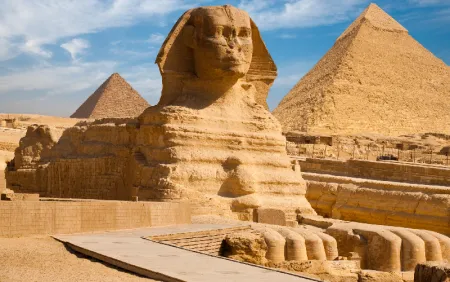
Great Sphinx of Giza, carved 2500 BCE, measures 73m long and 20m high. Contains three tunnels, hidden chambers & traces of red, blue & yellow paint.
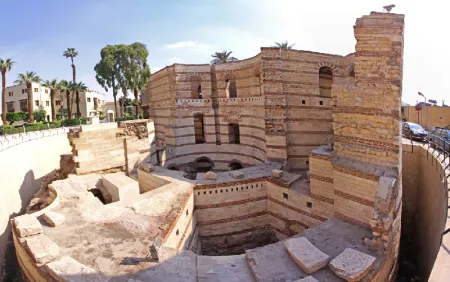
Babylon Fortress in Old Cairo, built 300 AD by Diocletian, features 10m Roman towers, Coptic churches, Ben Ezra Synagogue & museum with 16,000 artifacts.
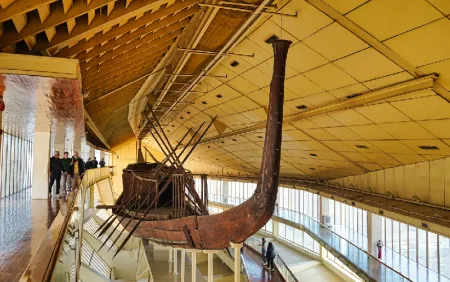
The Khufu Ship is a 4,600-year-old solar boat measuring 43.4 meters long. Built without nails using mortise-and-tenon joints, it's displayed at Grand Egyptian Museum.
Experience the Valley Temple of Khafre like never before. Explore its purpose, design, and must-see highlights—read the full guide now!