Khufu Ship
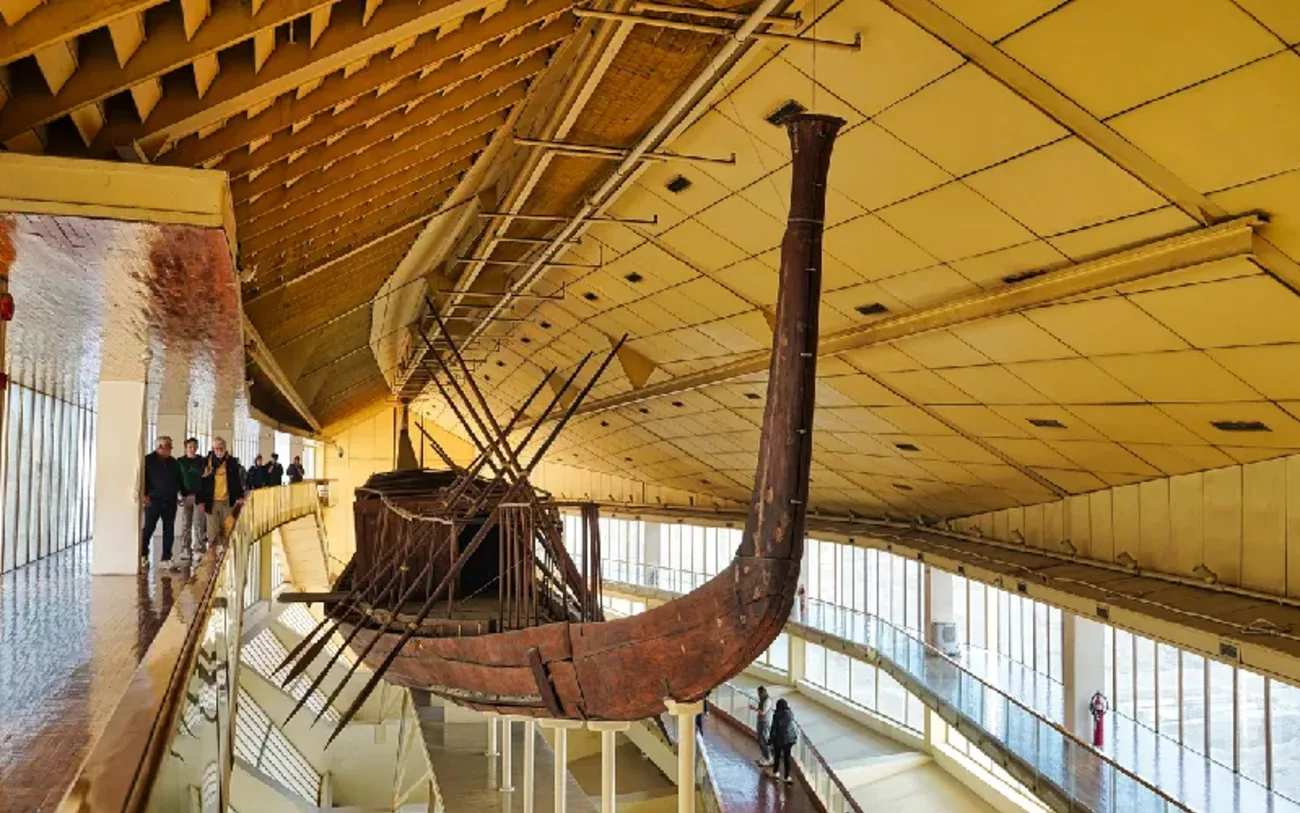
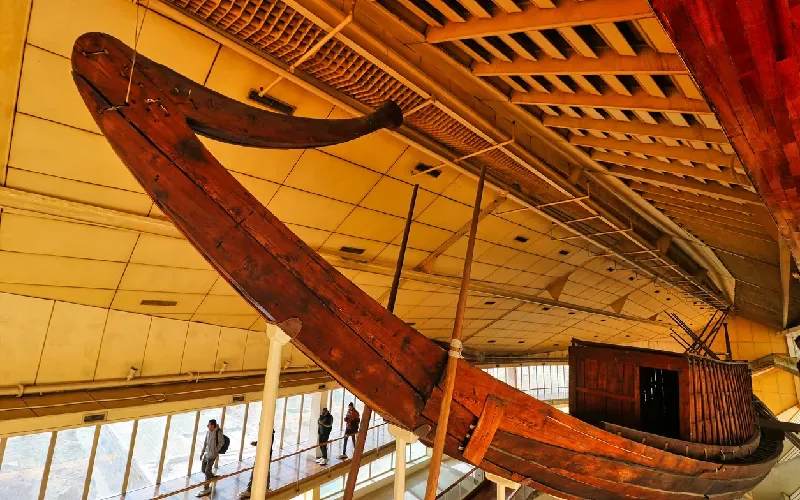
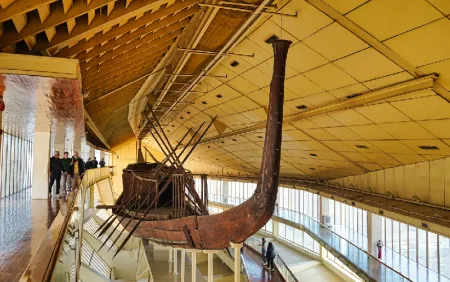
The Khufu ship rests beside the Great Pyramid of Giza, sealed there around 2500 BC. This 4,600-year-old solar barque ranks among the oldest, largest, and best-preserved vessels from ancient times. Pharaoh Khufu's ship stands as a true archeological treasure. The ancient Egyptian boat stretches 43.4 meters (142 ft) long and 5.9 meters (19 ft) wide. Experts call it "a masterpiece of woodcraft" - so well-built that it could sail today if placed in water.
The royal craft has transformed our knowledge of ancient Egyptian shipbuilding techniques. Known as the solar boat or pharaoh's ship, it holds the distinction of being the largest and oldest wooden artifact in human history. The 20-ton marvel made its way to the Grand Egyptian Museum from its previous home near the Pyramids of Giza. Visitors can now see what scholars consider the finest example of Ancient Egyptian shipbuilding ever found.
The full-sized cedar wood vessel stayed perfectly preserved though disassembled for nearly 4,500 years. This piece takes you through the story of this intact solar barque - from its discovery to its construction methods and its trip from a sealed pit to its museum home.
The Khufu Ship is a 4,600-year-old solar barque sealed beside the Great Pyramid of Giza around 2500 BC. This ancient Egyptian boat stretches 43.4 meters (142 feet) long and 5.9 meters (19 feet) wide, ranking among the oldest, largest, and best-preserved vessels from ancient times.
The Khufu Ship is approximately 4,600 years old, dating back to around 2500 BC during Pharaoh Khufu's reign. It holds the distinction of being the largest and oldest wooden artifact in human history.
Egyptian engineer and archeologist Kamal el-Mallakh found that there was something remarkable at the time he cleared rubble near the Great Pyramid of Giza in May 1954. His careful work revealed three meticulously excavated pits. One pit contained what would become one of the most important archeological finds of the 20th century.
El-Mallakh uncovered a sealed rectangular pit beneath a row of 40 limestone blocks. He created an exploratory hole in one of the blocks and peered inside. The sight amazed him - wooden planks and oars lay there, still covered with matting and rope remains. The cedar scent from these ancient artifacts was still detectable.
The team needed about 20 months to remove all 1,224 separate pieces of the disassembled ship. These wooden fragments stayed untouched for nearly 4,500 years. The limestone chamber preserved them perfectly. The pit's location was on the southern side of the Great Pyramid, about 12 meters (40 feet) deep beneath the Giza plateau.
The team found a second boat pit next to the first during their work. Both sealed pits were located opposite the Great Pyramid's southern side. The second boat's wooden pieces were finally extracted starting in 2014.
These discoveries are a great way to get knowledge about ancient Egyptian shipbuilding techniques, maritime technology, and funeral practices.
Egyptian engineer and archaeologist Kamal el-Mallakh discovered the Khufu Ship in May 1954 while clearing rubble near the Great Pyramid of Giza. He uncovered a sealed rectangular pit beneath a row of 40 limestone blocks containing the disassembled ship.
The Khufu Ship is now displayed at the Grand Egyptian Museum near Cairo. In August 2021, Egyptian authorities moved the 20-ton boat from the Solar Boat Museum near the Pyramids of Giza to its new permanent home, ensuring better conservation conditions.
The team discovered 1,224 separate wooden pieces of the disassembled ship. These wooden fragments stayed untouched for nearly 4,500 years in a sealed limestone chamber that preserved them perfectly.
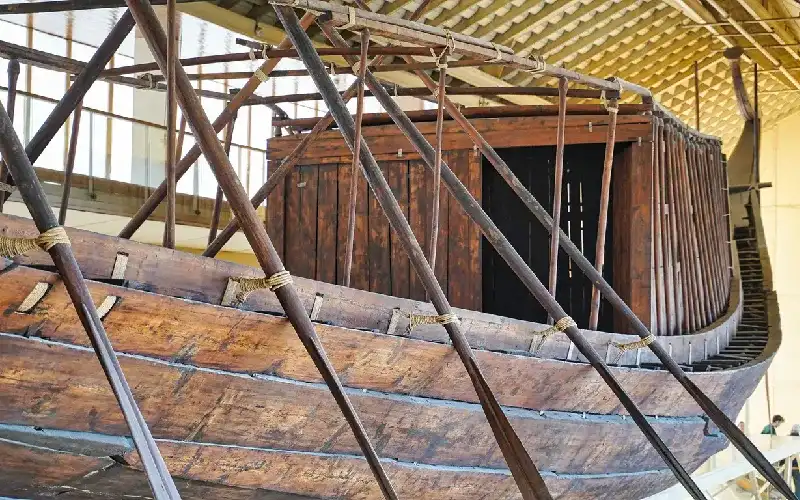
The Khufu ship stands as a masterpiece of ancient Egyptian craftsmanship, built mainly from imported Lebanon cedar. The builders used the "shell-first" construction technique and assembled the hull planks before adding internal structural parts. This remarkable vessel has no nails at all. The craftsmen connected adjacent planks using mortise-and-tenon joints made from Christ's thorn wood.
The ship's lashing system shows incredible ingenuity. The workers carved thousands of V-shaped channels into the planks' inside faces and "sewed" the ship together with halfa grass ropes. This complex rope network gave both flexibility and structural strength to the vessel. The builders used about three miles of rope throughout the construction.
Several planks make up the ship's flat bottom, which doesn't have a true keel. The wooden components are massive - many stretch beyond ten meters and are 10-15 centimeters thick. Research teams found that there was an interesting detail about the curved mid-sheer planks - builders twisted and bent them from straight planks instead of carving them from trunks.
The ship comes equipped with twelve oars, each one carved from a single piece of wood. Two steering oars sit at the stern, while ten more are placed amidships. Though the vessel looks complete, it might not have been meant for actual sailing since it lacks rigging and proper space for rowers.
Get in touch with our local experts for an unforgettable journey.
Plan Your Trip
The finding of disassembled wooden pieces in 1954 marked the beginning of a challenging reconstruction task. Egyptian antiquities specialist Ahmed Youssef Moustafa took charge of the complex reassembly process that lasted more than a decade. His shipbuilding expertise helped him piece together over 1,200 wooden fragments without any detailed plans or modern technology.
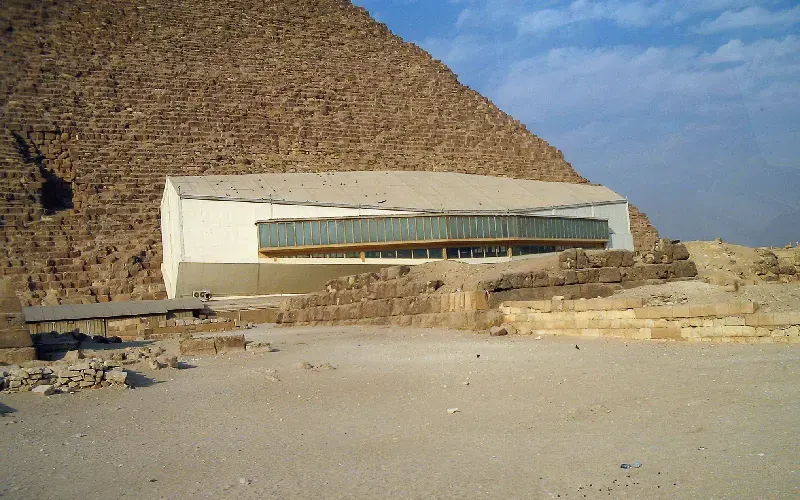
The restored vessel found its first home in a specialized facility built right above the excavation site near the Great Pyramid of Giza. This dedicated building became known as the Solar Boat Museum and opened its doors in 1982, quickly becoming a popular spot for Giza plateau visitors. The Khufu ship stayed in this climate-controlled environment for nearly four decades.
Egyptian authorities launched an ambitious project in August 2021 to move the ancient vessel to its new permanent home at the Grand Egyptian Museum. The team needed specialized equipment and extreme caution to transport the 20-ton boat. They moved it intact inside a metal cage, choosing nighttime hours and carefully planned routes to minimize risks.
The Khufu ship now stands as a centerpiece exhibit in the Grand Egyptian Museum near Cairo. Its new location ensures better conservation conditions and welcomes more visitors to see what experts call the finest example of ancient Egyptian shipbuilding. The boat remains a great way to get knowledge about ancient Egyptian craftsmanship and funeral customs.
The ship was built mainly from imported Lebanon cedar using "shell-first" construction technique. The remarkable vessel has no nails at all—craftsmen connected adjacent planks using mortise-and-tenon joints made from Christ's thorn wood and "sewed" the ship together with halfa grass ropes.
The Khufu ship is proof of ancient Egyptians' remarkable skill and craftsmanship. This 4,600-year-old vessel was found sealed next to the Great Pyramid of Giza and gives us a rare look into the past through its amazingly preserved wooden structure.
The ship's most fascinating feature is its construction technique. Ancient builders used no nails at all. They relied on mortise-and-tenon joints and a complex rope system that made the ship both flexible and strong. This approach shows how advanced their nautical engineering knowledge was thousands of years ago.
The ship's trip from its sealed pit to becoming a museum centerpiece took decades. Experts spent years putting together more than 1,200 wooden pieces after finding it in 1954. The ship's move to the Grand Egyptian Museum will help amaze future generations.
This vessel means much more than just its physical form. It has helped archeologists learn about ancient Egyptian maritime technology, trading abilities, and funeral customs. The wood's preservation for thousands of years shows how advanced the ancient Egyptians' conservation methods were.
Pharaoh Khufu's legacy lives through this magnificent boat. The vessel stayed silent for thousands of years but now tells us so much about a civilization that mastered engineering and artistic expression. The Khufu ship stands as the world's oldest intact ship and serves as a floating time capsule that teaches and inspires its visitors.
Egyptian antiquities specialist Ahmed Youssef Moustafa took charge of the complex reassembly process that lasted more than a decade. His shipbuilding expertise helped him piece together over 1,200 wooden fragments without any detailed plans or modern technology.
The team needed about 20 months to remove all 1,224 separate pieces of the disassembled ship from the sealed pit. The pit was located on the southern side of the Great Pyramid, about 12 meters (40 feet) deep beneath the Giza plateau.
Experts call it "a masterpiece of woodcraft" so well-built that it could sail today if placed in water. However, it might not have been meant for actual sailing since it lacks rigging and proper space for rowers, suggesting it was built for ceremonial or funerary purposes.
Builders used the "shell-first" construction technique, assembling the hull planks before adding internal structural parts. The workers carved thousands of V-shaped channels into the planks' inside faces and used about three miles of halfa grass rope to lash the ship together.
The ship comes equipped with twelve oars, each carved from a single piece of wood. Two steering oars sit at the stern, while ten more are placed amidships, demonstrating sophisticated ancient Egyptian boat design.
The ship was built mainly from imported Lebanon cedar for the hull. Craftsmen used Christ's thorn wood for mortise-and-tenon joints and halfa grass ropes (about three miles total) for the complex lashing system. Several planks make up the flat bottom without a true keel.
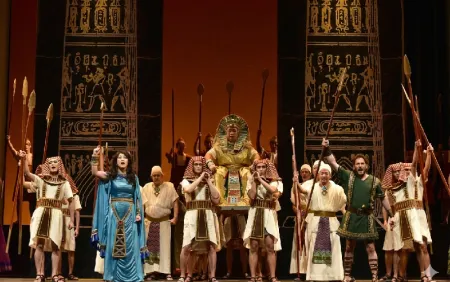
Opera Aida premiered in Cairo 1871, telling a timeless love story in ancient Egypt. Performed at Pyramids & temples, Verdi's masterpiece captivates audiences.
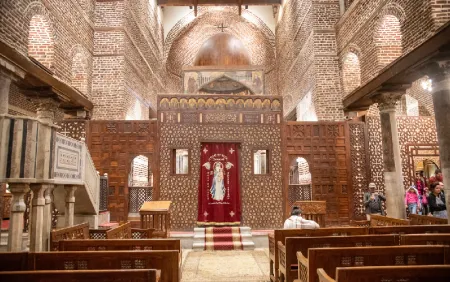
Saints Sergius and Bacchus Church were built to be dedicated to two Martyrs (Sergius and Bacchusand) traditionally believed to have been built on the spot where the Holy Family rested at the end of their journey into Egypt.
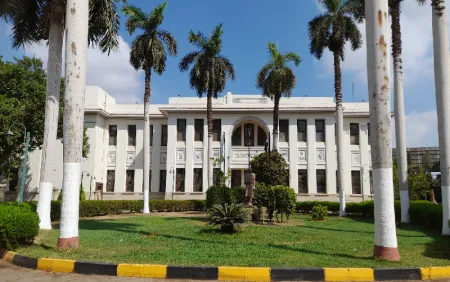
Cairo's Agricultural Museum, established 1938, features 7 halls showcasing 7,000 years of Egyptian farming history and ancient agricultural artifacts.
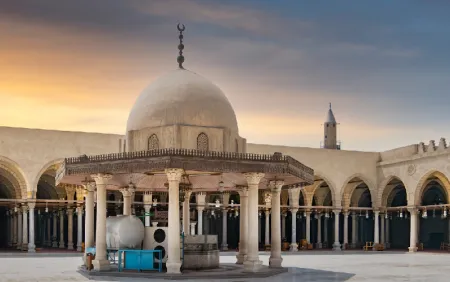
Fustat, founded 641 CE, was Egypt's first Islamic capital with 200,000 residents. This Silk Road trade hub beneath Old Cairo was deliberately destroyed in 1168.
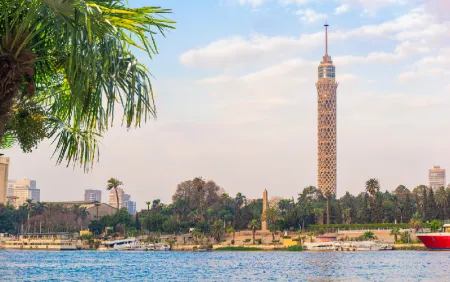
Cairo Tower's 187m lotus design offers 360° views & rotating restaurant. Discover hidden terrace & local secrets for Egypt's iconic landmark built 1956-1961.
Explore Birqash Camel Market in Cairo, where tradition and culture meet. Witness camel trading, local life, and a unique Egyptian market experience.
El Mosky is Cairo's authentic medieval marketplace from Ayyubid era. Serves locals with genuine prices, traditional crafts & spices. Metro accessible.
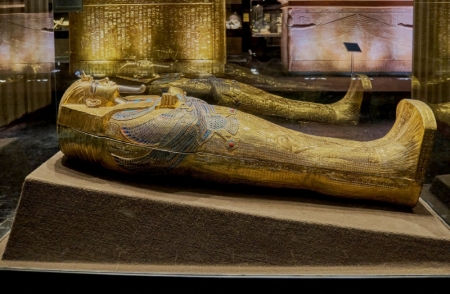
Learn about King Tutankhamun treasures and explore the secrets of his tomb, royal rituals, and preserved artifacts.
The Mohamed Ali Mosque is an Ottoman masterpiece built 1832-1857 inside Cairo Citadel. Called the Alabaster Mosque for its distinctive walls, it features a 52-meter central dome.
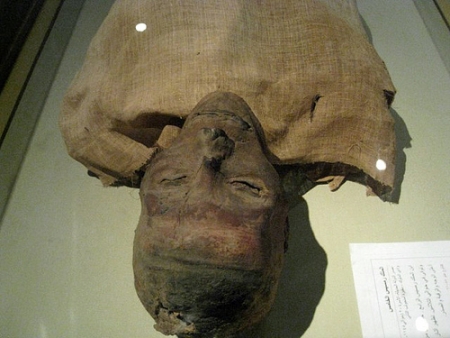
Egyptian mummies at Cairo's museums include 22 royal pharaohs moved in 2021 to NMEC. Features Tutankhamun, Hatshepsut, Seti I and 4,300-year-old preservation techniques.
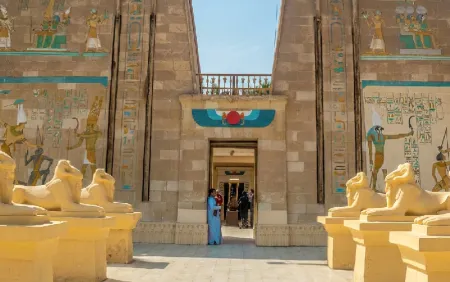
Pharaonic Village in Cairo, founded 1984, is a 30-acre living museum with 12 museums, King Tut's tomb replica & live ancient Egyptian demonstrations.
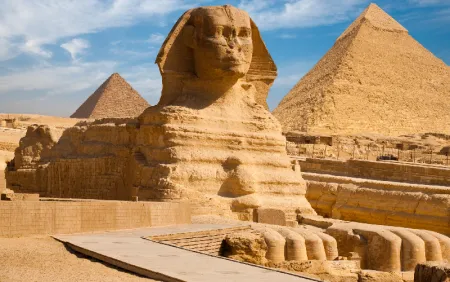
Great Sphinx of Giza, carved 2500 BCE, measures 73m long and 20m high. Contains three tunnels, hidden chambers & traces of red, blue & yellow paint.
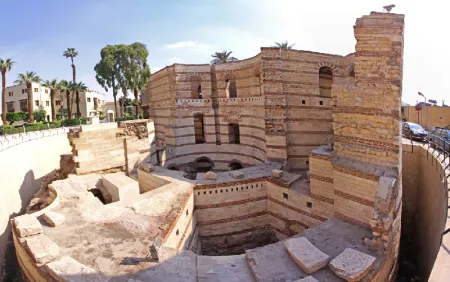
Babylon Fortress in Old Cairo, built 300 AD by Diocletian, features 10m Roman towers, Coptic churches, Ben Ezra Synagogue & museum with 16,000 artifacts.
The Khufu Ship is a 4,600-year-old solar boat measuring 43.4 meters long. Built without nails using mortise-and-tenon joints, it's displayed at Grand Egyptian Museum.
Experience the Valley Temple of Khafre like never before. Explore its purpose, design, and must-see highlights—read the full guide now!