Canopic Jars: Fascinating Story Behind Ancient Treasures
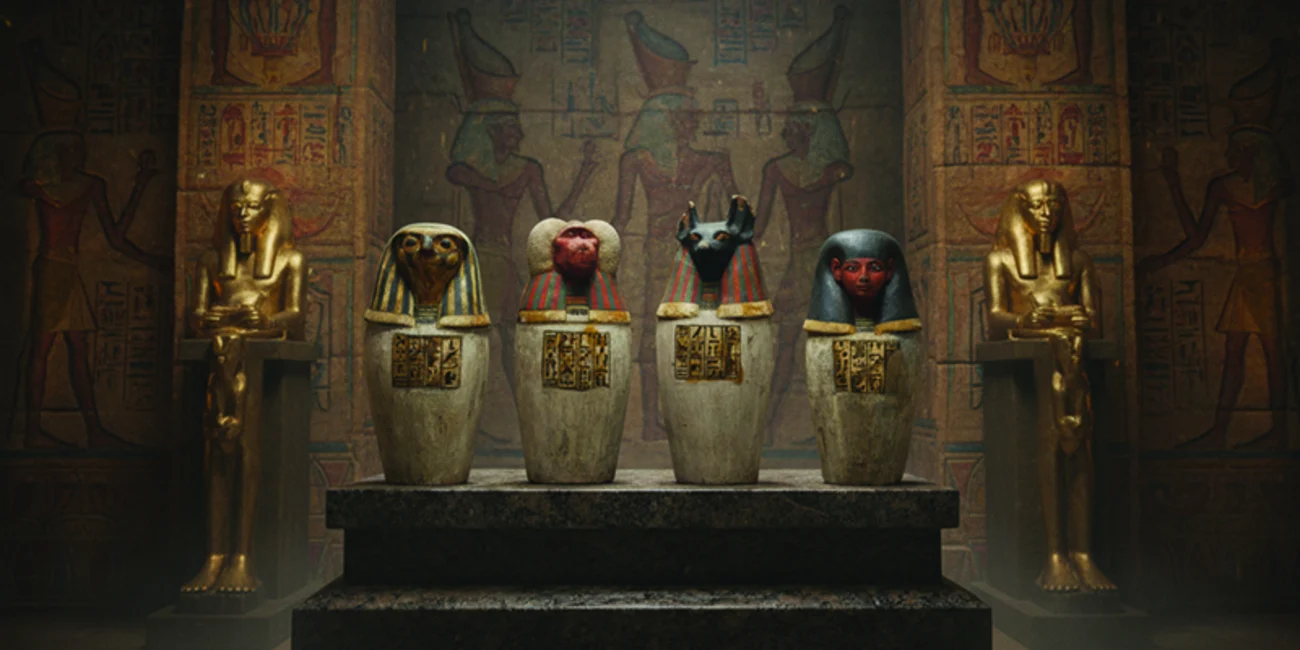
Canopic jars stand as one of ancient Egypt's most intriguing artifacts. These vessels played a vital role in mummification since the Old Kingdom period. The specialized funerary containers housed embalmed organs removed from the body during mummification. Ancient Egyptians removed four key organs—the lungs, liver, stomach, and intestines—to preserve the corpse for the afterlife.
The story of canopic jars reveals their remarkable evolution. Simple stone containers with plain lids marked their beginnings. These vessels transformed into elaborate containers that showcased the civilization's sophisticated funerary practices. Though organ removal started in the Old Kingdom (around 2575 BCE), these specialized containers became common during the First Intermediate Period. Artisans crafted Egyptian canopic jars from stone, wood, pottery, and glazed composition.
This piece will take you through the remarkable story of these artifacts. You'll learn about their vital role in mummification and meet the four sons of Horus who guarded the preserved organs. We'll get into modern discoveries that improved our understanding and reflect on their significance in ancient Egyptian culture. The sort of thing I love about these vessels continues to fascinate archeologists and history enthusiasts today.
Canopic jars were specialized funerary containers used to store embalmed organs removed during mummification. These vessels played a vital role in ancient Egyptian burial practices, ensuring the preservation of key organs for the afterlife.
Ancient Egyptians started removing organs during the Old Kingdom. They didn't use canopic jars regularly to store these organs until the First Intermediate Period. These special vessels helped preserve the dead person's organs during their trip to the afterlife.
Embalmers made an incision on the left side of the abdomen to remove four key organs - the lungs, liver, stomach, and intestines. Each organ needed careful preservation. They used natron salt to dry the organs and stop decay. The organs were then embalmed, coated with oils, and wrapped carefully in linen before being placed in their own jar.
The heart stayed in the body untouched. Egyptians believed it was where the soul lived and needed it to face judgment in the afterlife. The brain was pulled out through the nose and thrown away since they thought it wasn't important.
The whole ordeal of mummification took about 70 days. At first, people stored canopic jars in special chests next to the sarcophagus. Later, especially when you have the New Kingdom period, people placed them in rows under the bier or in the four corners of the burial chamber.
Better embalming methods made organ removal unnecessary over time. Still, canopic jars remained important symbols in burial rituals. Later periods saw the rise of smaller "dummy jars" that looked traditional but didn't actually hold any organs.
The four key organs preserved in canopic jars were the lungs, liver, stomach, and intestines. Embalmers dried them using natron salt, coated them with oils, and wrapped them carefully in linen before placing them in separate jars.
Organ removal began during the Old Kingdom (around 2575 BCE), but canopic jars became common during the First Intermediate Period as specialized vessels for preserving organs during mummification.
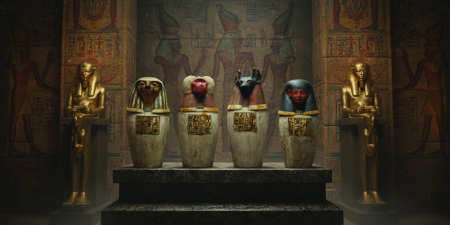
The Four Sons of Horus played a significant role as deities in Egyptian burial customs. They served as guardians of the internal organs preserved in canopic jars. The stoppers of these jars evolved during the late 18th dynasty to feature these four protective deities.
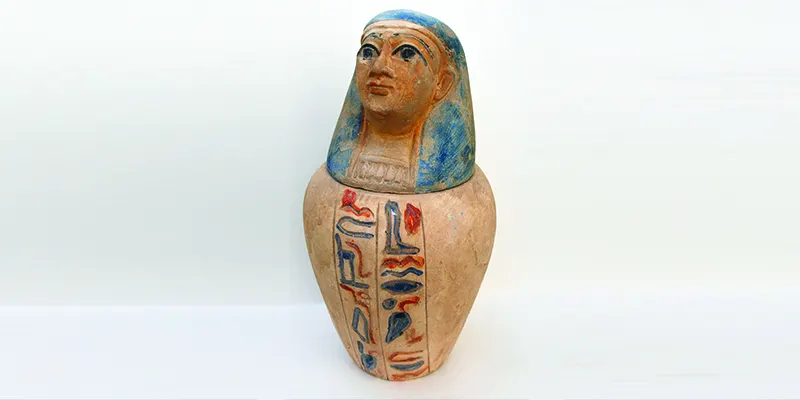
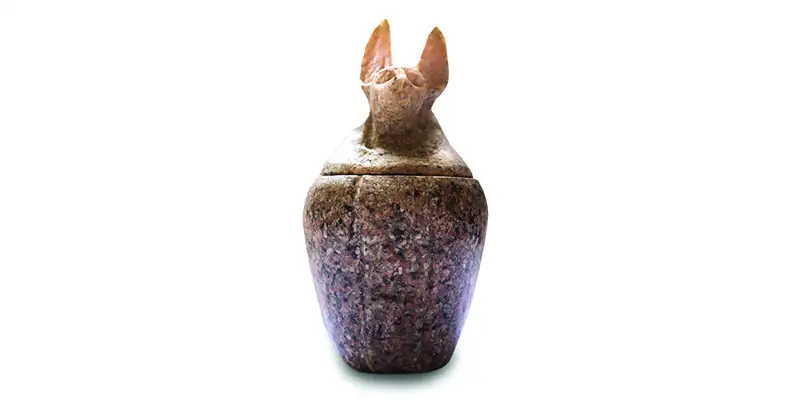
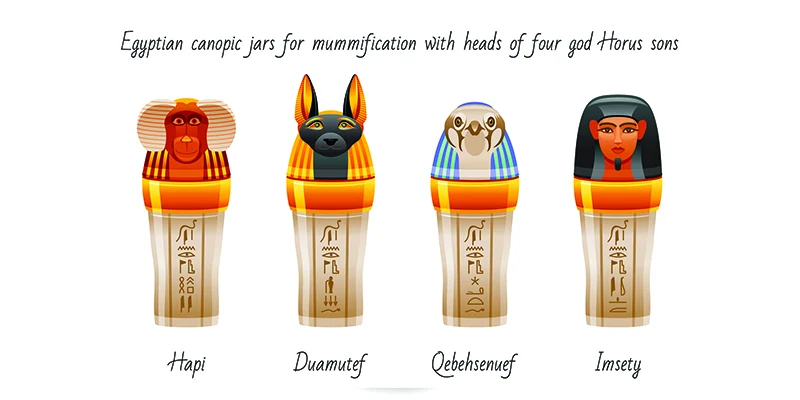
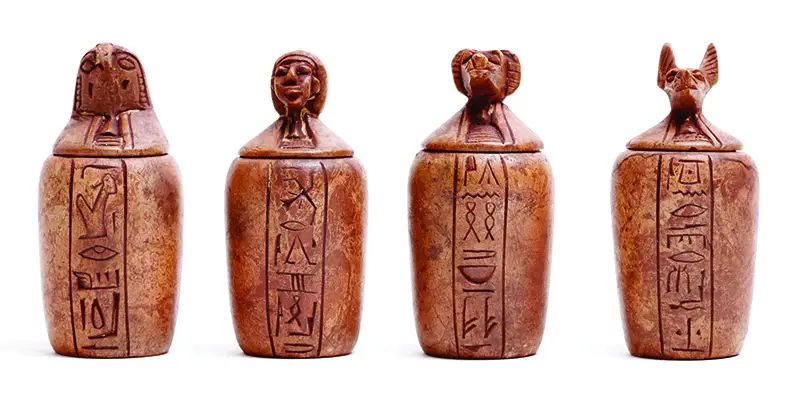
Each son had unique features and duties. Imsety appeared with a human head and protected the liver. Hapy showed a baboon head and guarded the lungs. Duamutef displayed a jackal head and watched over the stomach. The falcon-headed Qebehsenuef safeguarded the intestines.
These protective beings also linked to cardinal directions. Imsety stood for the south, Hapy represented the north, Duamutef symbolized the east, and Qebehsenuef embodied the west.
Four goddesses protected the sons themselves. Isis watched over Imsety, while Nephthys guarded Hapy. Neith protected Duamutef, and Serqet kept Qebehsenuef safe.
Ancient Egyptians believed that preserved organs were vital for rebirth in the afterlife. These four guardians helped maintain the deceased's vitality beyond death. Their images appeared on canopic jars, coffins, and funerary stelae.
These sons served broader spiritual purposes too. Imsety brought life back to the corpse, while Hapy helped with afterlife navigation. Duamutef worshiped the dead, and Qebehsenuef refreshed and reassembled the deceased.
The Four Sons of Horus—Imsety, Hapy, Duamutef, and Qebehsenuef—served as guardians of the internal organs. Their images appeared on the stoppers of canopic jars, reflecting their protective role in burial customs.
Each son had a unique role: Imsety (human head) protected the liver, Hapy (baboon head) guarded the lungs, Duamutef (jackal head) watched over the stomach, and Qebehsenuef (falcon head) safeguarded the intestines. They also represented cardinal directions and helped maintain the deceased’s vitality in the afterlife.
Get in touch with our local experts for an unforgettable journey.
Plan Your TripScientists have made remarkable breakthroughs in understanding ancient Egyptian canopic jars. Their most notable achievement is the first-ever recovery of ancient human DNA from these vessels. This innovative work creates new possibilities to study these overlooked artifacts.
Modern imaging methods have helped scientists analyze jar contents without damaging them. CT scans yield better diagnostic image quality (average rating 2.75) than MRI (1.78) and x-ray imaging (1.72). These scans revealed something unexpected - in stark comparison to this Herodotus' writings, the jars likely held small organ fragments rather than complete organs.
Scientists used CT-based volume calculations and found that most jars couldn't hold complete human organs, even after drying. This discovery substantially changes what we know about ancient Egyptian burial customs.
Archeologists have found some unusual departures from traditional practices. At Saqqara, they found a woman named Didibastett who was buried with six canopic jars instead of the usual four. CT scans showed these extra jars contained unidentified human tissue.
Scientists analyzed residues in mummification workshops and identified many substances. They found bitumen, cedar oil, cedar resin, pistachio resin, beeswax, and animal fat. This gave an explanation about specific materials used to preserve organs.
Canopic jars are without doubt remarkable windows into ancient Egyptian beliefs and practices. These vessels surpassed their practical function of organ preservation and became powerful symbols in Egyptian funerary traditions. Simple containers evolved into elaborately designed artifacts that reflected Egyptian religious concepts' development over centuries.
The Four Sons of Horus played a vital role as guardians. They protected specific organs while serving broader spiritual purposes for the deceased's trip to the afterlife. The Egyptians' detailed approach to afterlife preparations showed in this connection between physical preservation and spiritual protection.
Scientific techniques have substantially changed what we know about these ancient treasures. DNA recovery, advanced imaging, and chemical analysis have challenged long-held assumptions about canopic jars. The sort of thing I love is that researchers found that there was evidence of organ fragments rather than entire organs in these vessels. This discovery made scholars rethink traditional interpretations of mummification practices.
Ancient Egyptians thought proper preservation of bodily remains would ensure rebirth in the afterlife. These jars weren't just functional containers - they were vital components in a complex spiritual system. Their presence in burials continued even after actual organ removal became unnecessary, showing their deep religious importance.
The fascination with canopic jars goes beyond their historical function today. These artifacts help us learn about Egyptian religious beliefs, artistic traditions, technological capabilities, and social hierarchies. Each jar we find adds another piece to our understanding of this remarkable civilization.
Canopic jars ended up showing us how ancient Egyptians saw death not as an ending but as a transition that needed careful preparation. Their careful attention to preserving bodily organs reflects a civilization deeply invested in eternal life. These artifacts continue to captivate us across millennia, connecting modern humanity with ancient Egyptian hopes and beliefs about the afterlife.
Recent scientific techniques, including CT scans and DNA analysis, revealed that canopic jars often contained small organ fragments rather than entire organs. This has reshaped our understanding of ancient Egyptian burial practices and the jars’ true function.
Beyond preserving organs, canopic jars became powerful symbols in Egyptian funerary traditions. They represented spiritual protection, the promise of rebirth in the afterlife, and the intricate connection between physical preservation and religious beliefs.
Canopic jars were vital in ancient Egypt, preserving organs and symbolizing rebirth. Explore their history, the Four Sons of Horus, and modern discoveries.
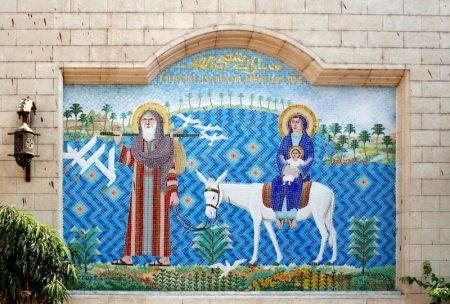
Journey along the Holy Family in Egypt's path. Learn about the historical route, significant sites, and the enduring legacy they left behind.
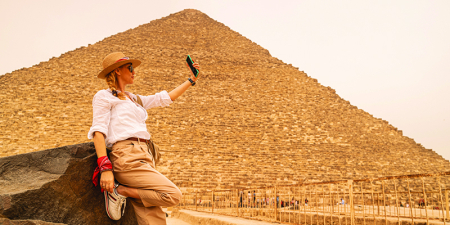
The Khufu Pyramid, located on the Giza Plateau in Egypt, is the largest and most famous pyramid ever built. Constructed around 2600 BC, it reflects ancient Egyptian engineering excellence, deep religious beliefs, and the divine power of Pharaoh Khufu.
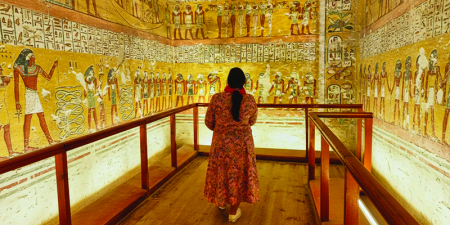
Ramesses IV, a New Kingdom pharaoh, left a lasting legacy through ambitious building projects and a uniquely preserved mummy. His tomb KV2 reveals key insights into ancient Egyptian beliefs about death and eternity.
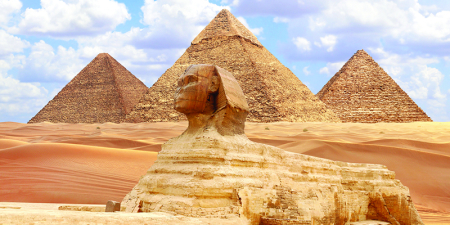
Explore the Khafre Pyramid, Egypt’s second largest Giza pyramid. Discover its unique architecture, the Great Sphinx, Mortuary & Valley Temples, and King Khafre statue in this iconic ancient Egyptian complex.
The Djoser Pyramid in Saqqara, Egypt, is the world’s first Step Pyramid, built for Pharaoh Djoser during the Third Dynasty. Designed by Imhotep, it revolutionized stone construction and ancient Egyptian burial practices, combining ceremonial, symbolic, and functional elements in a single monumental complex.
Menkaure Pyramid in Giza, Egypt, is the smallest of the three main pyramids, featuring unique dual-material casing, complex chambers, mortuary temple, and iconic King Menkaure statues
Discover how the Hathor Temple at Dendara connects ancient Egyptian religion with the stars and cosmos.