The Great Sphinx of Giza

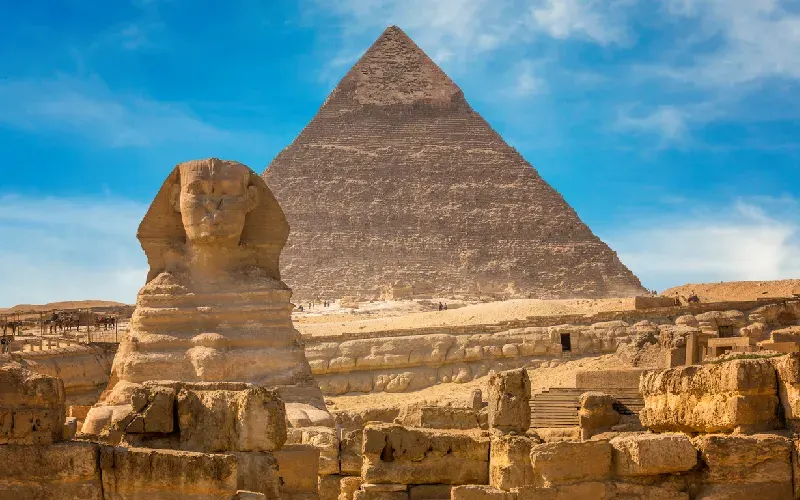
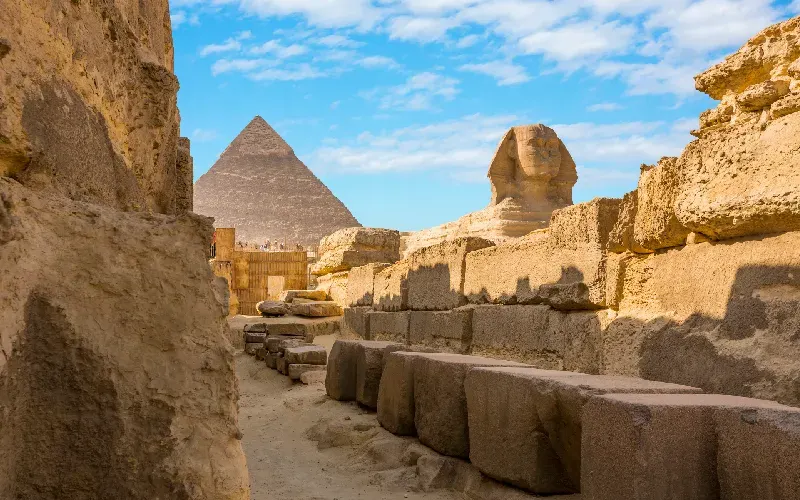
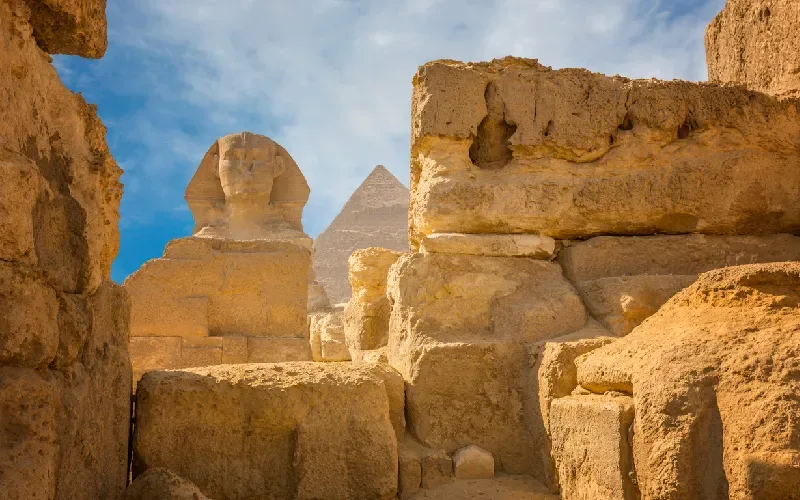
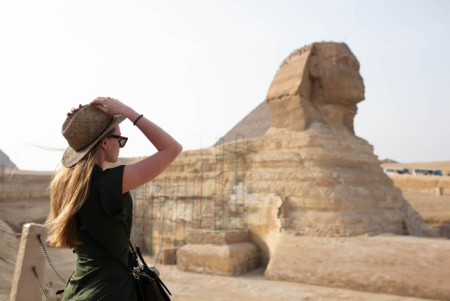
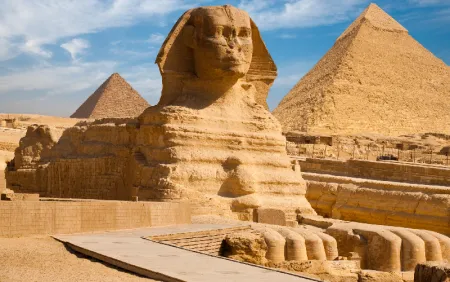
The Great Sphinx is located on the Giza plateau in Egypt, carved directly from the plateau's bedrock. This UNESCO World Heritage Site stands as the most prominent example of sphinx art worldwide, guarding the ancient monuments of Giza.
The Great Sphinx measures 73 meters (240 feet) long and 20 meters (66 feet) high, making it one of the world's largest sculptures. The monument features a 20-foot-wide face and rises 66 feet from its base to the head's top.
Most archaeologists believe ancient Egyptians carved the Great Sphinx around 2500 BCE during the Old Kingdom, under the reign of either Khufu or Khafre. This makes the monument approximately 4,500 years old, though some alternative theories suggest it might be as old as 9,000 years.
The Great Sphinx stands majestically on the Giza Plateau, carved from soft limestone with a lion's body and a pharaoh's head. Most Egyptologists believe the face belongs to Pharaoh Khafre, though this connection relies on circumstantial evidence. The monument features a 20-foot-wide face and rises 66 feet from its base to the head's top.
The Sphinx's damaged face remains one of its most fascinating aspects. Many people wrongly blame Napoleon Bonaparte for shooting off its nose. The real culprit was a Sufi named Muhammad Saim al-Dahr who damaged it in the ninth century AD. He believed people were wrongfully treating the statue as a deity.
Researchers have found that there were three tunnels inside the Great Sphinx, but these passages seem to end abruptly. Recent studies have also revealed hidden cavities beneath the monument. These include a deep hole near the tail that connects to a large chamber, and another smaller chamber lies underneath the paws.
The Sphinx's religious importance changed significantly over time. The New Kingdom period saw it become linked to the sun god Hor-em-akhet (Harmachis), known as "Horus-at-the-Horizon". Around 1400 BCE, Pharaoh Amenhotep II constructed a temple nearby and dedicated it to this cult, nearly a millennium after the Sphinx's creation.
Most scholars date the Sphinx to approximately 2500 BCE. However, some alternative theories suggest it might be much older - maybe even 9,000 years old. These theories stem from precipitation-induced weathering patterns found on the monument's upper sections.
Most Egyptologists believe the face belongs to Pharaoh Khafre, though this connection relies on circumstantial evidence. Some alternative theories suggest the head was re-carved from its original shape, possibly a lion's head.
Yes, researchers have found three tunnels inside the Great Sphinx, though these passages seem to end abruptly. These include "Perring's Hole" behind the head, a shaft on top that might have held a crown, and passages below leading to natural caves.
The Great Sphinx holds fascinating secrets behind its weathered exterior that sit in plain sight. Research has found that this ancient monument once showed off vibrant colors.
Scientists found red pigment traces on its cheeks that show its face was painted crimson, while blue and yellow pigments were found in other areas. The sort of thing I love is that the Sphinx didn't look like the plain stone we see today - it actually had what experts call "gaudy comic book colors".
The Sphinx's ceremonial beard came later, during Thutmose IV's reign. The original straight beard from Khafra's time was replaced with one that had a curved tip - a special feature that marked the wearer as a deity. This beard broke off over time, and archeologists found its pieces between the front paws in the 19th century. You can now see parts of it in Cairo's Egyptian Museum and London's British Museum.
The monument has many mysterious shafts and tunnels running through and under it. These include "Perring's Hole" behind the head, a shaft on top that might have held a crown, and passages below that lead to natural caves. Historical records tell us priests used these tunnels to sneak inside the Sphinx and make people think an oracle was speaking from within.
A popular legend suggests an ancient library exists under the Sphinx, with its entrance near the right paw. However, archeologists haven't found anything to support this story.
Get in touch with our local experts for an unforgettable journey.
Plan Your Trip
Researchers have proposed several controversial theories that challenge what most archeologists believe about the Great Sphinx. The most compelling evidence comes from geologist Robert Schoch's study of erosion patterns on the Sphinx's body and surrounding walls. His research showed these wavy vertical patterns came from rainfall rather than wind or sand. This evidence led Schoch to date the monument between 7000-5000 BCE, maybe even as far back as 9000 BCE.
The logic behind this theory makes sense. Egypt hasn't seen heavy rainfall in at least 7,000 years. Water erosion on the Sphinx means it must be older than Egypt's desert climate.
The Sphinx's astronomical features raise more questions. It faces east and lines up perfectly with the rising sun during spring equinox. Graham Hancock and Robert Bauval believe the Sphinx might represent Leo constellation as it appeared around 10,500 BCE.
The Sphinx's head seems unusually small compared to its body. Some experts think it was carved again from its original shape - possibly a lion's head.
These alternative views suggest an advanced civilization existed thousands of years before ancient Egypt. Mainstream Egyptologists reject these ideas because they lack archeological evidence.
The remarkable construction required about 100 workers using stone hammers and copper chisels, who completed this massive statue carved from limestone bedrock in roughly three years during the Old Kingdom period.
Contrary to popular belief, Napoleon Bonaparte did not shoot off the Sphinx's nose. The real culprit was a Sufi named Muhammad Saim al-Dahr who damaged it in the ninth century AD because he believed people were wrongfully treating the statue as a deity.
Yes, the Sphinx's ceremonial beard came later during Thutmose IV's reign. The original straight beard from Khafra's time was replaced with one that had a curved tip—a special feature marking the wearer as a deity. The beard broke off over time, with pieces now in Cairo's Egyptian Museum and London's British Museum.
Yes, research has revealed that the Great Sphinx once displayed vibrant colors. Scientists found red pigment traces on its cheeks showing the face was painted crimson, while blue and yellow pigments were found in other areas—what experts call "gaudy comic book colors."
Recent studies have revealed hidden cavities beneath the monument, including a deep hole near the tail that connects to a large chamber, and another smaller chamber underneath the paws. Historical records tell us priests used tunnels to make people think an oracle was speaking from within.
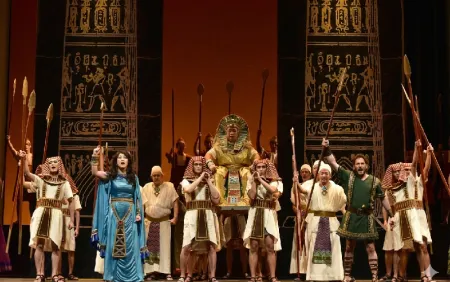
Opera Aida premiered in Cairo 1871, telling a timeless love story in ancient Egypt. Performed at Pyramids & temples, Verdi's masterpiece captivates audiences.
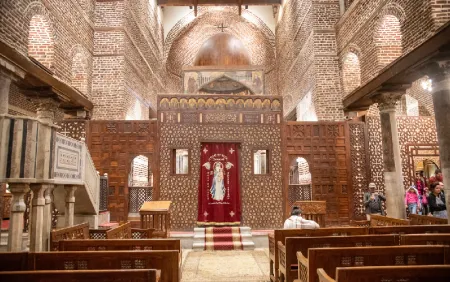
Saints Sergius and Bacchus Church were built to be dedicated to two Martyrs (Sergius and Bacchusand) traditionally believed to have been built on the spot where the Holy Family rested at the end of their journey into Egypt.
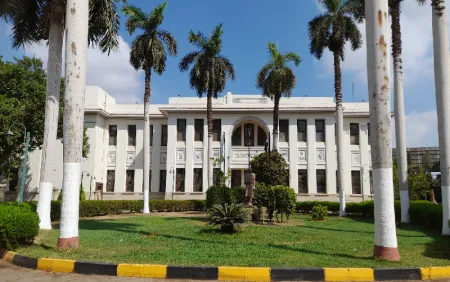
Cairo's Agricultural Museum, established 1938, features 7 halls showcasing 7,000 years of Egyptian farming history and ancient agricultural artifacts.
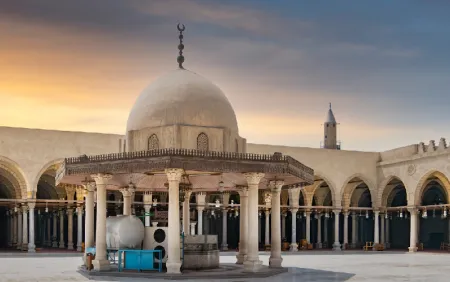
Fustat, founded 641 CE, was Egypt's first Islamic capital with 200,000 residents. This Silk Road trade hub beneath Old Cairo was deliberately destroyed in 1168.
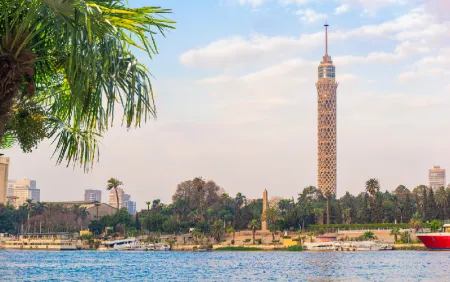
Cairo Tower's 187m lotus design offers 360° views & rotating restaurant. Discover hidden terrace & local secrets for Egypt's iconic landmark built 1956-1961.
Explore Birqash Camel Market in Cairo, where tradition and culture meet. Witness camel trading, local life, and a unique Egyptian market experience.
El Mosky is Cairo's authentic medieval marketplace from Ayyubid era. Serves locals with genuine prices, traditional crafts & spices. Metro accessible.
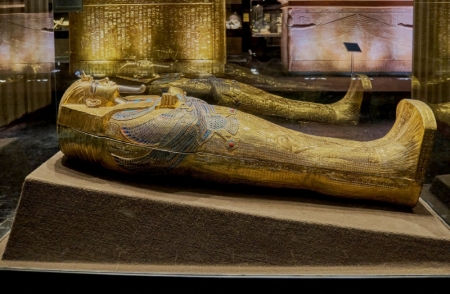
Learn about King Tutankhamun treasures and explore the secrets of his tomb, royal rituals, and preserved artifacts.
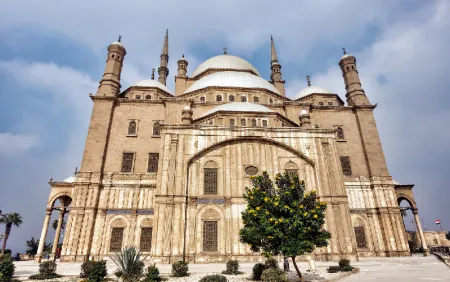
The Mohamed Ali Mosque is an Ottoman masterpiece built 1832-1857 inside Cairo Citadel. Called the Alabaster Mosque for its distinctive walls, it features a 52-meter central dome.
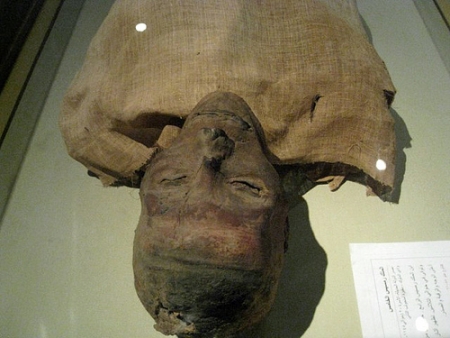
Egyptian mummies at Cairo's museums include 22 royal pharaohs moved in 2021 to NMEC. Features Tutankhamun, Hatshepsut, Seti I and 4,300-year-old preservation techniques.
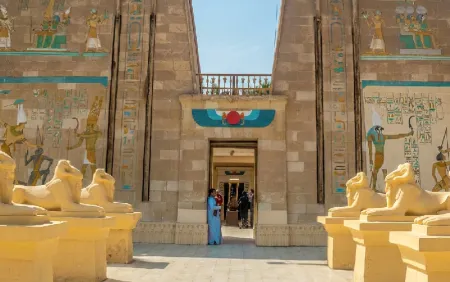
Pharaonic Village in Cairo, founded 1984, is a 30-acre living museum with 12 museums, King Tut's tomb replica & live ancient Egyptian demonstrations.
Great Sphinx of Giza, carved 2500 BCE, measures 73m long and 20m high. Contains three tunnels, hidden chambers & traces of red, blue & yellow paint.
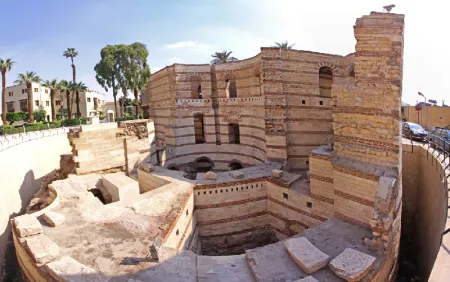
Babylon Fortress in Old Cairo, built 300 AD by Diocletian, features 10m Roman towers, Coptic churches, Ben Ezra Synagogue & museum with 16,000 artifacts.
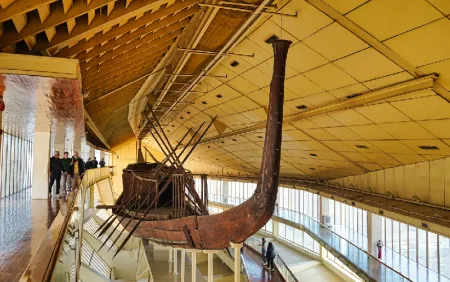
The Khufu Ship is a 4,600-year-old solar boat measuring 43.4 meters long. Built without nails using mortise-and-tenon joints, it's displayed at Grand Egyptian Museum.
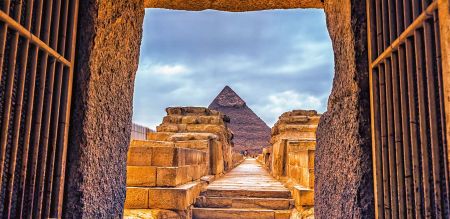
Experience the Valley Temple of Khafre like never before. Explore its purpose, design, and must-see highlights—read the full guide now!