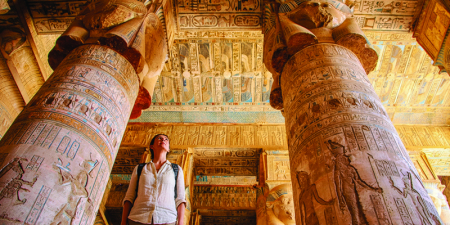
Dendara Temple: Design and Historical Significance

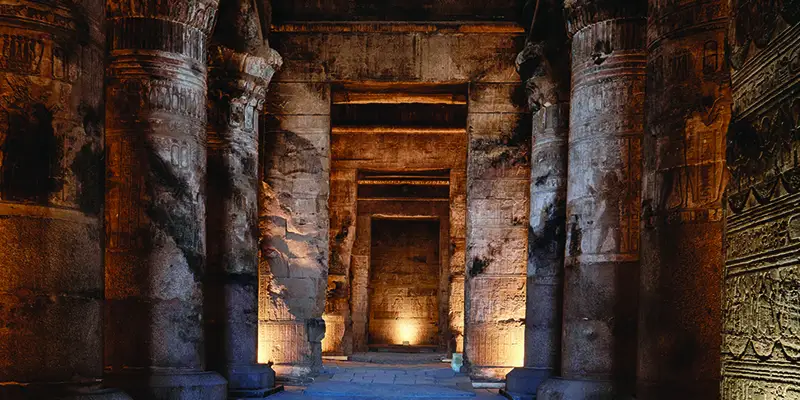
The Dendara Temple is one of the best-preserved religious monuments of ancient Egypt and a remarkable example of Egyptian sacred architecture. Located approximately 2.5 kilometers southeast of the modern town of Dendera near Qena, the temple complex covers an area of nearly 40,000 square meters. Its monumental entrance, defined by massive columns and imposing stone walls, immediately reflects the power and artistic refinement of ancient Egyptian builders.
At the heart of the complex stands the Hathor Temple, dedicated to Hathor, one of the most important deities in Ancient Egypt Hathor worship. Although the visible structure dates mainly to the Greco-Roman period, the temple was constructed over much earlier sacred foundations, demonstrating the site’s long-standing religious importance. For centuries, Dendara served as a major cult center where rituals honoring the Ancient Egyptian Goddess Hathor were performed continuously, adapting to political and cultural changes while preserving core religious traditions.
The Dendara Temple is an ancient Egyptian religious complex located near Qena, Upper Egypt, dedicated mainly to the goddess Hathor.
The location of the Dendara Temple was carefully chosen for both religious and cosmic reasons. Positioned near a prominent bend of the Nile River, the site held strategic and symbolic significance. In ancient times, Dendera was the capital of the sixth nome of Upper Egypt, further enhancing its political and religious status.
Archaeological discoveries in nearby cemeteries reveal burials and artifacts dating back to the Old Kingdom, confirming that the area had been considered sacred for thousands of years. The temple’s main axis is oriented northward, aligned with the ancient pole star Alpha Draconis. This precise orientation reflects the ancient Egyptians’ advanced astronomical knowledge and their belief in the cosmic role of Ancient Egypt Hathor, who was associated with the sky, stars, and divine order.
The Hathor Temple is located at Dendara, about 70 km north of Luxor and near the modern city of Qena in Upper Egypt.
The architectural history of Dendara Temple spans more than two millennia. The earliest structures on the site date back to the reign of King Pepi I of the Sixth Dynasty, around 2250 BCE. Later phases include remains of a temple from the Eighteenth Dynasty, highlighting the site’s continuous religious use throughout different historical periods.
Major construction activity took place during the Late Period and the Ptolemaic era. King Nectanebo I initiated the construction of a mammisi, or birth house, along with the Temple of Isis. The Temple of Isis was later completed under Ptolemy X.
The current Hathor Temple, which dominates the complex today, began construction on July 16, 54 BCE, during the reign of Ptolemy XII. Work continued under successive Ptolemaic rulers and was later expanded by Roman emperors. One of the most significant Roman additions was the hypostyle hall built under Emperor Tiberius, featuring massive columns that define the temple’s grandeur.
The main Hathor Temple was built during the Ptolemaic and Roman periods, starting in 54 BCE, on earlier sacred foundations.
Get in touch with our local experts for an unforgettable journey.
Plan Your TripOne of the most striking features of the Dendara Temple is the exceptional preservation of its colors and reliefs. After the temple was abandoned in antiquity, desert sands gradually buried large sections of the structure. This natural covering protected the walls and ceilings from sunlight, moisture, and human damage for centuries.
When Napoleon’s expedition encountered the temple in 1798, observers were astonished by the vivid colors that had survived nearly intact. The ceilings, painted in deep blues and adorned with astronomical scenes, remained particularly vibrant. These well-preserved decorations provide rare insight into the original appearance of ancient Egyptian temples.
Modern restoration efforts began in the early 21st century, focusing on careful cleaning and conservation. Advanced techniques have allowed specialists to remove soot and dirt while preserving the original pigments, ensuring that the artistic legacy of the Hathor Temple remains visible for future generations.
The temple was buried under desert sands for centuries, which protected its colors, reliefs, and architectural details from damage.
Upon entering the Hathor Temple, visitors encounter the grand hypostyle hall, one of the most impressive interior spaces in Egyptian temple architecture. The hall contains 24 massive columns, each topped with four-faced capitals depicting the head of Hathor. These faces look toward the four cardinal directions, symbolizing the goddess’s universal presence.
The ceiling of the hypostyle hall is decorated with astronomical imagery painted against a turquoise-blue background. Scenes include representations of the sky goddess Nut, zodiac symbols, and celestial bodies, emphasizing the connection between Ancient Egypt Hathor and cosmic cycles. The walls are covered with hieroglyphic texts describing rituals, offerings, and temple ceremonies.
Visitors can see the hypostyle hall, sanctuary, crypts, rooftop chapels, astronomical ceilings, and Hathor-headed columns.
Beyond the hypostyle halls lies the sanctuary, the most sacred part of the Dendara Temple. This chamber once housed the cult statue of the Ancient Egyptian Goddess Hathor, and access was strictly limited to the pharaoh and high-ranking priests. Surrounding the sanctuary are multiple subsidiary rooms used for storing ritual objects, offerings, incense, food, and sacred liquids.
These chambers illustrate the complexity of temple rituals and the organized structure of religious life in ancient Egypt. Every space within the Hathor Temple served a specific ceremonial purpose, reinforcing the temple’s role as a center of divine interaction.
Beneath the temple floor lies a network of twelve crypts, accessible through narrow passages and stairways. These crypts were used to store sacred objects and ritual equipment. The reliefs carved within them are among the most intriguing in the temple.
One crypt contains scenes of King Pepi I offering a statue to Hathor, linking the later temple to its Old Kingdom origins. Another chamber features the famous and controversial “Dendera Light” relief, which continues to inspire debate among scholars and visitors alike.
The roof of the Dendara Temple was an important ceremonial space. Two staircases lead upward: one spirals in a symbolic falcon-like path associated with Horus, while the other follows a straight route used during religious processions. These staircases allowed priests to carry Hathor’s statue to the rooftop during festivals.
At the top are two chapels, one dedicated to Osiris and another that once housed the famous Dendera Zodiac. These rooftop structures emphasize the temple’s connection between earth, sky, and the afterlife.
The design of Dendara Temple reflects profound religious symbolism. Hathor was a multifaceted deity representing love, joy, music, fertility, protection, and motherhood. As the divine mother of the pharaoh, she symbolized royal legitimacy and cosmic balance.
The temple’s orientation and ceiling decorations reflect detailed astronomical knowledge. Panels on the ceiling depict day and night cycles, star constellations, and celestial events. This integration of architecture and astronomy highlights the Egyptians’ belief that harmony between the heavens and earth was essential to maintaining cosmic order.
Hathor was an ancient Egyptian goddess associated with love, music, fertility, protection, and motherhood, and was closely linked to royal power.
Among the most debated elements of the Hathor Temple is the so-called “Dendera Light.” While some fringe theories suggest it represents ancient electrical technology, mainstream Egyptology interprets it as a symbolic depiction of creation myths involving the god Harsomtus emerging from a lotus flower.
Another major highlight is the Dendera Zodiac, a circular astronomical relief originally located on the temple roof. Now housed in the Louvre, it depicts zodiac constellations, planets, and decans, offering valuable insight into Greco-Roman-era Egyptian astronomy. Scholars continue to debate its exact dating and external influences.
The Dendera Zodiac is a circular astronomical relief that depicts zodiac signs and celestial bodies, originally carved on the temple roof.
The Dendara Temple stands as a masterpiece of ancient Egyptian religious architecture and artistic expression. From its early Old Kingdom origins to its grand Greco-Roman form, the Hathor Temple reflects centuries of devotion to the Ancient Egyptian Goddess Hathor. Its preserved colors, detailed reliefs, astronomical symbolism, and architectural complexity make it a unique window into ancient Egyptian belief systems.
Today, the temple continues to fascinate scholars, visitors, and historians alike, serving as both an archaeological treasure and a powerful testament to the spiritual, scientific, and artistic achievements of ancient Egypt.
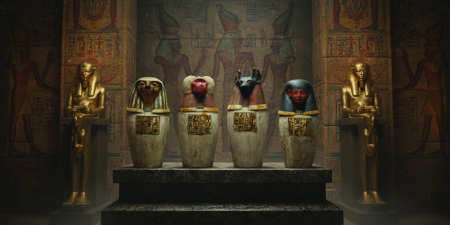
Canopic jars were vital in ancient Egypt, preserving organs and symbolizing rebirth. Explore their history, the Four Sons of Horus, and modern discoveries.
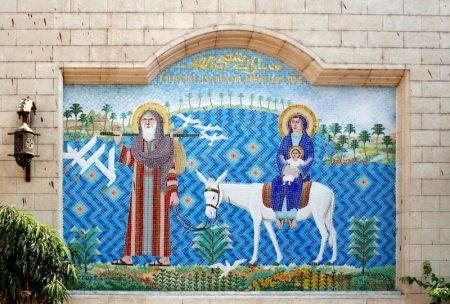
Journey along the Holy Family in Egypt's path. Learn about the historical route, significant sites, and the enduring legacy they left behind.
The Khufu Pyramid, located on the Giza Plateau in Egypt, is the largest and most famous pyramid ever built. Constructed around 2600 BC, it reflects ancient Egyptian engineering excellence, deep religious beliefs, and the divine power of Pharaoh Khufu.
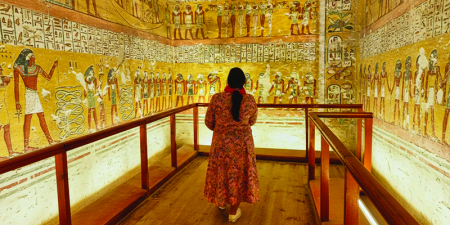
Ramesses IV, a New Kingdom pharaoh, left a lasting legacy through ambitious building projects and a uniquely preserved mummy. His tomb KV2 reveals key insights into ancient Egyptian beliefs about death and eternity.
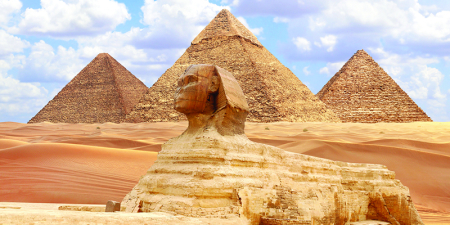
Explore the Khafre Pyramid, Egypt’s second largest Giza pyramid. Discover its unique architecture, the Great Sphinx, Mortuary & Valley Temples, and King Khafre statue in this iconic ancient Egyptian complex.
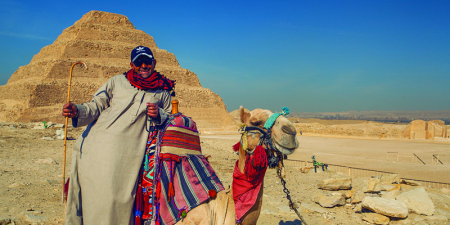
The Djoser Pyramid in Saqqara, Egypt, is the world’s first Step Pyramid, built for Pharaoh Djoser during the Third Dynasty. Designed by Imhotep, it revolutionized stone construction and ancient Egyptian burial practices, combining ceremonial, symbolic, and functional elements in a single monumental complex.
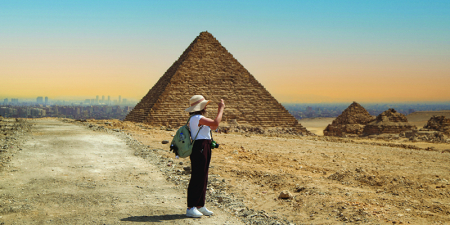
Menkaure Pyramid in Giza, Egypt, is the smallest of the three main pyramids, featuring unique dual-material casing, complex chambers, mortuary temple, and iconic King Menkaure statues
Discover how the Hathor Temple at Dendara connects ancient Egyptian religion with the stars and cosmos.