St. Antony Monastery

St Anthony Monastery is one of the oldest monasteries worldwide. A continuous community of monks has called it home for almost 2,000 years.
The Egyptian desert houses this remarkable religious site, which proves the rich history of early Christian and monastic traditions.
The monastery's most important historical value comes from its founders - followers of Saint Anthony of Egypt (c. 251-356 AD). These founders became the first Christian monks in history. Christianity took root in Egypt while St Anthony Monastery emerged. The Copts established one of the oldest Christian communities in the Middle East during the 1st Century AD. Archeologists have found fascinating details about monastic life.
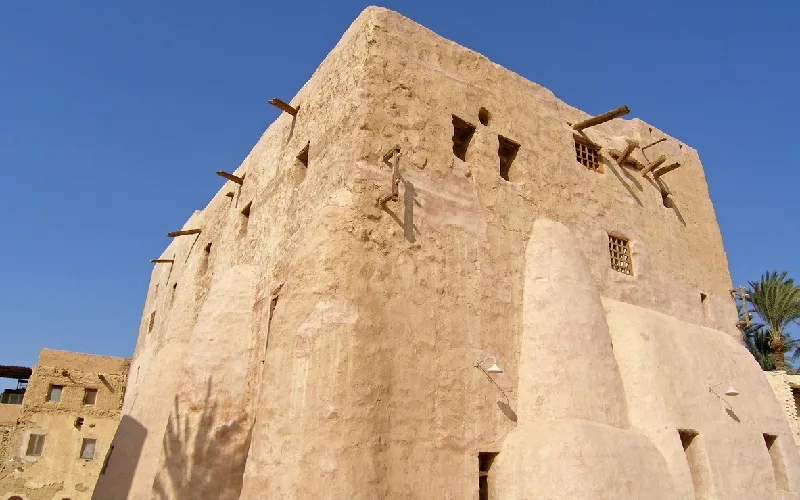
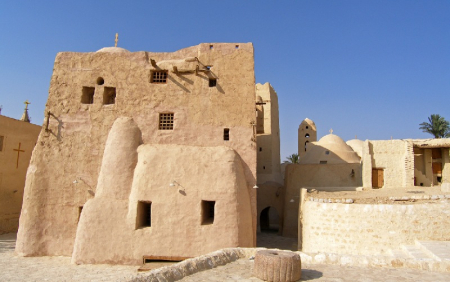
Small rooms built with sun-dried mudbricks date back to the Fatimid period (969-1181 CE). These spaces served as original dormitories and later expanded to include bakeries and livestock enclosures.
This piece uncovers the rich heritage of St Anthony Monastery. The story spans from its ancient beginnings to recent findings and gives an explanation of how this remarkable place has survived through centuries.
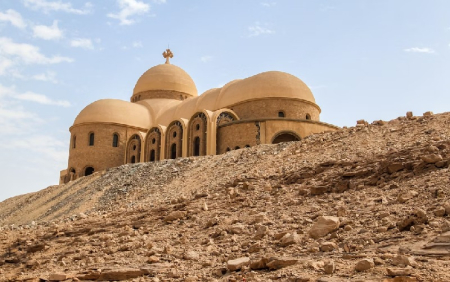
St Anthony Monastery is located in the Egyptian desert on a mountain between the Nile and the Red Sea. This remarkable religious site has been continuously inhabited by a community of monks for almost 2,000 years, making it one of the oldest monasteries worldwide.
St Anthony Monastery was built by Anthony's disciples in 356 AD following his death. It stands as one of the world's oldest continuously inhabited monasteries, with an unbroken monastic tradition spanning nearly two millennia.
St Anthony Monastery's story begins with Anthony the Great, who was born in Koma, Egypt around 251 AD. His life took a dramatic turn after his wealthy parents died when a Sunday sermon resonated deeply with him. Anthony, just 20 years old at the time, took Jesus's words from Matthew 19:21 to heart: "sell what you have and give to the poor". He distributed his family's lands to neighbors and sold all his property. The proceeds went to help the poor, and he arranged for his sister to live with a group of Christian virgins.
Around 270-271 AD, Anthony made his way to the desert, becoming the most influential figure in anchoritic monasticism. He spent his initial days among the tombs near his village before moving to Pispir (now Der-el-Memun), a mountain near the Nile. There, he lived in solitude within an abandoned Roman fort for two decades.
Anthony emerged from his isolation near 305 AD and hosted growing numbers of monks who gathered around him. He later settled on a mountain between the Nile and the Red Sea, where his namesake monastery stands today.
Anthony's death in 356 AD left behind a legacy that drew thousands of monks and nuns to the desert. His biographer Athanasius noted that "the desert had become a city". The monastery, built by Anthony's disciples in 356 AD, stands as one of the world's oldest continuously inhabited monasteries.
Around 270-271 AD, Anthony was inspired by Jesus's words from Matthew 19:21 during a Sunday sermon: "sell what you have and give to the poor." At just 20 years old, he distributed his wealth and made his way to the desert, living in solitude within an abandoned Roman fort for two decades.
Anchoritic monasticism refers to the practice of living in solitude for religious purposes. Saint Anthony became the most influential figure in this movement when he retreated to the Egyptian desert, inspiring thousands of monks and nuns to follow his example of desert contemplative life.
A fascinating archeological discovery came to light at St Anthony Monastery in 2003 as renovation work started at the Church of the Holy Apostles. Father Maximous el-Antony, who has called the monastery home for over 27 years, led the excavation team that would reveal centuries of hidden history.
The team made this discovery almost by chance. Their search for traditional water basins used in ancient "water mass" ceremonies led them to find two basins at different depths instead of one. This unexpected find pushed them to dig deeper, which revealed an 8th-century church's foundation beneath the 15th-century structure.
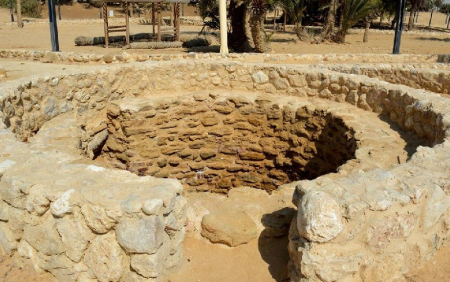
The archeologists then made an extraordinary discovery under these layers - they found a group of monastic cells from the 4th century. These rooms, built with sun-dried mudbricks, showed how the monastery's earliest monks lived their daily lives. The team found everyday objects in the cells, including pottery, ovens, and wall inscriptions that helped them date the structures.
The dig site revealed six connected rooms, each with its own purpose. The team found three baking ovens in one large chamber, while another room seemed to be a monk's private quarters with a raised platform for sleeping. The archeologists also found a basin where monks would soak palm fronds to weave them into mats and baskets.
The monastery made these historic cells available to visitors after completing the excavation and conservation work. The archeologists covered the cells with thick glass flooring in 2008, so visitors could walk above this remarkable piece of early Christian history.
In 2003, during renovation work at the Church of the Holy Apostles, archaeologists discovered a group of monastic cells from the 4th century beneath the 15th-century structure. These rooms, built with sun-dried mudbricks, contained pottery, ovens, and wall inscriptions revealing how the monastery's earliest monks lived.
Get in touch with our local experts for an unforgettable journey.
Plan Your Trip
St Anthony Monastery has become a living museum where history remains available to today's visitors. The 1990s saw major restoration work to preserve the historic buildings at its heart and the beautiful 13th century wall paintings.
The monastery resident Father Maximous foresaw the need for a gallery to showcase historical artifacts for pilgrims and visitors. So they converted a former guest house within the monastery walls into this gallery that now serves as a conservation and storage facility.
Teams have found about 3,000 pottery sherds, studied 900 fragments and restored 115 vessels. A pottery kiln discovery near the monastery points to important local production, particularly bell-shaped bowls from the 11th to 13th centuries. The recovered manuscripts tell an even richer story. These include Coptic medical texts and Judaeo-Arabic translations from the 9th to 13th centuries that show the monastery's role as a cultural and intellectual hub.
The monastery's most innovative preservation technique uses glass flooring installed over ancient monastic cells. This transparent solution replaces traditional sand covering and lets visitors view excavated structures while protecting delicate mudbrick remains. The team designed a steel support structure that protects sensitive structures beneath. Remote-controlled lighting improves the visibility of these remarkable ruins.
In 2008, the monastery installed thick glass flooring over the ancient monastic cells, allowing visitors to walk above this remarkable piece of early Christian history while protecting the delicate mudbrick remains. Remote-controlled lighting improves visibility of the ruins beneath.
St Anthony Monastery serves as a remarkable bridge between ancient Christian history and today. This extraordinary site has endured almost two millennia while serving its original purpose as a home for monks devoted to contemplative life. The monastery represents more than historic buildings - it embodies Saint Anthony's living legacy. His bold choice to seek God in the desert sparked a movement that spread throughout Christianity.
The monastery evolved through centuries but stayed true to its roots. Archeological findings have added new perspectives to our understanding of early monastic life. Simple furnishings and practical spaces in ancient cells paint a vivid picture of daily life. These devoted individuals sought spiritual growth through simplicity and prayer.
Modern preservation methods, especially the innovative glass flooring, let visitors walk above history while protecting these delicate structures. This balanced approach to conservation honors the past and makes it available to modern pilgrims and tourists. The monastery's former living spaces now showcase remarkable collections of artifacts, manuscripts, and pottery that the public can now appreciate.
History lives on beyond museums and textbooks at St Anthony Monastery. Living traditions continue unbroken for thousands of years as communities deepen their commitment to preserve what matters most. Today's visitors witness something special – practices and traditions that link directly to Christian monasticism's earliest days.
St Anthony Monastery stands as both historical treasure and vibrant spiritual center. Generations of monks have ensured this desert sanctuary fulfills its original purpose while offering glimpses into the past. This blend of ancient tradition and careful preservation creates a unique destination. People seeking to understand Christian monasticism's roots or experience timeless spirituality will find something extraordinary here.
Saint Anthony of Egypt (c. 251-356 AD) was born in Koma, Egypt around 251 AD. After his wealthy parents died, he distributed his family's lands, sold all his property to help the poor, and became the most influential figure in anchoritic monasticism, earning the title "Anthony the Great."
Father Maximous el-Antony, who has called the monastery home for over 27 years, led the excavation team that revealed centuries of hidden history. The discovery came almost by chance during their search for traditional water basins used in ancient ceremonies.
The excavation revealed six connected rooms, each with its own purpose. Archaeologists found three baking ovens in one large chamber, a monk's private quarters with a raised sleeping platform, a basin for soaking palm fronds to weave mats and baskets, and various everyday objects.
The 1990s saw major restoration work to preserve the historic buildings and beautiful 13th-century wall paintings. The monastery also converted a former guest house into a gallery that serves as a conservation and storage facility for historical artifacts.
Teams have found about 3,000 pottery sherds, studied 900 fragments, and restored 115 vessels. A pottery kiln discovery near the monastery points to important local production, particularly bell-shaped bowls from the 11th to 13th centuries.
The recovered manuscripts include Coptic medical texts and Judaeo-Arabic translations from the 9th to 13th centuries, demonstrating the monastery's role as a cultural and intellectual hub during the medieval period.
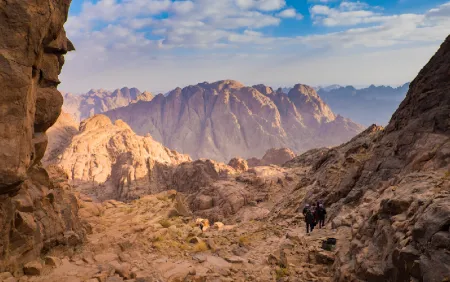
The Sinai Peninsula in northeastern Egypt spans 23,000 square miles bridging Africa and Asia. Home to Mount Sinai, 6th-century Saint Catherine's Monastery and Bedouin tribes.
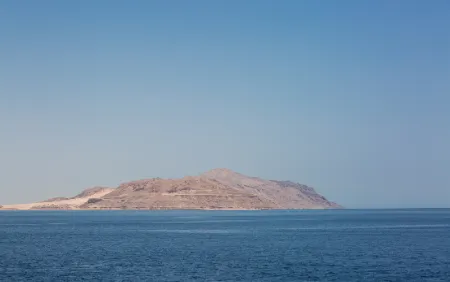
Tiran Island, 25km from Sharm El Sheik, spans 80 square kilometers with 4 legendary reef systems. Offers snorkeling tours, diving and encounters with dolphins, sharks and sea turtles.
Sharm El Naga, 40km south of Hurghada, is a Red Sea paradise rated 4.3/5. Features shore-accessible reef, 200+ coral species, sea turtles & beach resort.
Ras Mohammed, 25km from Sharm El Sheik, features 220+ coral species, Magic Lake, rare mangroves & Earthquake Crack. Rated 4.6/5 stars.
Nuweiba features 15km coastline, 70km south of Taba. Offers Bedouin camps, pristine beaches, Colored Canyon & eco-friendly lodges.
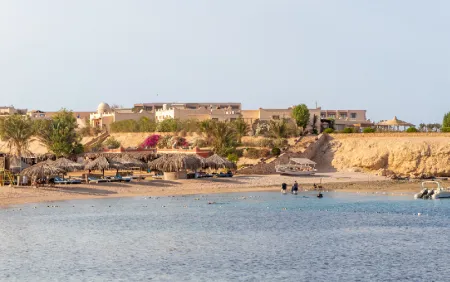
Naama Bay Sharm El Sheik—vibrant nightlife with promenade sunset walks, Egyptian dining, belly dancing shows, shisha cafés, night diving & Casino Royale.
Moses Springs in Pinnacles National Park is a 2.4-mile trail with talus caves, California condors, Bear Gulch Reservoir & volcanic cliffs.
Giftun Island near Hurghada features 6 beaches including Orange Bay, 196 coral species & 1,000+ fish species. Egypt's first marine park since 1986.
Soma Bay is a gated peninsula 45km from Hurghada with 6 luxury hotels, 20 dive sites & 300-day kitesurfing. Hurghada offers vibrant city culture.
St Anthony Monastery in Egyptian desert is the world's oldest, inhabited 2,000 years. Built 356 AD with 4th-century cells beneath glass flooring.
St Paul's Monastery, founded 4th century, houses the cave where Paul of Thebes lived from 250 AD. Features natural spring flowing 4 cubic meters daily and 500 active monks.