Hathor Temple at Dendara

The Hathor Temple ranks among Egypt's best-preserved ancient temples. Many visitors walk through its magnificent halls without noticing subtle details that show its true significance. About 2.5 kilometers southeast of Dendera, this architectural marvel's construction started in 54 BCE during the late Ptolemaic period. Ptolemy XII commissioned the main structure, and Queen Cleopatra VII almost finished it. The complex's oldest section dates back to 345 BCE, when Nectanebo II, Egypt's last native pharaoh, built it.
The temple complex has managed to keep its remarkable structural integrity through the ages. Builders dedicated it to Hathor, the Egyptian goddess of love, fertility, music, and dancing. The Dendara Temple complex includes several structures beyond the main temple - a basilica, two birth houses, and a sacred lake. The site's extraordinary nature comes from its hidden symbols, architectural details, and historical elements that casual observers often miss. We'll explore this ancient wonder's secrets that have endured more than two thousand years of history.
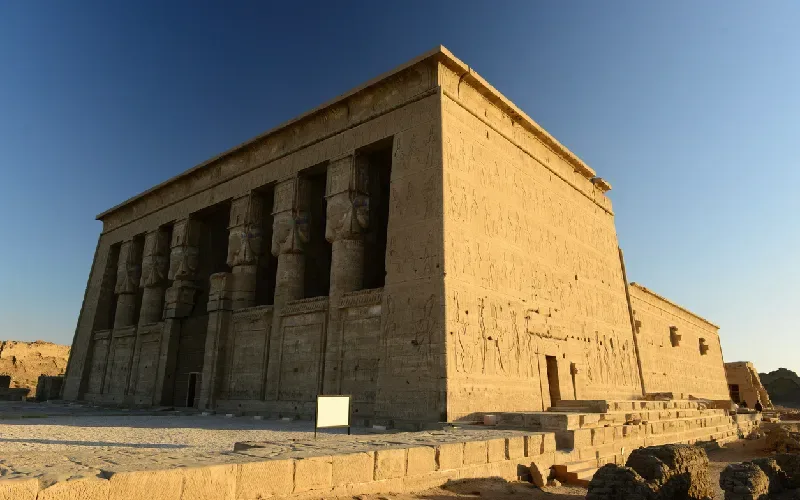
The Hathor Temple is located about 2.5 kilometers southeast of Dendera in Egypt. This architectural marvel sits within an enormous mud-brick enclosure wall surrounding a 40,000 square meter complex on the Nile's west bank.
Construction of the main structure started in 54 BCE during the late Ptolemaic period. Ptolemy XII commissioned it, and Queen Cleopatra VII nearly completed it. The complex's oldest section dates back to 345 BCE when Nectanebo II, Egypt's last native pharaoh, built it.
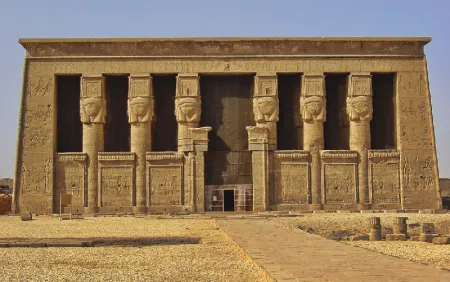
A massive gateway built by Roman emperors Domitian and Trajan welcomes visitors to the Hathor Temple at Dendera. The gateway sits within an enormous mud-brick enclosure wall that surrounds the 40,000 square meter complex. The temple's entrance differs from traditional Egyptian designs since it lacks the usual colonnade or pylon gateway.
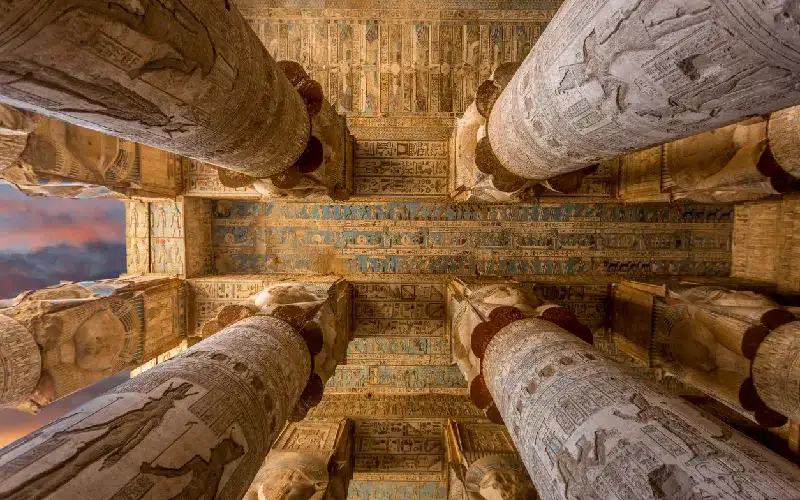
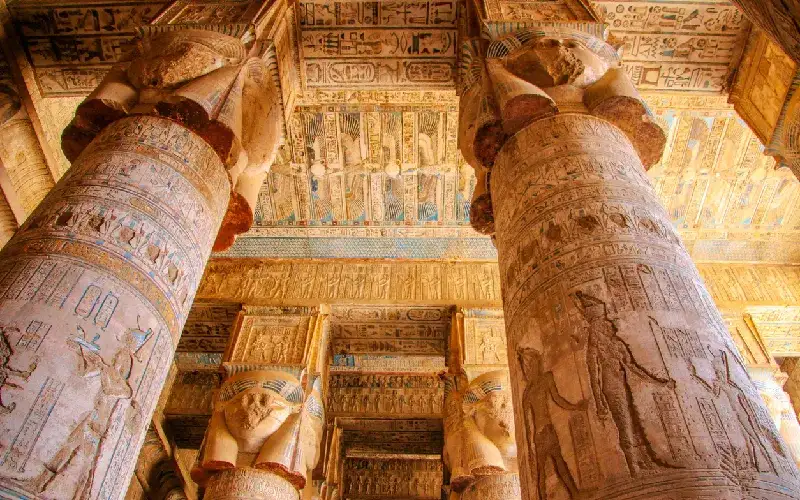
Visitors who step inside will discover the temple's most impressive feature - a magnificent hypostyle hall that Emperor Tiberius added. This grand space showcases 18 colossal columns that reach 15 meters high. Each column bears the face of goddess Hathor, easily identified by her distinctive cow ears. The columns, notwithstanding that they show signs of ancient vandalism, remain awe-inspiring.
These columns feature capitals that cleverly mimic sistrums, Hathor's sacred musical instrument. The ceiling above fascinates visitors with its extraordinarily vibrant original paint, which has been cleaned. Against a striking turquoise-blue background, this celestial ceiling displays astronomical depictions, zodiac symbols, and the sky goddess Nut.
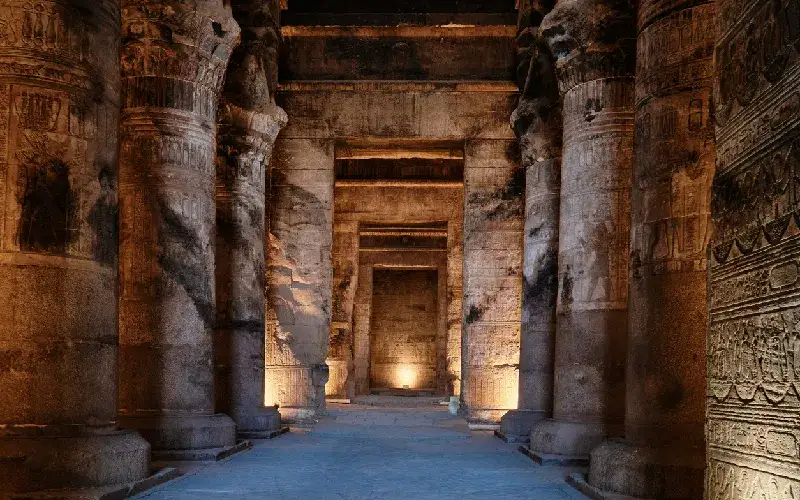
The temple's layout leads visitors through a second hypostyle room with six additional columns before reaching Hathor's main sanctuary. Rich hieroglyphics cover the walls, showing rituals, deities, and offerings. Roman emperors appear on these walls as Egyptian pharaohs making offerings to the gods.
The magnificent hypostyle hall, added by Emperor Tiberius, showcases 18 colossal columns reaching 15 meters high. Each column bears the face of goddess Hathor, identifiable by her distinctive cow ears. The capitals cleverly mimic sistrums, Hathor's sacred musical instrument.
The Hathor Temple holds secret worlds beneath its polished floors that most visitors never find. The temple's central core conceals fourteen crypts that stretch down three to four stories, and these underground chambers house some of its most remarkable treasures. Hidden trapdoors lead to these secret rooms that once held the most sacred ritual objects.
Visitors can see the intriguing "Dendera Light" relief in one of the open crypts. This strange carving shows a snake that emerges from a lotus flower inside an oval container. While some alternative theorists suggest it shows ancient Egyptian electrical technology, scholars identify it as the god Harsomtus, who represents creation.
This temple's brilliance goes beyond what meets the eye. The building's exceptional acoustics let people hear whispers from one wall to the other side of the hall—a feature that helped ancient priestesses give mysterious responses to worshippers' prayers.
The temple's rooftop holds hidden treasures that reward visitors who climb the ceremonial staircase. This space played a vital role during New Year celebrations as priests carried Hathor's statue up to welcome the first sunrise. The Chapel of Osiris stands in the eastern corner, its walls decorated with scenes of his resurrection.
Dedicated explorers can crawl through narrow passages that once served secret ceremonial purposes. These tight spaces lead to the temple's most guarded mysteries.
The temple's central core conceals fourteen crypts stretching down three to four stories. These underground chambers, accessed through hidden trapdoors, once housed the most sacred ritual objects. Some crypts are open for visitors to explore.
The "Dendera Light" relief, found in one of the open crypts, shows a snake emerging from a lotus flower inside an oval container. While some alternative theorists suggest it depicts ancient Egyptian electrical technology, scholars identify it as the god Harsomtus, who represents creation.
The rooftop holds hidden treasures accessed via a ceremonial staircase. This space played a vital role during New Year celebrations when priests carried Hathor's statue up to welcome the first sunrise. The Chapel of Osiris stands in the eastern corner with walls decorated with resurrection scenes.
Get in touch with our local experts for an unforgettable journey.
Plan Your Trip
The Hathor Temple at Dendera stands as more than just an architectural marvel - it represents a complete cosmic worldview. The temple walls act as a living map of how Egyptians understood the universe. Plant motifs adorn the lower sections, ritual scenes cover the middle walls, and stars and constellations decorate the ceilings. This three-tiered design reflects the Egyptian concept of creation.
The temple meant much more than stone and artistry to its worshippers. It served as a sacred meeting point where human and divine worlds came together. Hathor, the goddess of love, music, dance, and fertility, made this temple a vibrant center of celebration, healing, and spiritual renewal.
The temple complex operated like a bustling small town. It was a powerful economic institution that controlled significant wealth and resources through its vast estates. Workshops, storage areas, and living quarters surrounded the main sanctuary.
Priests maintained the temple's sacred daily rhythm. Each morning, they "awakened" Hathor's statue, dressed it in fine textiles and jewelry, and presented offerings. The temple came alive during festivals. The Beautiful Reunion celebration marked Hathor's sacred marriage to Horus, when her statue journeyed by boat from Dendera to Edfu. This journey symbolized cosmic harmony and life's renewal.
The Hathor Temple stands as proof of ancient Egyptian architectural mastery and religious devotion. Most tourists admire its grand columns and colorful ceiling paintings, yet this temple's true wonders remain hidden beneath the surface, both literally and figuratively. Massive stone structures conceal secret crypts that once housed sacred objects, while the temple's walls tell stories through carefully arranged hieroglyphics that most visitors pass without understanding.
This temple worked as a complete microcosm of Egyptian understanding of life, death, and spiritual connection. Their view of creation itself reflects in its three-tiered design, while daily rituals and festivals brought these ancient stones to life. On top of that, it served as an economic powerhouse that controlled vast resources and operated like a small town with workshops, living quarters, and storage areas.
Visitors who explore beyond the obvious attractions find a deeper experience. The "Dendera Light" relief, mysterious acoustic properties, and sacred rooftop rituals show a civilization way beyond the reach and influence of what many believe. These subtle details show how deeply ancient Egyptians understood astronomy, architecture, and acoustics.
The Hathor Temple embodies more than an archeological wonder—it provides a window into a complex society that valued cosmic harmony, celebrated life's cycles, and created spaces where divine and human realms could meet. Patient and curious explorers will find this ancient temple still whispers its secrets, ready to share stories spanning more than two millennia of human history.
The temple was dedicated to Hathor, the Egyptian goddess of love, fertility, music, and dancing. Builders created this as a sacred center for celebration, healing, and spiritual renewal where human and divine worlds could meet.
The Dendara Temple complex includes several structures beyond the main temple: a basilica, two birth houses (mammisi), a sacred lake, workshops, storage areas, and living quarters. The complex operated like a bustling small town.
The ceiling features extraordinarily vibrant original paint that has been cleaned. Against a striking turquoise-blue background, this celestial ceiling displays astronomical depictions, zodiac symbols, and the sky goddess Nut, demonstrating ancient Egyptian astronomical knowledge.
The temple features exceptional acoustics allowing people to hear whispers from one wall to the other side of the hall. This feature helped ancient priestesses give mysterious responses to worshippers' prayers, adding to the temple's mystical atmosphere.
The Beautiful Reunion celebration marked Hathor's sacred marriage to Horus. During this festival, Hathor's statue journeyed by boat from Dendera to Edfu, symbolizing cosmic harmony and life's renewal. This was one of the temple's most important annual celebrations.
Priests maintained sacred daily rhythms. Each morning, they "awakened" Hathor's statue, dressed it in fine textiles and jewelry, and presented offerings. These rituals kept the temple alive as a functioning religious center connecting human and divine realms.
Upper Egypt features world's largest collection of ancient buildings at Luxor and Karnak, plus Abu Simbel, Temple of Horus & Nubian villages along the Nile.
Beni Hassan, 20km south of Minya, features 39 Middle Kingdom tombs with 4,000-year-old wall paintings. Highlights include 400 wrestling pairs and caravan of Asiatics.
The Hathor Temple at Dendera is one of Egypt's best-preserved temples. Built starting 54 BCE, it features hidden crypts, exceptional acoustics and astronomical ceiling paintings.